
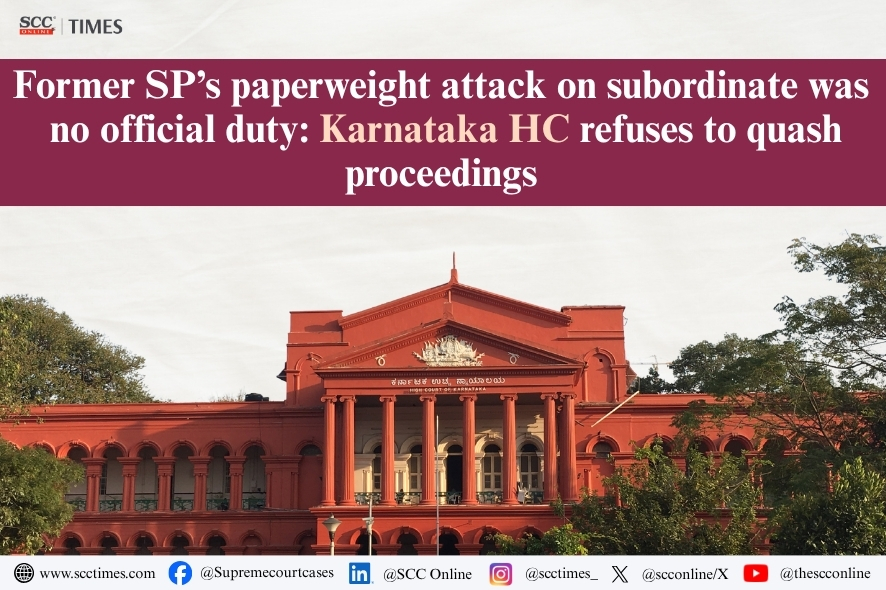
Karnataka High Court: SP Paperweight Assault Not Official Duty
Summary
- The Karnataka High Court refused to quash proceedings against a former Superintendent of Police.
- The former SP was accused of attacking a subordinate with a paperweight.
- The court applied a "nexus test" to determine if the act was connected to official duty.
- It concluded that the paperweight attack was not an official duty, despite Section 170 of the Karnataka Police Act, 1963, protecting reasonable excesses.
The Court's Decision
The court explicitly stated that the former SP’s paperweight attack on a subordinate was "no official duty."
The Karnataka High Court recently issued a significant ruling concerning the scope of statutory protection for police officers, specifically declining to quash proceedings against a former Superintendent of Police (SP). The case involved allegations that the former SP had attacked a subordinate using a paperweight. The court determined that this particular act did not fall within the ambit of official duty, thereby rejecting the plea to halt legal proceedings. This decision underscores a narrow interpretation of what constitutes an action performed in an official capacity, even for high-ranking officers.
The High Court's refusal to quash the proceedings against the former SP highlights the judiciary's commitment to scrutinizing actions claimed to be part of an officer's official function. The court's analysis centered on a critical legal principle known as the "nexus test," which evaluates the connection between an officer's overt actions and their professional responsibilities. By applying this test, the Karnataka High Court concluded that the assault, involving a paperweight, lacked the necessary link to the discharge of official duties.
Understanding the Legal Framework
Central to the Karnataka High Court's determination is the "nexus test," a judicial standard employed to ascertain whether an accused individual's actions are "wholly or reasonably connected to discharge of official function." This test is crucial in cases involving public servants, particularly police officers, as it helps define the boundaries of their statutory protections. The application of this test ensures that while officers are shielded for legitimate actions taken in their line of work, this protection does not extend to all personal conduct.
The legal context for this protection is rooted in Section 170 of the Karnataka Police Act, 1963. This specific provision grants statutory safeguards to police personnel, even extending to "reasonable excesses" committed during the performance of their duties. The intent behind such provisions is to allow officers to perform their challenging roles without undue fear of prosecution for minor missteps or unavoidable overreach in high-pressure situations. However, the High Court's recent ruling clarifies that this protection is not absolute and is contingent upon the actions maintaining a discernible connection to official responsibilities.
Applying the Nexus Test to the Incident
In the specific instance involving the former Superintendent of Police, the Karnataka High Court meticulously applied the aforementioned nexus test to the alleged paperweight attack on a subordinate. The court's analysis focused on whether such an act could be deemed "wholly or reasonably connected" to the former SP's official duties. Despite the broad protections offered by Section 170 of the Karnataka Police Act, 1963, which accounts for reasonable excesses, the court found the nature of the assault to be outside the scope of official conduct.
The court explicitly stated that the former SP’s paperweight attack on a subordinate was "no official duty." This definitive conclusion meant that the actions of the former SP did not qualify for the statutory immunity typically afforded to police officers for acts performed in their official capacity. Consequently, the High Court saw no grounds to quash the proceedings, allowing the legal process against the former officer to continue. This outcome underscores the judiciary's role in delineating the precise boundaries of police immunity, ensuring accountability for actions that stray beyond professional obligations.
Implications for Police Accountability
This ruling by the Karnataka High Court carries significant implications for the scope of police immunity and accountability within the state. By refusing to quash proceedings against a former SP for an assault deemed "no official duty," the court has reinforced a stringent interpretation of the "nexus test." This judicial stance clarifies that the statutory protection under Section 170 of the Karnataka Police Act, 1963, while acknowledging "reasonable excesses," does not shield officers from prosecution for actions entirely disconnected from their professional functions.
The decision serves as a crucial precedent for understanding the limits of protection for police officers accused of misconduct. It suggests that actions involving personal aggression, even within a workplace setting, may not automatically be considered part of an officer's official capacity, particularly when they involve an assault. This narrow interpretation of the police official duty nexus test in India is vital for maintaining public trust and ensuring that law enforcement personnel are held accountable for their conduct, especially when allegations of assault by a police officer in an official capacity arise. The Karnataka High Court's ruling thus provides critical clarity on the viability of quashing proceedings for alleged misconduct, particularly in cases where the alleged act lacks a clear link to official duties.
Practical Implications
This Karnataka High Court ruling provides critical clarity on the 'nexus test' for determining if a police officer's actions fall within their official duty, thereby impacting statutory protections. Lawyers representing or prosecuting police officers must understand this narrow interpretation to effectively advise on the viability of quashing proceedings for alleged misconduct.
Source
Source: Original reporting via SCC Times
How does this affect you?
Get an AI analysis of this article grounded in your jurisdictions, practice areas, and any policy documents you've uploaded to Wansom.
Finish Reading the Full Story and the Expert Analysis.
Get the latest legal & regulatory intelligence in India
Wansom is AI and can make mistakes.