
Kenya High Court: Kanja Amin Ordered to Produce Missing Busia Businessman
Summary
- The High Court ordered Inspector General Douglas Kanja and DCI boss Mohamed Amin to produce missing Busia businessman Ahmed Ibrahim Ali Mohamed within 48 hours.
- Justice Samuel Mohochi ruled the 292-day disappearance illegal and a violation of constitutional rights, awarding Sh5.84 million in damages.
- The court rejected the State's claim of abduction by criminals, citing security agency involvement and investigative failures at a highly secured location.
- The ruling holds multiple state entities jointly and severally liable for the constitutional damages.
- Top security officials must issue public and private apologies to Mr. Mohamed's family and conduct an internal inquiry into the incident.
What Happened
The Constitution of Kenya does not permit citizens to vanish into thin air, nor does it tolerate unacknowledged, secret detentions.
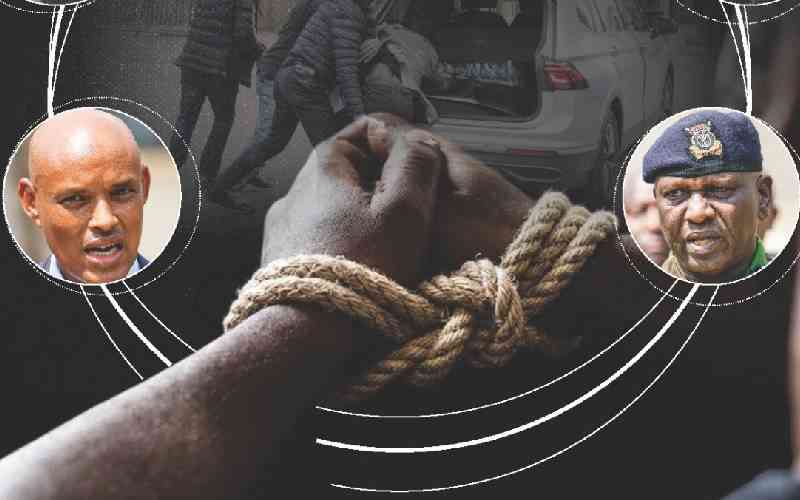
Kenya's High Court has issued a directive compelling Inspector General Douglas Kanja and Director of Criminal Investigations (DCI) Mohamed Amin to account for the whereabouts of Busia businessman Ahmed Ibrahim Ali Mohamed. The order mandates that Mr. Mohamed be produced, whether alive or deceased, within 48 hours. This ruling comes 292 days after his disappearance, which Justice Samuel Mohochi of the High Court declared to be illegal, unconstitutional, and a violation of Mr. Mohamed's fundamental rights.
In a judgment delivered on Friday, November 13, 2026, Justice Mohochi's order functions similarly to a writ of habeas corpus, requiring the Inspector General, the DCI boss, and the Anti-Terrorism Police Unit (ATPU) commander to present Mr. Mohamed before the court within three days. The court also awarded Mr. Mohamed Sh5.84 million in constitutional damages, encompassing general, aggravated, and exemplary compensation, holding several state entities jointly and severally liable for his prolonged absence.
Legal Context and Findings
Justice Mohochi explicitly stated that Mr. Mohamed's unlawful arrest, subsequent incommunicado detention, and ongoing enforced disappearance constituted a continuous and flagrant breach of his fundamental rights as enshrined in Articles 25(a), 28, 29, and 49 of the Constitution of Kenya. The court firmly rejected the State's assertion that Mr. Mohamed might have been abducted by criminals impersonating police officers, finding that the circumstances surrounding the incident strongly suggested the involvement of security agencies.
The judge highlighted that the abduction occurred in the vicinity of Korinda Main Prison, a highly secure area typically staffed by armed prison officers. Justice Mohochi questioned how ordinary criminals could have halted a passenger bus, activated its interior lights, inspected passengers' identification documents, removed Mr. Mohamed, and searched his luggage, all within sight of a heavily guarded correctional facility, without any intervention. The court observed that the abductors operated with the unchallenged authority characteristic of state agents, who seemingly possessed absolute immunity and control over that specific geographical territory.
Furthermore, the court criticized the police for their investigative failures, noting their omission to interview the bus driver, Peter Kimemia, who was present during the incident. Investigators also neglected to visit Korinda Main Prison or question the armed prison officers on duty when the businessman was seized. These significant omissions, according to Justice Mohochi, undermined the State's narrative that civilian criminals were responsible. Consequently, an adverse inference was drawn against the security agencies, given that critical operational details, such as roadblock specifics, deployment rosters, vehicle logs, command structures, and intelligence records, were exclusively within the State's purview. The judge emphasized that the executive cannot infringe upon a citizen's liberty based on unsubstantiated conjecture, declaring that "The Constitution of Kenya does not permit citizens to vanish into thin air, nor does it tolerate unacknowledged, secret detentions."
Accountability and Redress
The High Court's ruling holds the Inspector General, the National Police Service, the DCI, the ATPU commander, the Director-General of the National Intelligence Service, the Interior Cabinet Secretary, and the Attorney General jointly and severally accountable for the Sh5.84 million in constitutional damages. This comprehensive liability underscores the judiciary's commitment to ensuring police accountability in cases of enforced disappearance in Kenya.
Beyond monetary compensation, the court issued additional directives aimed at addressing the institutional failures. The Inspector General and the DCI director are mandated to hold a physical meeting with Mr. Mohamed's family within 14 days to offer an unreserved apology for what the court termed institutional indolence, deliberate omissions, and a failure to conduct timely and effective investigations. Additionally, these two security chiefs must publish a formal public apology within 21 days, which includes broadcasting it on at least two mainstream local radio stations within Busia County, in both Kiswahili and the predominant local dialect. The Inspector General has also been ordered to initiate a comprehensive internal administrative inquiry into potential involvement and co-conspiracy within the security apparatus regarding Mr. Mohamed's disappearance.
Practical Implications
This ruling establishes a significant precedent for holding Kenyan security agencies accountable for enforced disappearances and unlawful detentions, making it crucial for lawyers to advise clients on their rights to constitutional damages under Articles 25, 28, 29, and 49. It underscores the judiciary's commitment to protecting fundamental rights and rejecting state denials in such cases, indicating a heightened risk for state actors involved in such violations.
Source
How does this affect you?
Get an AI analysis of this article grounded in your jurisdictions, practice areas, and any policy documents you've uploaded to Wansom.
Finish Reading the Full Story and the Expert Analysis.
Get the latest legal & regulatory intelligence in Kenya
Wansom is AI and can make mistakes.