
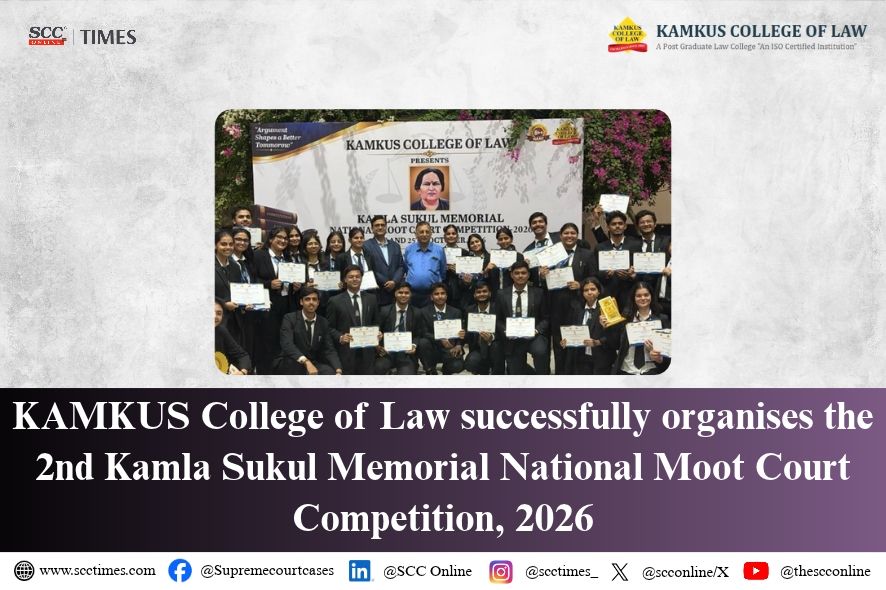
KAMKUS College: Kamla Sukul Memorial Moot Court 2026 on AI Deepfakes
Summary
- The 2nd Kamla Sukul Memorial National Moot Court Competition, 2026, was hosted by KAMKUS College of Law on October 24-25, 2026.
- The competition's theme focused on "Generative AI, Deepfakes, and Democracy," addressing constitutional issues related to freedom of speech, reputation, and electoral integrity.
- Twenty-one teams from various Indian law schools participated, showcasing their legal research and advocacy skills.
- Symbiosis Law School, Pune, won the championship, receiving the KAMKUS Vidhi Ratna Trophy and a cash prize.
- Special awards were given for Best Researcher, Best Speaker, and Best Memorial, with SCC Online and SCC Times providing key support.
Competition Overview
The central theme for the Kamla Sukul Memorial Moot Court 2026 proposition was "Generative Artificial Intelligence, Deepfakes, and Democracy," exploring the constitutional dimensions of freedom of speech, reputation, electoral integrity, and intermediary liability.
KAMKUS College of Law in Ghaziabad recently hosted the second iteration of the Kamla Sukul Memorial National Moot Court Competition, 2026. This significant national event unfolded over two days, specifically on October 24 and 25, 2026, providing a crucial platform for legal education and advocacy development. The competition operated under the guidance of several key figures from the Bhagirath Sewa Sansthan, including Chairman Mr. Kusumakar Sukul, Secretary Mr. Karunakar Sukul—who also serves as Chief Mentor for KAMKUS College of Law—and Director Mr. Amitabh Sukul.
The institution's Moot Court Committee meticulously organized the event, aiming to immerse law students in practical aspects of constitutional adjudication, legal research methodologies, and the art of advocacy, particularly concerning modern technological challenges. Dr. Tabassum Baig convened the competition, supported by co-conveners Dr. Neelima Agarwal, Ms. Somna Singhal, and Mr. Prakhar Dwivedi, alongside dedicated faculty and student volunteers. This collaborative effort ensured a smooth and impactful experience for all participants.
Thematic Focus on Emerging Legal Challenges
The central theme for the Kamla Sukul Memorial Moot Court 2026 proposition was "Generative Artificial Intelligence, Deepfakes, and Democracy," exploring the constitutional dimensions of freedom of speech, reputation, electoral integrity, and intermediary liability. This timely topic required participants to delve into the intricate legal landscape surrounding AI-generated misinformation, the proliferation of deepfake content, and their potential impact on democratic processes.
Students were tasked with analyzing complex issues such as intermediary accountability in the digital age, the boundaries of free speech and expression, and the imperative to safeguard individual dignity, privacy, and reputation amidst rapid technological advancements. The proposition offered a robust framework for examining the intersection of law, technology, and governance, pushing participants to engage critically with contemporary societal concerns.
National Participation and Distinguished Achievements
The competition attracted a diverse array of talent, with 21 teams representing prominent law schools and universities from across India. Esteemed institutions such as Symbiosis Law School, Pune (Maharashtra); University Institute of Legal Studies, Punjab University, Chandigarh; Sharda University, Greater Noida; Delhi Metropolitan Education, Noida; Fairfield Institute of Management and Technology, New Delhi; Banasthali Vidyapith, Rajasthan; Manav Rachna University, Haryana; SRM University Delhi-NCR; and Quantum University, Uttarakhand, were among those participating.
Throughout the two-day event, participants showcased exceptional abilities in legal research, memorial drafting, constitutional interpretation, analytical reasoning, and oral advocacy. The experience was designed to simulate a realistic courtroom environment, allowing students to confront and address the evolving challenges at the nexus of legal principles, technological innovation, and democratic governance. Following a series of intensely contested rounds, Symbiosis Law School Pune moot team emerged as the champion, earning the KAMKUS Vidhi Ratna Trophy, a cash prize of 11,000, and certificates. Sharda University secured the runner-up position, receiving a trophy, certificates, and a cash prize of 5,100.
Special awards were also presented to recognize outstanding individual and team performances. The Best Researcher award was jointly conferred upon the University Institute of Legal Studies, Punjab University, Chandigarh, and Fairfield Institute of Management and Technology, New Delhi. The Best Speaker honor went to a representative from Fairfield Institute of Management and Technology, New Delhi, while Delhi Metropolitan Education (DME), Noida, was recognized for the Best Memorial. Each recipient of these special awards received a trophy, certificates, and a cash prize of 2,100.
Educational Significance and Support
The Kamla Sukul Memorial National Moot Court Competition India received significant backing from SCC Online, which served as the Knowledge Partner, and SCC Times, acting as the Media Partner. Their involvement substantially amplified the academic reach and professional influence of the event. Mr. Karunakar Sukul underscored the increasing necessity for legal professionals to comprehend artificial intelligence, digital governance, and the array of technological challenges that are continually emerging.
Dr. Ambuj Sharma, the Principal, highlighted the critical role that national-level competitions like this play in cultivating research aptitude, critical thinking, advocacy skills, and overall professional competence among aspiring legal practitioners. Dr. Neetu Mankotia, the Vice-Principal, extended gratitude to all participants, judges, organizers, and supporting institutions whose contributions were instrumental in the competition's success. The event served as a vital component of legal education, preparing students for the complexities of the modern legal landscape.
Practical Implications
This article reports on a student moot court competition and does not contain direct, actionable legal implications for practicing lawyers or compliance officers. Its primary relevance is to legal education and the development of future legal professionals.
Source
How does this affect you?
Get an AI analysis of this article grounded in your jurisdictions, practice areas, and any policy documents you've uploaded to Wansom.
Finish Reading the Full Story and the Expert Analysis.
Wansom is AI and can make mistakes.