
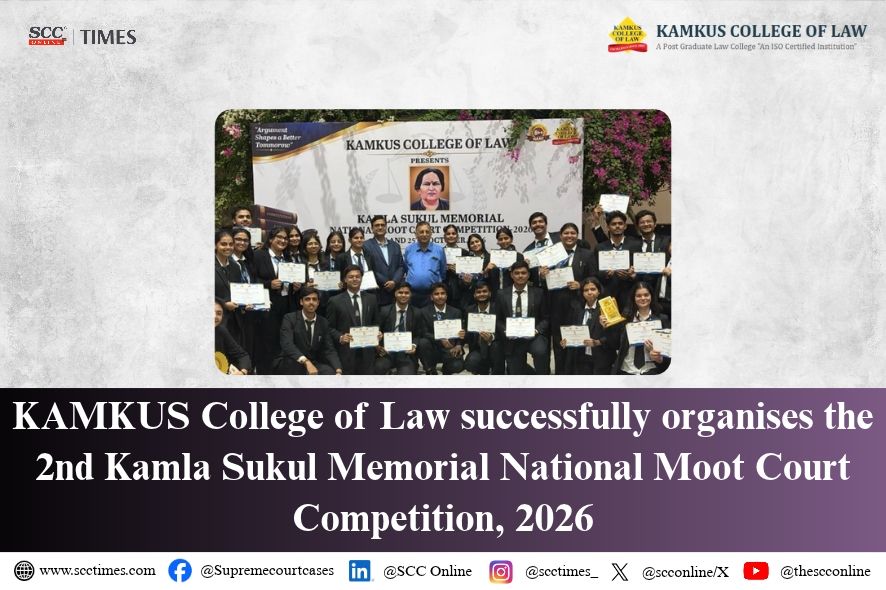
KAMKUS College of Law Organizes 2nd National Moot Court Competition
KAMKUS College of Law in Ghaziabad, India, successfully hosted its 2nd Kamla Sukul Memorial National Moot Court Competition on October 24-25, 2026. This two-day national event, organized by the college's Moot Court Committee under the patronage of the Bhagirath Sewa Sansthan, brought together 21 teams from prominent law schools across India. The competition's central theme revolved around the contemporary legal challenges posed by Generative Artificial Intelligence, Deepfakes, and Democracy, specifically exploring the constitutional dimensions of freedom of speech, reputation, electoral integrity, and intermediary liability.
This event holds significant legal importance as it underscores the legal community's proactive engagement with rapidly evolving technological advancements that challenge established legal norms. The focus on AI-generated misinformation, deepfake content, and their impact on democratic processes highlights critical areas where existing laws, particularly constitutional provisions, are being tested. For practitioners, it signals the increasing need to understand and navigate the complex interplay between technology and fundamental rights, preparing future legal professionals for a landscape where digital ethics and legal accountability are paramount.
The legal context for the moot proposition is deeply rooted in the Indian Constitution, particularly Article 19(1)(a) concerning freedom of speech and expression, and Article 21, which implicitly protects reputation and personal liberty. The discussion around electoral integrity also implicates the Representation of the People Act, 1951, and the broader principles of free and fair elections. Furthermore, the theme touches upon the Information Technology Act, 2000, especially regarding intermediary liability, and anticipates future legislative and judicial developments in regulating AI. The Indian legal system, with its robust constitutional framework, is uniquely positioned to address these novel challenges.
Key parties involved in this academic legal development include KAMKUS College of Law as the primary organizer, supported by the Bhagirath Sewa Sansthan. Participating institutions comprised a wide array of leading law schools and universities from across India, such as Symbiosis Law School, Pune; University Institute of Legal Studies, Punjab University, Chandigarh; and Sharda University, Greater Noida, among others. The event was convened by Dr. Tabassum Baig and co-convened by Dr. Neelima Agarwal, Ms. Somna Singhal, and Mr. Prakhar Dwivedi, with substantial faculty and student volunteer support.
Practitioners should closely monitor developments in the legal and regulatory landscape concerning Generative AI and deepfakes, as these technologies are poised to generate significant litigation in areas such as defamation, intellectual property infringement, electoral law violations, and data privacy. Attorneys advising clients in technology, media, and political sectors must stay abreast of emerging judicial interpretations and potential legislative reforms. The themes explored in this moot competition serve as a strong indicator of future legal battlegrounds, necessitating a proactive approach to legal research and strategy development in these cutting-edge domains.
How does this affect you?
Get an AI analysis of this article grounded in your jurisdictions, practice areas, and any policy documents you've uploaded to Wansom.
Finish Reading the Full Story and the Expert Analysis.
Wansom is AI and can make mistakes.