
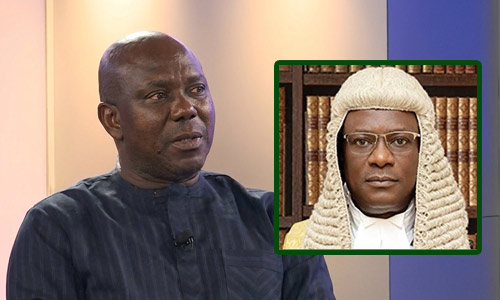
Kalu Kalu: Attacks Justice Lifu ADC Judgment Over 'Coconut Judge' Remarks
Summary
- Lawyer Kalu Kalu publicly criticized a Federal High Court judgment by Justice Peter O. Lifu concerning an ADC leadership dispute.
- Kalu Kalu referred to Justice Lifu as a "Coconut Judge" and claimed he "Doesn’t Read" during a Channels Television appearance.
- Channels TV presenter Seun Okinbaloye objected to the remarks, leading Kalu Kalu to withdraw his statement.
- The incident highlights ethical considerations for lawyers when publicly commenting on judicial decisions.
What Happened
This event serves as a reminder for legal practitioners regarding the ethical boundaries and professional decorum expected when publicly commenting on judicial decisions.
Nigerian lawyer Kalu Kalu, a known member of the African Democratic Congress (ADC), recently voiced strong disapproval regarding a judgment handed down by Justice Peter O. Lifu of the Federal High Court. The ruling in question pertained to an ongoing leadership dispute within the ADC, a matter of significant internal party contention. Kalu's critique extended beyond the merits of the decision, directly targeting the judicial officer responsible for the verdict.
During a public appearance on Channels Television, Kalu Kalu articulated his severe reservations about Justice Lifu's judicial conduct, employing particularly harsh language. He controversially stated that the judge "Doesn’t Read" and referred to him as "A Coconut Judge." These pointed remarks, delivered on a national broadcast, immediately drew a reaction from the program's presenter, Seun Okinbaloye, who intervened to object to the nature of the lawyer's comments.
Following the presenter's objection, Kalu Kalu subsequently retracted the specific derogatory remark he had made concerning Justice Lifu. This incident underscores the delicate balance legal practitioners must maintain when expressing dissent regarding judicial outcomes, especially in public forums.
Ethical Boundaries of Judicial Criticism
The public comments made by Kalu Kalu regarding Justice Peter O. Lifu's judgment in the African Democratic Congress leadership dispute highlight critical ethical considerations for legal professionals in Nigeria. Lawyers are generally afforded the right to critique judicial decisions, but this right is not without bounds. Professional codes of conduct typically mandate respect for the judiciary and prohibit language that could undermine public confidence in the courts or constitute contempt.
Such strong, personal attacks on a judge, particularly those implying a lack of competence or diligence, can cross the line from legitimate criticism into professional misconduct. The expectation is that any critique of a judgment should be based on legal reasoning and presented in a respectful manner, even when disagreeing fundamentally with the outcome or rationale. The withdrawal of the remark by Kalu Kalu on Channels TV, prompted by the presenter, suggests an acknowledgment of the potentially inappropriate nature of his initial statement.
This event serves as a reminder for legal practitioners regarding the ethical boundaries and professional decorum expected when publicly commenting on judicial decisions. Lawyers should be mindful of potential professional misconduct or contempt of court implications arising from intemperate criticism of judges or judgments, even when disagreeing with rulings.
Implications for Judicial Integrity
The incident involving Kalu Kalu's public denunciation of Justice Lifu's ruling carries significant implications for the perception of judicial integrity and the administration of justice in Nigeria. When a lawyer, particularly one involved in the case's political context, makes such disparaging remarks about a judge, it can erode public trust in the impartiality and competence of the judiciary. The Federal High Court's authority, and by extension, the entire legal system, relies heavily on the respect accorded to its officers and decisions.
Maintaining a robust and independent judiciary is paramount for the rule of law. While transparency and accountability are crucial, the manner in which judicial officers are criticized plays a vital role in preserving the institution's standing. The swift public objection and subsequent retraction of the remark underscore a societal expectation that even in contentious legal and political matters, a certain level of decorum and professionalism must be upheld by all parties, especially those sworn to uphold the law. This episode thus contributes to the ongoing discourse surrounding the appropriate limits of free speech for legal professionals within the judicial ecosystem.
Practical Implications
This incident serves as a reminder for legal practitioners regarding the ethical boundaries and professional decorum expected when publicly commenting on judicial decisions. Lawyers should be mindful of potential professional misconduct or contempt of court implications arising from intemperate criticism of judges or judgments, even when disagreeing with rulings.
Source
How does this affect you?
Get an AI analysis of this article grounded in your jurisdictions, practice areas, and any policy documents you've uploaded to Wansom.
Finish Reading the Full Story and the Expert Analysis.
Get the latest legal & regulatory intelligence in Nigeria
Wansom is AI and can make mistakes.