
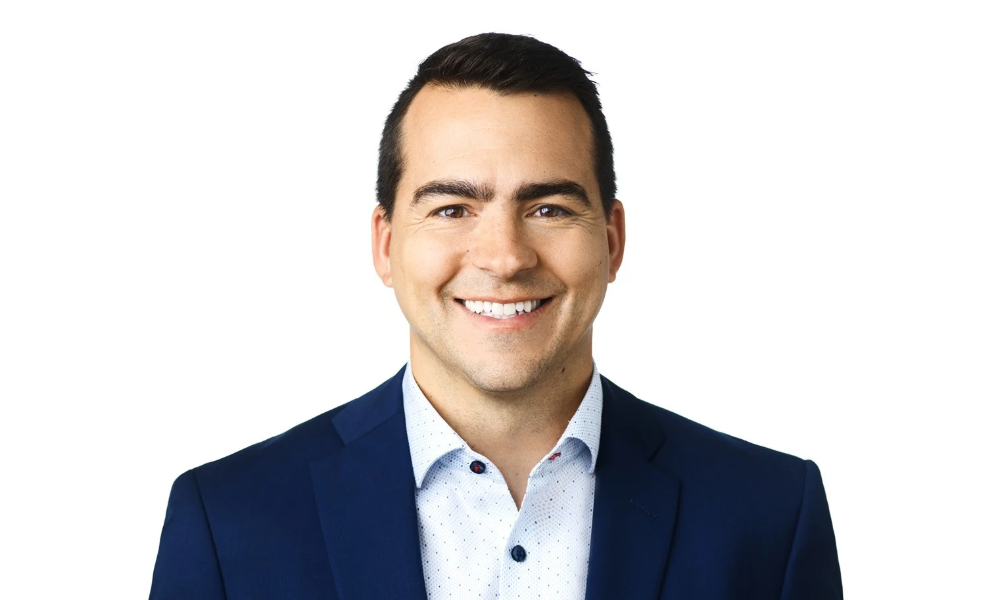
Justin Robichaud: Named FLSC President for 2026-2027 Term
Summary
- Justin Robichaud has been named president of the Federation of Law Societies of Canada for the 2026-2027 term.
- He previously served as the FLSC's vice president and was the youngest president of the Law Society of New Brunswick.
- Robichaud emphasized the FLSC's commitment to public interest, independent regulation, and upholding the rule of law across Canada.
- The year 2026 will be significant for the FLSC, with new leadership, governance changes, and a strategic plan implementation.
- He will lead alongside president-elect Atrisha Lewis and second vice president Tanya Chamberlain, supported by a diverse national council.
Leadership Transition at FLSC
The Federation has a crucial responsibility to anticipate and address these developments, fostering collaboration across jurisdictions and providing a unified national voice on issues impacting the profession, the public, and the administration of justice.
Justin Robichaud KC has been designated as the incoming president of the Federation of Law Societies of Canada (FLSC) for the 2026-2027 term. This significant appointment places him at the helm of the national coordinating body for Canada's provincial and territorial law societies, which are responsible for the regulation of the legal profession in the public interest. Robichaud will assume the presidency following Louis-Martin Beaumont, who will have served as president during the 2025-2026 term.
Prior to this upcoming role, Robichaud held the position of vice president within the FLSC, demonstrating a clear progression in his leadership within the organization. His ascent to the presidency marks a pivotal moment for the Federation as it prepares for a period of anticipated change and strategic development, underscoring the importance of strong leadership in guiding the Canadian legal profession's regulatory landscape.
A Career Dedicated to Legal Regulation
Justin Robichaud KC brings a wealth of experience in legal governance to his new role. Notably, he holds the distinction of being the youngest individual ever elected president of the Law Society of New Brunswick, where he led the provincial regulator through the 2022-2023 term. His commitment to legal oversight extends further, as he also presided over the New Brunswick branch of the Canadian Bar Association from 2018 to 2019.
Beyond his leadership positions, Robichaud has actively contributed to the Law Society of New Brunswick through his participation in numerous committees and task forces. His contributions were recognized in 2022 when the Law Society nominated him to the Federal Council. Professionally, Robichaud is a co-founder of Fidelis Law Droit, a Moncton-based litigation firm established in 2014, where his practice concentrates on personal injury and insurance law. He earned his bachelor of laws and bachelor of business administration degrees from the Université de Moncton, and also served as a sessional lecturer at the university's faculty of law from 2018 to 2022. He was called to the bar in 2011 and received his King's Counsel designation in 2021.
Strategic Vision for the Canadian Legal Profession
Robichaud has articulated a clear vision for his tenure, emphasizing the FLSC's core mandate. He expressed his honor in taking on the responsibility and his eagerness to collaborate with colleagues from across Canada. He highlighted a shared commitment among jurisdictions to protecting the public interest, upholding the independent regulation of the legal profession, and promoting the rule of law, despite the diverse legal traditions and regulatory environments present throughout the country.
Looking ahead, Robichaud identified 2026 as a critical year for the FLSC, anticipating the arrival of a new Chief Executive Officer and new council members, alongside the implementation of significant governance changes and a new strategic plan. He acknowledged the continuous evolution of the legal profession, which presents both new challenges and opportunities for those tasked with its regulation. The Federation has a crucial responsibility to anticipate and address these developments, fostering collaboration across jurisdictions and providing a unified national voice on issues impacting the profession, the public, and the administration of justice.
The Federation's Governing Body
As Justin Robichaud steps into his role as FLSC new president, he will be supported by a robust leadership team and a diverse council representing legal regulators from across Canada. Atrisha Lewis will serve as vice president and president-elect, with Tanya Chamberlain holding the position of second vice president. Louis-Martin Beaumont, Robichaud's predecessor, will continue to contribute to the council as past president.
The council also includes representatives from various provincial and territorial law societies: Stacy Petriuk (Law Society of Alberta), Andrea V. Argue (Law Society of Saskatchewan), Ken Mandzuik (Law Society of Manitoba), Michelle Lomazzo (Law Society of Ontario), Rémi Bourget (Barreau du Québec), François Lebreux (Chambre des notaires du Québec), Frank E. DeMont (Nova Scotia Barristers’ Society), Catherine Fawcett (Law Society of New Brunswick), Cynthia Taylor (Law Society of Prince Edward Island), Rodney Zdebiak (Law Society of Newfoundland and Labrador), Megan É. Whittle (Law Society of Yukon), the Law Society of the Northwest Territories, and Curtis Mesher (Law Society of Nunavut). This collective leadership ensures broad representation and collaborative governance for the Canadian legal profession regulation.
Practical Implications
Lawyers and compliance officers should note the incoming leadership at the Federation of Law Societies of Canada, as changes in this key regulatory body can influence national legal policy, regulatory priorities, and the strategic direction of the legal profession's oversight across Canada, potentially impacting future practice standards or compliance requirements.
Source
How does this affect you?
Get an AI analysis of this article grounded in your jurisdictions, practice areas, and any policy documents you've uploaded to Wansom.
Finish Reading the Full Story and the Expert Analysis.
Get the latest legal & regulatory intelligence in Canada
Wansom is AI and can make mistakes.