
Justice V Mohana: Law, Music, Cinema Intersect in Human Experience
Summary
- Supreme Court Justice V Mohana delivered a speech drawing parallels between law, music, and cinema, emphasizing their shared role in interpreting human experience.
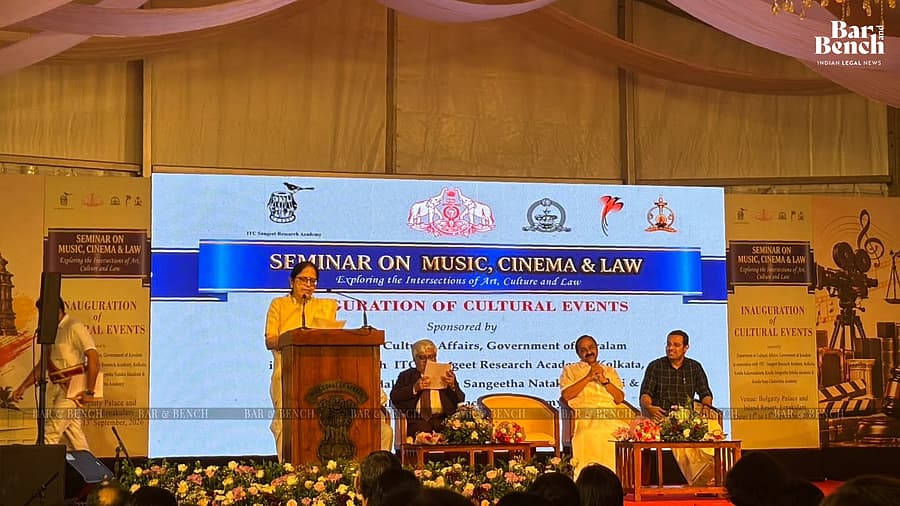
- She spoke at a three-day seminar titled 'Music, Cinema and Law: Exploring the Intersections of Art, Culture and Law,' co-organized by the Kerala Judicial Academy and NUALS in Kochi.
- Justice Mohana highlighted that law, like music, operates within a framework of rules, such as the Constitution and legislation, but judges must interpret these faithfully in an ever-changing world.
- She stressed that art matters to law because behind every legal case and dispute lies a human experience, moving beyond mere categories and procedures.
Bridging Disciplines
Behind every legal dispute, there is a human experience, and behind every case, there is an individual whose life is directly affected by the law's application.
Supreme Court Justice V Mohana recently offered a compelling perspective on the interconnectedness of law, music, and cinema, highlighting their shared essence in interpreting and understanding human experiences. During a Friday address, Justice Mohana articulated how these seemingly disparate fields all operate within distinct frameworks to make sense of the world around us. Her insights were delivered at the inaugural ceremony of a significant three-day seminar titled 'Music, Cinema and Law: Exploring the Intersections of Art, Culture and Law,' held at Bolgatty in Kochi.
The seminar, a collaborative effort between the Kerala Judicial Academy and the National University of Advanced Legal Studies (NUALS), brought together legal luminaries and cultural observers. The event was formally inaugurated by Kerala Chief Minister VD Satheesan, with Justice Mohana present alongside Kerala High Court Chief Justice Soumen Sen and Justice Anil K Narendran, underscoring the importance of this interdisciplinary dialogue. Justice V Mohana's speech served as a foundational exploration into how artistic and legal disciplines, despite their differences, converge on the fundamental task of interpretation.
The Evolving Legal Framework
Drawing a direct parallel between the structured nature of music and the legal system, Justice Mohana explained that just as music relies on rules, rhythm, structure, and harmony to guide an artist's creation, law is similarly grounded in its own foundational elements. The Constitution, legislation, and established procedures provide the essential framework within which judges and lawyers operate, defining the boundaries of their work. This comparison underscores a core aspect of Indian legal philosophy, suggesting that while law provides a rigid structure, its application requires a nuanced understanding akin to artistic expression.
Justice Mohana emphasized that law is not fundamentally different from these artistic forms in its reliance on structure. However, she pointed out the delicate and continuous task faced by judges: to interpret legal principles faithfully while simultaneously acknowledging the dynamic and ever-changing world in which these laws are applied. This recognition of a constantly evolving societal context is crucial for a relevant and just legal system, reminding practitioners that legal interpretation is an ongoing process of adaptation.
Humanity at the Core of Law
A central theme of Justice Mohana's address was the profound relevance of art to the legal profession. She posited that the answer to why art matters to law is straightforward: while the legal system often focuses on categories, principles, and procedures, it is imperative to remember the human element at its core. Behind every legal dispute, there is a human experience, and behind every case, there is an individual whose life is directly affected by the law's application.
This perspective offers a philosophical framework for legal interpretation, advocating for an approach that transcends mere procedural adherence. By emphasizing the human experience, Justice Mohana's insights encourage a more holistic understanding of justice, suggesting that a deeper engagement with culture and art can enrich legal thought. This approach aligns with a broader understanding of law as a reflection of society, where contextual interpretation often holds more weight than strict adherence to abstract categories.
Practical Implications
This speech by Justice V Mohana provides a philosophical framework for legal interpretation, reminding practitioners that law operates within a constantly changing world and involves human experience. Lawyers might draw on these insights to craft more nuanced arguments or to understand judicial approaches that prioritize contextual interpretation over strict adherence to categories.
Source
How does this affect you?
Get an AI analysis of this article grounded in your jurisdictions, practice areas, and any policy documents you've uploaded to Wansom.
Finish Reading the Full Story and the Expert Analysis.
Wansom is AI and can make mistakes.