
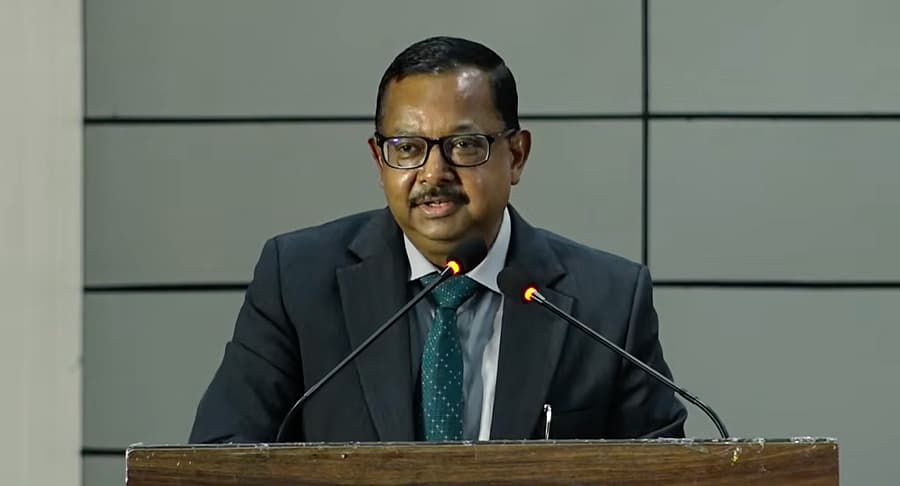
Supreme Court Justice Ujjal Bhuyan: Weed Out Frivolous Criminal Cases
Summary
- Supreme Court Justice Ujjal Bhuyan stated that frivolous criminal cases make India's justice system an object of ridicule.
- He urged trial courts to launch a special drive to weed out such cases, which are often based on trivial grounds like consuming food or social media comments.
- Justice Bhuyan noted that despite their ridiculous nature, these cases are registered, chargesheeted, and proceed to trial.
- As of September 17, 4.27 crore criminal cases are pending across Indian courts, with 95.31% (4.07 crore) at the trial court level.
- The Justice's remarks emphasize the need for greater ethical scrutiny in criminal litigation to address systemic pendency.
Judicial Call for Action
Justice Bhuyan asserted that such cases are making the system an object of ridicule in the eyes of the liberal democratic world.
Supreme Court Justice Ujjal Bhuyan recently voiced strong concerns regarding the proliferation of frivolous criminal cases within India's justice system. Speaking on Thursday at the 4th Discourse, an event organized by the Centre for Discourses on Criminal and Constitutional Jurisprudence at the India International Centre in New Delhi, Justice Bhuyan asserted that such cases are making the system an object of ridicule in the eyes of the liberal democratic world.
During his address on the topic of 'ethics in criminal litigation and the duties of the defence and the prosecution,' Justice Bhuyan urged trial courts to initiate a special drive specifically aimed at identifying and eliminating these unwarranted criminal charges India. His remarks underscore a growing judicial sentiment that many cases entering the system lack substantive merit and contribute to systemic inefficiencies.
The Scope of Unwarranted Charges
Justice Bhuyan highlighted numerous examples of trivial grounds on which criminal cases are being registered, illustrating the absurdity of some accusations. These include instances related to consuming food, reciting poems, participating in demonstrations, or merely raising slogans. He further cited cases stemming from comments made on social media, performances by stand-up comedians, and even the titles and contents of books and movies.
The Supreme Court Justice emphasized that the accusations in these Justice Ujjal Bhuyan frivolous criminal cases are often ridiculous, bordering on an affront to one's intelligence. Despite their questionable nature, the registration of such cases continues unabated, with chargesheets frequently filed, leading to full trials. This persistence of insubstantial litigation places an undue burden on individuals and the judicial machinery.
Exacerbating Systemic Pendency
The prevalence of these frivolous cases directly contributes to the severe backlog plaguing the Indian criminal justice system pendency. Justice Bhuyan drew attention to alarming statistics from the National Judicial Data Grid, which, as of September 17, reported a staggering 4.27 crore criminal cases pending across all courts in India.
A significant majority of this backlog, specifically 4.07 crore cases, or 95.31 percent of the total, are pending before the trial courts. In contrast, 19.84 lakh cases, representing 4.64 percent, are pending before the High Courts. This data underscores the critical need for India trial courts to weed out cases that lack merit, thereby alleviating the immense pressure on the lower judiciary and improving the overall efficiency of the system.
Implications for Ethical Litigation
Justice Bhuyan's strong statement signals a potential shift towards greater judicial scrutiny of criminal case initiation, particularly at the trial court level. His emphasis on ethics in criminal litigation India suggests that the judiciary is increasingly aware of how easily the system can be misused for trivial matters, impacting both individual liberties and the public perception of justice.
This call from a Supreme Court Justice Bhuyan criminal litigation expert highlights the imperative for all stakeholders—prosecution, defense, and the judiciary—to uphold higher ethical standards and ensure that criminal proceedings are reserved for genuine offenses, rather than becoming a tool for harassment or an outlet for petty grievances.
Practical Implications
This statement from a Supreme Court Justice signals a potential shift towards greater judicial scrutiny of criminal case initiation at the trial court level in India. Lawyers should be aware of this sentiment when advising clients on challenging seemingly frivolous charges, preparing discharge applications, or arguing for quashing proceedings, as it may influence judicial disposition.
Source
How does this affect you?
Get an AI analysis of this article grounded in your jurisdictions, practice areas, and any policy documents you've uploaded to Wansom.
Finish Reading the Full Story and the Expert Analysis.
Get the latest legal & regulatory intelligence in India
Wansom is AI and can make mistakes.