
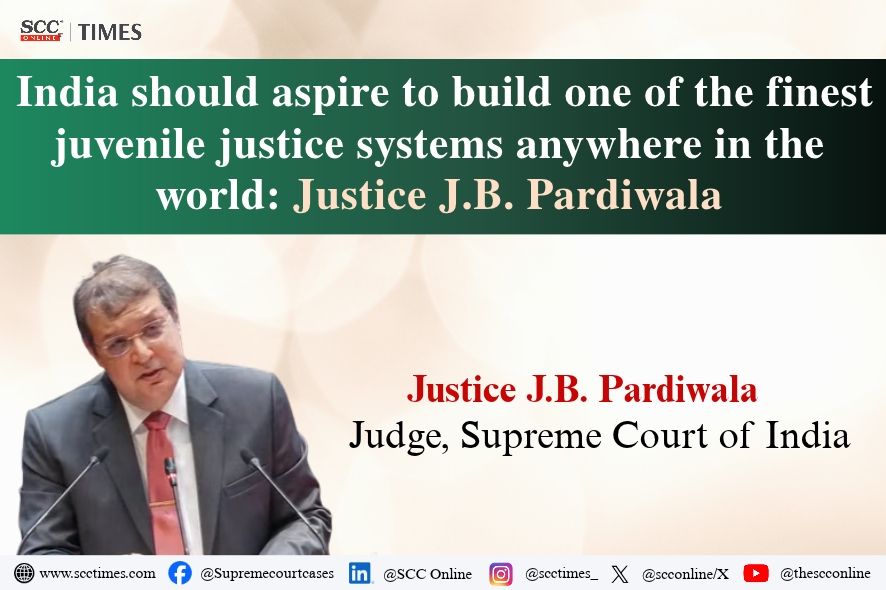
Justice Pardiwala: India to Lead Global Child Justice with JJ Act 2015
Summary
- Justice J.B. Pardiwala urged India to develop one of the world's finest juvenile justice systems.
- His remarks were delivered at a consultation marking ten years of the Juvenile Justice (Care and Protection of Children) Act, 2015.
- The Supreme Court Justice emphasized the need to surpass the nation's inherited child protection framework.
- This vision underscores a commitment to significant advancements within India's child support and protection mechanisms.
A Vision for Global Leadership in Juvenile Justice
India should aspire not only to build a better child protection system than the one it inherited, but to build one of the finest child support and juvenile justice systems anywhere in the world.
During a significant gathering marking a decade since the enactment of the Juvenile Justice (Care and Protection of Children) Act, 2015, Supreme Court Justice J.B. Pardiwala articulated an ambitious vision for India's approach to child welfare. In his address at the National Annual Stakeholders Consultation on Ten Years of the Juvenile Justice (Care and Protection of Children) Act, 2015, Justice Pardiwala asserted that the nation must strive to establish one of the preeminent child support and juvenile justice systems globally.
This powerful statement by Justice Pardiwala underscored a commitment to not merely improving upon existing frameworks but to setting a new international standard. He emphasized that the goal extends beyond simply enhancing the inherited child protection system; it involves creating a model that stands among the finest worldwide. This call to action highlights a profound dedication to the rights and well-being of children within the Indian legal and social landscape.
The Juvenile Justice (Care and Protection of Children) Act, 2015 at Ten Years
The occasion for Justice J.B. Pardiwala's speech was particularly noteworthy, coinciding with the ten-year milestone of the Juvenile Justice (Care and Protection of Children) Act, 2015. This legislation, often referred to as the JJ Act 2015, forms a critical pillar of India's child protection system, governing the care, protection, treatment, and rehabilitation of children in conflict with the law and children in need of care and protection.
The National Annual Stakeholders Consultation served as a crucial forum for evaluating the impact and effectiveness of the JJ Act 2015 over its first decade. Such consultations are vital for assessing legislative performance, identifying areas for improvement, and fostering collaborative efforts among various stakeholders involved in child welfare. Justice Pardiwala's remarks provided a forward-looking perspective on how this foundational Act can evolve to meet future challenges and aspirations.
Implications for Legal Practitioners and Future Reforms
Justice Pardiwala's call for India to build one of the finest juvenile justice systems carries significant implications for legal professionals, particularly those practicing in juvenile justice or child protection. His speech signals a potential future direction towards a more robust, comprehensive, and possibly stricter or more refined system, moving beyond the current provisions of the Juvenile Justice (Care and Protection of Children) Act, 2015.
Lawyers engaged in this field should be acutely aware of this ongoing discourse and the potential for substantial reforms to the JJ Act 2015. Such developments could directly impact case strategies, introduce new compliance requirements, and necessitate evolving advocacy efforts. The emphasis on global excellence suggests that any forthcoming changes would aim to align India's child protection framework with international best practices, thereby demanding a heightened level of expertise and adaptability from legal practitioners.
Practical Implications
Lawyers practicing in juvenile justice or child protection in India should be aware of the ongoing discourse and potential for significant reforms to the Juvenile Justice (Care and Protection of Children) Act, 2015. This signals a future direction towards a more robust and potentially stricter or more comprehensive system, which could impact case strategies, compliance requirements, and advocacy efforts.
Source
How does this affect you?
Get an AI analysis of this article grounded in your jurisdictions, practice areas, and any policy documents you've uploaded to Wansom.
Wansom is AI and can make mistakes.