
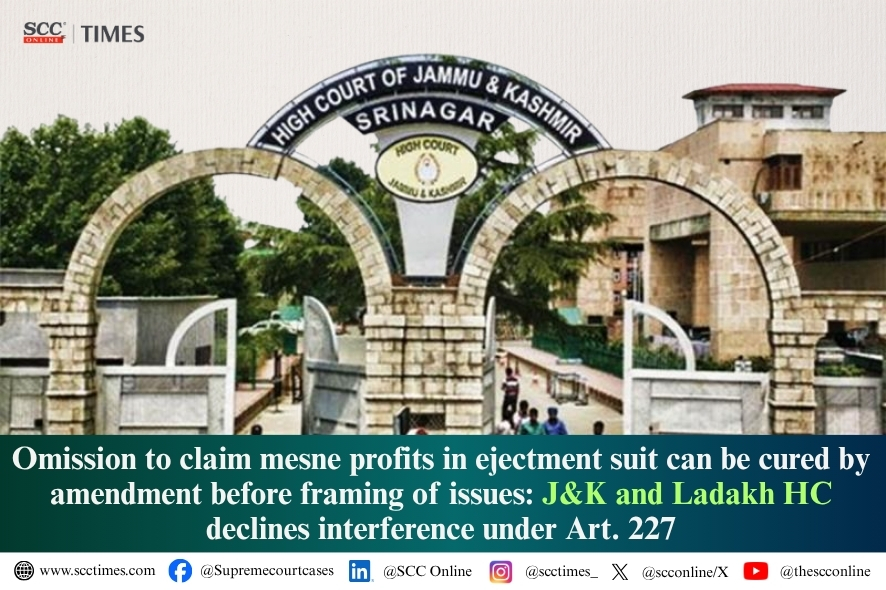
J&K Ladakh High Court: Upholds Mesne Profits Amendment in Ejectment Suit
Summary
- The J&K and Ladakh High Court declined to interfere with a Trial Court's order allowing a plaint amendment.
- The amendment, made under Order VI Rule 17 CPC, sought to include a claim for mesne profits at ₹50,000 per month.
- The High Court's decision, rendered under Article 227, affirmed that an omission to claim mesne profits in an ejectment suit can be rectified by amendment.
- This procedural flexibility is permissible provided the amendment is sought before the framing of issues in the case.
The High Court's Stance on Procedural Amendments
This procedural allowance ensures that plaintiffs are not unduly penalized for initial oversights and can pursue comprehensive relief, including compensation for wrongful possession, thereby preventing multiplicity of litigation.
The High Court of Jammu & Kashmir and Ladakh recently affirmed a Trial Court's decision, declining to intervene in an order that permitted a plaintiff to modify their initial legal submission. This particular amendment, sought under the provisions of Order VI Rule 17 of the Code of Civil Procedure (CPC), aimed to incorporate a demand for mesne profits. The plaintiff had specifically requested these profits at a rate of ₹50,000 per month.
The High Court's refusal to exercise its supervisory jurisdiction under Article 227 of the Constitution of India effectively upheld the Trial Court's discretion in allowing this significant alteration to the original plaint. The case underscores the judiciary's approach to rectifying omissions in pleadings, particularly when such corrections are sought at an early stage of litigation.
Legal Framework and Procedural Nuances
At the heart of this ruling lies Order VI Rule 17 of the Code of Civil Procedure, which grants courts the power to allow either party to alter or amend their pleadings at any stage of the proceedings, provided it is necessary for determining the real questions in controversy between the parties. This procedural flexibility is crucial for ensuring that justice is not derailed by mere technicalities or initial oversights, allowing for the comprehensive presentation of a party's case.
In the context of an ejectment suit, a claim for mesne profits represents compensation for the unlawful occupation of property, reflecting the benefits the defendant derived or might have derived from such possession during the period of wrongful occupation. The ability to introduce such a claim through a pleadings amendment before issues are formally framed is a significant aspect of procedural law in India, as it allows for the full scope of relief to be considered. The J&K Ladakh High Court's decision to not interfere with the Trial Court's order highlights the limited scope of its powers under Article 227, which typically allows intervention only in cases of grave injustice, manifest error of law, or jurisdictional impropriety, not merely to re-evaluate discretionary orders made by lower courts.
Implications for Property Disputes in the Region
This ruling from the J&K Ladakh High Court provides important clarity regarding the amendment of pleadings, specifically addressing the omission to claim mesne profits in an ejectment suit. It reinforces the principle that such an omission can be cured by an amendment under Order VI Rule 17 CPC, particularly when the request is made prior to the framing of issues in the case.
This procedural allowance ensures that plaintiffs are not unduly penalized for initial oversights and can pursue comprehensive relief, including compensation for wrongful possession, thereby preventing multiplicity of litigation. The decision serves as a vital precedent for legal practitioners handling property disputes across the Union Territories of Jammu & Kashmir and Ladakh, emphasizing the importance of utilizing the Code of Civil Procedure amendment India provisions to perfect claims. It underscores that courts are generally inclined to permit amendments that facilitate a complete adjudication of the dispute, especially when no prejudice is caused to the opposing party by the timing of the amendment, and the amendment merely seeks to clarify or expand upon existing claims. This J&K Ladakh HC mesne profits amendment ruling offers valuable guidance.
Practical Implications
This ruling clarifies that an omission to claim mesne profits in an ejectment suit can be cured by amendment under Order VI Rule 17 CPC, provided it's done before issues are framed. Lawyers handling property disputes in India, particularly in the J&K and Ladakh jurisdiction, should be aware of this procedural flexibility to ensure comprehensive claims for their clients and avoid potential loss of relief due to initial oversight.
Source
Source: Original reporting via SCC Times
How does this affect you?
Get an AI analysis of this article grounded in your jurisdictions, practice areas, and any policy documents you've uploaded to Wansom.
Finish Reading the Full Story and the Expert Analysis.
Get the latest legal & regulatory intelligence in India
Wansom is AI and can make mistakes.