
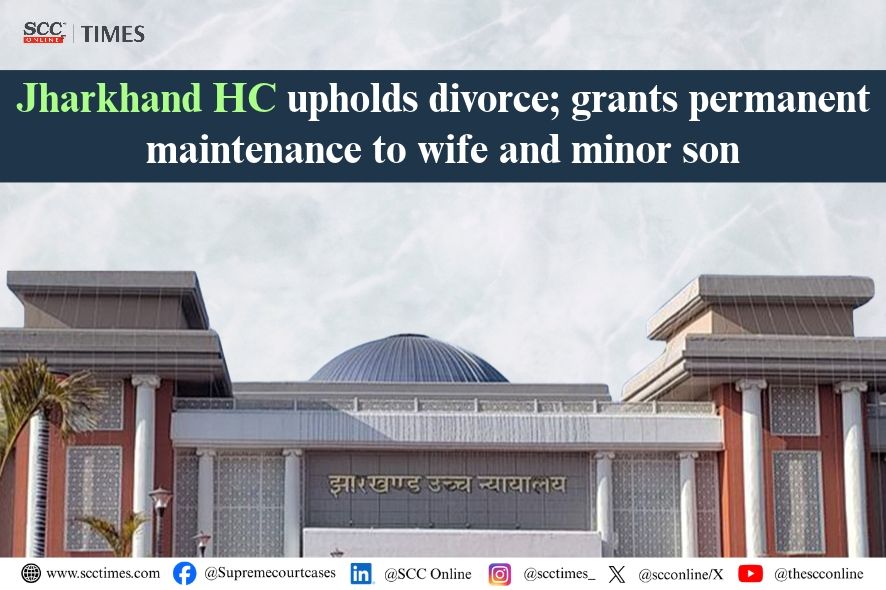
Jharkhand High Court: Upholds Divorce, Rules on Permanent Maintenance
Summary
- A Family Court initially granted a divorce based on non-compliance with a decree for restitution of conjugal rights.
- The wife subsequently appealed this divorce decree to the Jharkhand High Court.
- The Jharkhand High Court upheld the divorce, affirming the Family Court's decision.
- Concurrently, the High Court ordered the provision of permanent maintenance for both the wife and their minor son.
- This ruling reinforces the legal grounds for divorce based on unfulfilled restitution of conjugal rights and ensures financial support for dependents.
Genesis of the Marital Conflict
Crucially, in addition to upholding the divorce, the Jharkhand High Court also made a significant pronouncement regarding financial support.
The marital union between the parties involved in this case eventually led to a series of legal actions concerning their relationship. These proceedings ultimately culminated in a significant decision by a Family Court, which formally dissolved their marriage. The basis for this initial divorce decree was the failure of one party to comply with an earlier judicial order mandating the restitution of conjugal rights.
This prior decree, aimed at encouraging reconciliation and the resumption of marital cohabitation, remained unfulfilled, providing the legal foundation for the subsequent dissolution of the marriage. The Family Court, observing the continued non-compliance, proceeded to grant the divorce, effectively ending the marital bond between the husband and wife. This initial ruling set the stage for further legal challenges.
The Appeal and Legal Principles
Following the Family Court's decision, the wife initiated an appeal, challenging the validity of the divorce decree before the Jharkhand High Court. This legal challenge sought to overturn the lower court's judgment, bringing the complex matrimonial dispute to a higher judicial authority for review. The case thus presented the Jharkhand High Court with an opportunity to re-examine the grounds upon which the divorce was initially granted.
Central to the Family Court's original decision, and subsequently to the Jharkhand High Court divorce appeal, was the principle that non-compliance with a decree for restitution of conjugal rights can serve as a legitimate basis for divorce under Indian law. This legal provision allows for the dissolution of a marriage when one spouse deliberately fails to adhere to a court order to resume cohabitation, indicating an irretrievable breakdown of the marital relationship. The High Court's review would therefore scrutinize whether the Family Court correctly applied this legal standard.
High Court's Affirmation and Financial Support
The Jharkhand High Court, after careful consideration of the arguments presented during the appeal, ultimately upheld the divorce decree issued by the Family Court. This decision affirmed the lower court's finding that the marriage could be dissolved due to the uncomplied decree for restitution of conjugal rights. The High Court's ruling solidified the legal termination of the marital relationship, confirming the validity of the divorce.
Crucially, in addition to upholding the divorce, the Jharkhand High Court also made a significant pronouncement regarding financial support. The court directed that permanent maintenance be provided to both the wife and their minor son. This aspect of the ruling ensures that despite the dissolution of the marriage, the wife and child receive ongoing financial assistance, a common consideration in matrimonial disputes in India. This comprehensive decision addressed both the marital status and the economic well-being of the dependents.
Broader Implications for Matrimonial Law
This ruling from the Jharkhand High Court regarding permanent maintenance and divorce carries important implications for matrimonial disputes across India. It reinforces the established legal position that a divorce can be granted when a decree for restitution of conjugal rights remains uncomplied with, providing clarity on the finality of such marital dissolutions. The court's consistent approach to awarding permanent alimony to the wife and minor son further underscores the judiciary's commitment to ensuring financial security for dependents post-divorce.
Lawyers handling matrimonial disputes in India should particularly note this judgment. It serves as a valuable precedent, guiding strategy in similar cases that involve both the grounds for divorce and the critical aspect of financial provision for family members. The decision highlights the dual focus of the courts: resolving marital status while simultaneously safeguarding the economic interests of the wife and child, thereby shaping future legal arguments and outcomes in cases involving Jharkhand HC permanent maintenance divorce.
Practical Implications
Lawyers handling matrimonial disputes in India should note this ruling as it reinforces the grounds for divorce based on non-compliance with a decree for restitution of conjugal rights, and the court's consistent approach to awarding permanent maintenance to the wife and minor son. This precedent can guide strategy in similar cases involving divorce finality and financial support for dependents.
Source
Source: Original reporting via SCC Times
How does this affect you?
Get an AI analysis of this article grounded in your jurisdictions, practice areas, and any policy documents you've uploaded to Wansom.
Finish Reading the Full Story and the Expert Analysis.
Get the latest legal & regulatory intelligence in India
Wansom is AI and can make mistakes.