
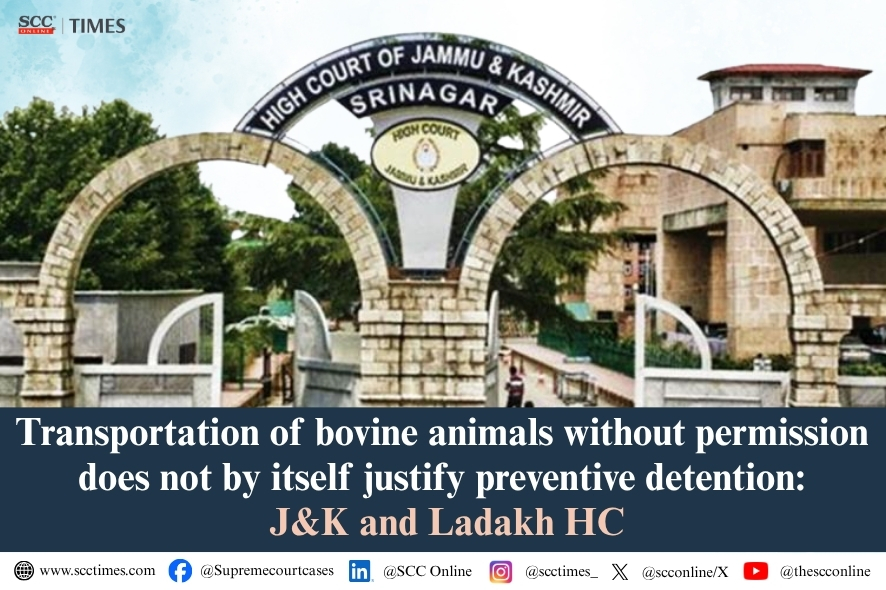
J&K Ladakh HC: Preventive Detention for Bovine Transport Invalidated
Summary
- The J&K and Ladakh High Court ruled that unauthorized bovine transport alone does not justify preventive detention based on "public order."
- Preventive detention is constitutionally unsustainable if the detenue is not informed of their right to represent before the detaining authority.
- The court emphasized that "public order" cannot be invoked merely for alleged transportation of bovine animals without permission.
- This ruling reinforces procedural safeguards and limits the scope for arbitrary preventive detention in India.
What Happened
Preventive detention becomes constitutionally unsustainable if an individual is not informed of their fundamental right to make a representation before the detaining authority.
The Jammu and Kashmir and Ladakh High Court has recently clarified the stringent conditions under which preventive detention orders can be legally sustained, particularly in cases involving the unauthorized movement of livestock. The court explicitly stated that the mere alleged transportation of bovine animals without proper permission does not, by itself, constitute grounds to invoke "public order" as a justification for preventive detention. This significant ruling underscores the judiciary's commitment to safeguarding individual liberties against potentially arbitrary state action.
The court's pronouncement came in the context of challenges to detention orders issued under preventive detention laws. It highlighted that for such detention to be constitutionally valid, the alleged actions must genuinely threaten public order, a threshold that unauthorized bovine transport typically fails to meet. This decision from the J&K Ladakh HC concerning preventive detention related to bovine transport sets a clear precedent, emphasizing that administrative convenience or minor infractions cannot be conflated with serious threats to societal peace.
Legal Context and Grounds for Challenge
A critical aspect of the court's decision revolved around the procedural safeguards afforded to individuals facing preventive detention. The J&K and Ladakh High Court unequivocally declared that preventive detention becomes constitutionally unsustainable if the detenue is not adequately informed of their fundamental right to make a representation before the detaining authority. This right to representation is a cornerstone of due process in preventive detention cases in India.
The court's emphasis on this procedural requirement means that authorities must not only provide the detenue with the grounds for their detention but also explicitly apprise them of their avenue to challenge the order. Failure to inform the detenue about their right to representation before the detaining authority renders the detention order invalid, irrespective of the alleged substantive grounds. This ruling reinforces the principle that even in matters of national security or public order, constitutional guarantees for individuals must be meticulously upheld.
Why It Matters
This judgment from the J&K Ladakh HC regarding preventive detention in cases of bovine transport carries substantial implications for the application of preventive detention laws across India. It serves as a vital check on the executive's power to detain individuals without trial, particularly when the justification hinges on vague or exaggerated interpretations of "public order." The ruling clarifies that the bar for invoking public order is high and cannot be lowered for actions that do not genuinely disrupt the community's peace and tranquility.
Furthermore, the decision provides crucial grounds for challenging preventive detention orders where procedural infirmities exist, specifically concerning the right to representation. It empowers individuals and their legal counsel to scrutinize such orders for constitutional violations, ensuring that the state adheres to established legal norms. This reinforces the importance of the right to representation for a detenue, making it a non-negotiable element for the legality of any preventive detention. The ruling strengthens the protection against arbitrary detention and upholds the rule of law.
Practical Implications
This ruling provides critical grounds for challenging preventive detention orders where the 'public order' justification is tenuous, such as mere bovine transport without permission, or where the detenue's right to representation has been violated. Lawyers should scrutinize such orders for constitutional infirmities and advise clients on their right to challenge detention.
Source
Source: Original reporting via SCC Times
How does this affect you?
Get an AI analysis of this article grounded in your jurisdictions, practice areas, and any policy documents you've uploaded to Wansom.
Finish Reading the Full Story and the Expert Analysis.
Wansom is AI and can make mistakes.