
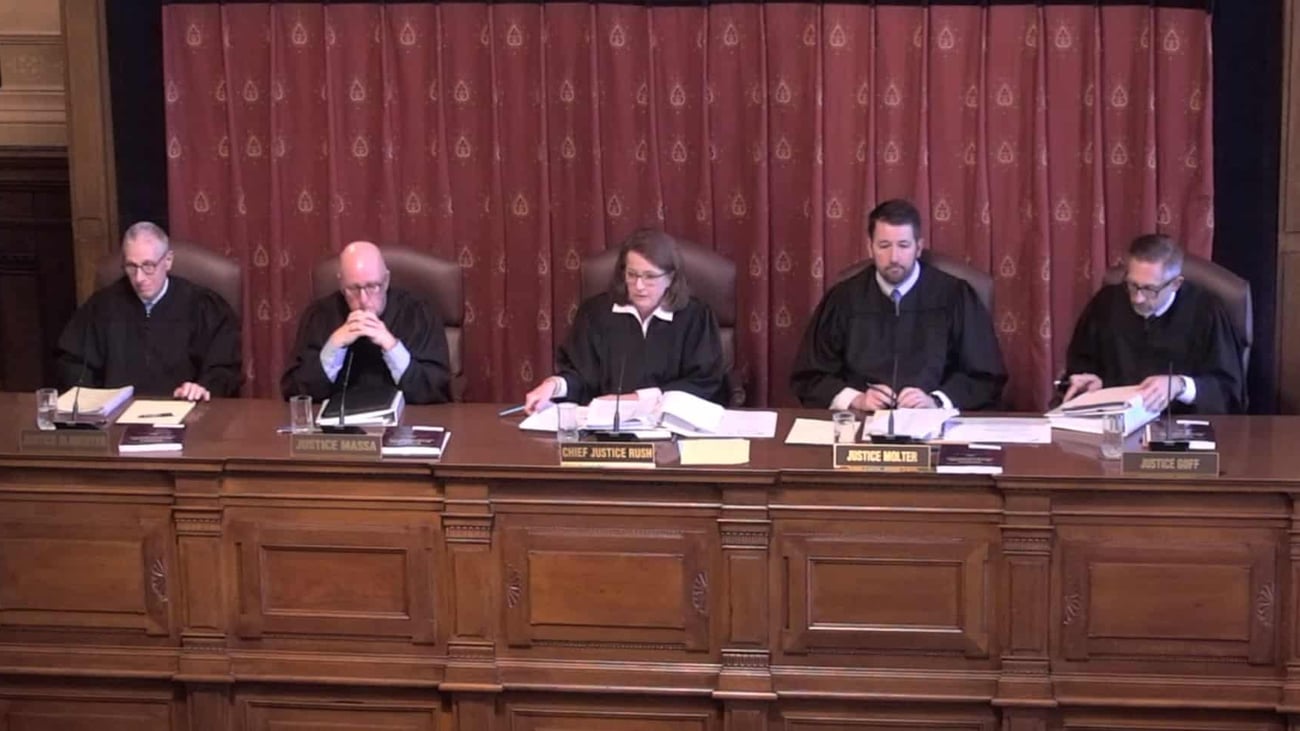
Indiana Supreme Court: Hears Abortion Ban Religious Freedom Challenge
Summary
- The Indiana Supreme Court heard arguments on January 19, 2023, regarding a religious freedom challenge to the state's near-total abortion ban.
- The state appealed a lower court's injunction that had favored anonymous women and Hoosier Jews For Choice, who argued the ban violated their religious beliefs.
- The state contended the ban does not violate the Indiana Religious Freedom Restoration Act (RFRA) and that claims of injury were speculative.
- Plaintiffs argued the law causes ongoing harm, forcing them to change behaviors due to their inability to obtain religiously required abortions.
- The case examines whether the state must grant religious exemptions to its abortion law, given existing exceptions for rape, incest, and life-threatening conditions.
Indiana Supreme Court Hears Religious Freedom Challenge
The Indiana Supreme Court's final decision will define the scope of religious freedom protections under state law, particularly concerning health regulations.
The Indiana Supreme Court convened on Thursday, January 19, 2023, to hear oral arguments in a significant appeal concerning the state's near-total abortion ban. This legal proceeding centers on whether the ban can be enforced against individuals who assert religious objections to its provisions. The high court is reviewing a lower court's decision that had previously issued an injunction, temporarily blocking the controversial abortion statute from taking effect for these specific plaintiffs.
This appeal stems from a class action lawsuit initiated by anonymous women and the advocacy organization Hoosier Jews For Choice. These plaintiffs challenged the state's abortion restrictions on religious freedom grounds, leading to the lower court's favorable ruling. The state subsequently appealed this injunction, urging the five-judge panel of the Indiana Supreme Court to overturn the lower court's decision, lift the injunction, and affirm that the abortion law does not infringe upon individuals' religious liberties. The state's highest court had previously upheld the core abortion law in 2023, but this current case introduces a distinct religious freedom dimension to its constitutionality.
Legal Arguments and the Indiana RFRA
Central to the arguments is the Indiana Religious Freedom Restoration Act (RFRA), which mandates that the government must demonstrate a compelling interest to burden an individual's religious exercise and must employ the least restrictive means available to achieve that interest. Representing the state, Indiana Solicitor General James Barta contended that the abortion ban aligns with the RFRA, asserting that the lower court's ruling — which he characterized as granting a right to religiously motivated abortions — was unprecedented. Barta maintained that the nation's historical respect for religious practice has never extended to a right to intentionally end human life. He further argued that the plaintiffs' claims were speculative, noting that none had been pregnant during the four years of litigation, rendering their alleged injuries hypothetical.
Chief Justice Loretta Rush questioned Barta on whether the case bore resemblance to the U.S. Supreme Court's decision in *Burwell v. Hobby Lobby*, where the high court ruled that a company could refuse to comply with government insurance mandates for contraceptives based on religious objections. Barta distinguished the cases, explaining that the *Hobby Lobby* plaintiffs faced imminent deadlines and substantial financial penalties, unlike the present situation. Conversely, Ken Falk of the ACLU of Indiana, representing the plaintiffs, argued that the Indiana abortion law inflicts ongoing harm on his clients. He stated that the individual plaintiffs, whose sincere religious beliefs had previously led them to seek abortions, are now unable to obtain such religiously required procedures due to the state's law, forcing them to alter their behaviors in fundamental ways to avoid pregnancies they could not terminate.
Implications for Religious Exemptions and State Law
Indiana's abortion statute permits exceptions only in cases of rape, incest, or when a life-threatening condition or fatal fetal anomaly poses a risk to the mother. Falk highlighted what he perceived as an inconsistency, arguing that the state has failed to provide a valid justification for allowing these specific exemptions while denying those based on religious conviction. He contended that the state's purported interest in preventing abortions has already been compromised by the existing exceptions, undermining its argument against religious exemptions. Justice Geoffrey Slaughter pressed Falk on how the government could craft a law that accommodates a religious exception while simultaneously upholding its interest in preventing abortions.
This case, challenging the abortion ban constitutionality Indiana, holds significant weight for the future interpretation of the Indiana Religious Freedom Restoration Act. The Indiana Supreme Court's final decision will define the scope of religious freedom protections under state law, particularly concerning health regulations. The outcome could establish a crucial precedent regarding religious objections Indiana abortion law and the potential for religious exemptions to various state mandates, impacting how state interests are balanced against individual religious exercise.
Practical Implications
Lawyers should closely monitor the Indiana Supreme Court's final ruling to understand the scope of religious freedom protections under the Indiana RFRA against state-level health regulations. This decision could establish a significant precedent for advising clients on potential religious exemptions to various state laws or defending state mandates against such challenges.
Source
How does this affect you?
Get an AI analysis of this article grounded in your jurisdictions, practice areas, and any policy documents you've uploaded to Wansom.
Finish Reading the Full Story and the Expert Analysis.
Wansom is AI and can make mistakes.