
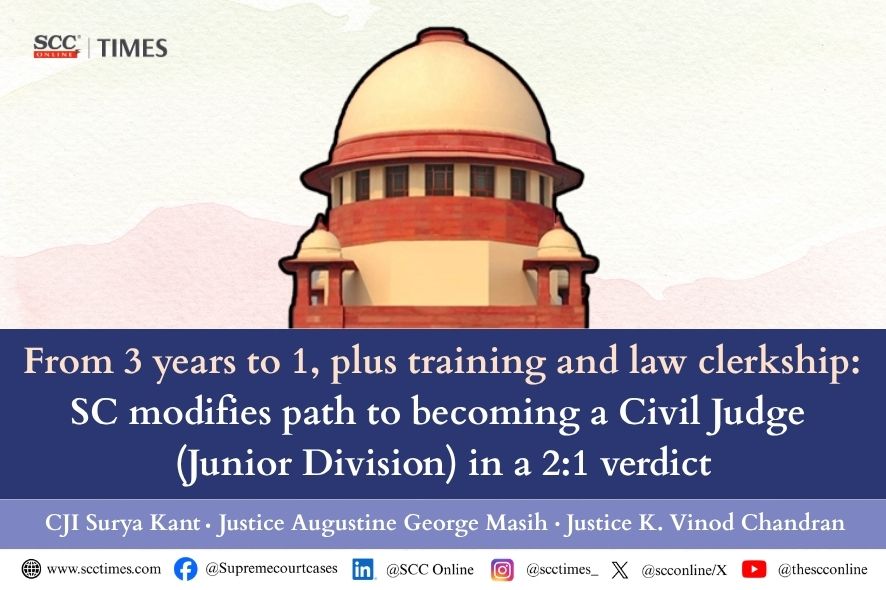
Supreme Court of India: Streamlined Civil Judge Recruitment Process Introduced
Summary
- The Supreme Court of India has modified the recruitment process for Civil Judges (Junior Division), introducing a new transitional regime.
- Fresh law graduates will now be able to enter the civil judge service after completing their LL.B. degree and undergoing prescribed training.
- The court has reduced the Bar practice requirement from three years to one year, followed by structured judicial training and Law Clerkship.
What Happened
The key changes introduced by the Supreme Court include reducing the Bar practice requirement from three years to one year, followed by structured judicial training and a Law Clerkship.
In a landmark decision, the Supreme Court of India has modified the recruitment process for Civil Judges (Junior Division), introducing a new transitional regime that aims to streamline and modernize the selection process. The court's verdict, delivered in a 2:1 majority, has significant implications for fresh law graduates and practicing lawyers alike.
The key changes introduced by the Supreme Court include reducing the Bar practice requirement from three years to one year, followed by structured judicial training and a Law Clerkship. This new regime is expected to provide a faster path to recruitment for fresh law graduates, who will now be able to enter the civil judge service after completing their LL.B. degree and undergoing the prescribed training.
The court's decision has been hailed as a major reform in the judicial appointments process, which was previously criticized for being opaque and biased towards experienced lawyers.
Relevant Legal/Regulatory Context
The Supreme Court's verdict is a significant development in the ongoing efforts to modernize and professionalize the Indian judiciary. The court has been actively engaged in reforming the judicial appointments process, with a focus on increasing transparency and merit-based selection. In recent years, the court has introduced several reforms, including the creation of a Judicial Appointments Commission and the implementation of a structured training program for new recruits.
The introduction of the Law Clerkship requirement is also a significant development, as it aims to provide fresh law graduates with hands-on experience in judicial work and expose them to the practical aspects of the legal profession. This is expected to enhance their skills and knowledge, making them more competitive candidates for civil judge positions.
The court's decision has been welcomed by lawyers and compliance officers, who see it as a positive step towards increasing diversity and merit-based selection in the judicial appointments process.
Why It Matters
The Supreme Court's verdict has significant implications for fresh law graduates and practicing lawyers alike. The new transitional regime is expected to provide a faster path to recruitment for fresh law graduates, who will now be able to enter the civil judge service after completing their LL.B. degree and undergoing the prescribed training.
Lawyers and compliance officers should watch for the implications of this new transitional regime on their clients' eligibility for civil judge positions. Fresh law graduates may now have a faster path to recruitment, which could lead to increased competition in the job market. Additionally, the introduction of structured judicial training and Law Clerkship requirements is expected to enhance the skills and knowledge of fresh recruits, making them more competitive candidates.
The court's decision has been hailed as a major reform in the judicial appointments process, which was previously criticized for being opaque and biased towards experienced lawyers. The verdict is expected to increase transparency and merit-based selection in the civil judge recruitment process.
Practical Implications
Lawyers and compliance officers should watch for the implications of this new transitional regime on their clients' eligibility for civil judge positions, particularly fresh law graduates who may now have a faster path to recruitment.
Source
Source: Original reporting via SCC Times
How does this affect you?
Get an AI analysis of this article grounded in your jurisdictions, practice areas, and any policy documents you've uploaded to Wansom.
Wansom is AI and can make mistakes.