
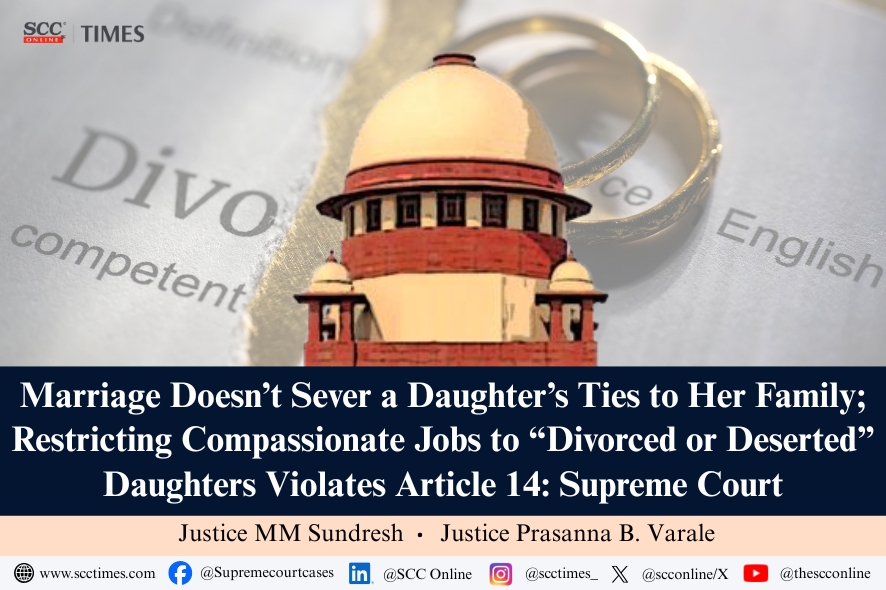
Supreme Court: Married Daughters Eligible for Compassionate Jobs in India
Summary
- The Supreme Court has ruled that a daughter does not automatically sever ties with her family upon marriage.
- Married daughters are now more likely to be eligible for compassionate appointments in government jobs.
- The ruling is based on Article 14 of the Indian Constitution, which guarantees equality before the law to all citizens.
- The decision challenges traditional notions of family relationships and the role of women within them.
What Happened
any classification differentiating a daughter from a son is, per se, unconstitutional
The Supreme Court of India has issued a landmark ruling that challenges the traditional notion of a married daughter's relationship with her parental family. In a decision that has significant implications for employment law, the court held that a daughter does not automatically sever ties with her family upon marriage. This means that married daughters are now more likely to be eligible for compassionate appointments in government jobs, potentially expanding their access to these positions.
The ruling was made in response to a petition filed by a group of women who argued that the current system of compassionate appointments unfairly discriminates against married daughters. Under existing rules, only divorced or deserted daughters were considered eligible for these appointments, while married daughters were excluded from consideration. The Supreme Court's decision effectively overturns this discriminatory practice and ensures that all daughters, regardless of their marital status, are treated equally under the law.
The court's ruling is based on Article 14 of the Indian Constitution, which guarantees equality before the law to all citizens. In its judgment, the court emphasized that any classification or distinction between individuals must be based on rational criteria and not arbitrary or discriminatory in nature.
Legal Context
The Supreme Court's decision is a significant development in the ongoing struggle for women's rights and equality in India. The ruling has far-reaching implications for employment law, particularly with regards to compassionate appointments in government jobs. Under existing rules, these appointments were typically reserved for widows, divorced or deserted daughters, and other vulnerable individuals who required financial support. However, the Supreme Court's decision has effectively opened up this opportunity to married daughters as well.
The court's reliance on Article 14 of the Indian Constitution is also noteworthy. This provision guarantees equality before the law to all citizens and prohibits any arbitrary or discriminatory classification or distinction between individuals. In its judgment, the court emphasized that the existing system of compassionate appointments was unconstitutional because it unfairly discriminated against married daughters.
The Supreme Court's decision has sparked widespread debate about the role of family ties in employment law. While some have hailed the ruling as a major victory for women's rights, others have expressed concerns about the potential implications for family relationships and social norms.
Why It Matters
The Supreme Court's decision has significant practical implications for lawyers advising clients on government job applications. With married daughters now more likely to be eligible for compassionate appointments, lawyers must take this into account when advising their clients. This may involve revising existing advice or expanding client services to include married daughters who are seeking employment in government jobs.
The ruling also has broader social implications, as it challenges traditional notions of family relationships and the role of women within them. By recognizing that a daughter does not automatically sever ties with her family upon marriage, the court's decision has helped to promote greater equality and understanding between generations.
Ultimately, the Supreme Court's decision is a testament to the ongoing struggle for women's rights and equality in India. As the country continues to evolve and modernize, this ruling serves as an important reminder of the need for continued vigilance and advocacy on behalf of marginalized communities.
Practical Implications
Lawyers advising clients on government job applications should note that the Supreme Court's ruling makes it more likely for married daughters to be eligible for compassionate appointments, potentially expanding their client base or altering existing advice.
Source
Source: Original reporting via SCC Times
How does this affect your business?
Get an AI analysis of this article grounded in your jurisdictions, practice areas, and any policy documents you've uploaded to Wansom.
Wansom is AI and can make mistakes.