
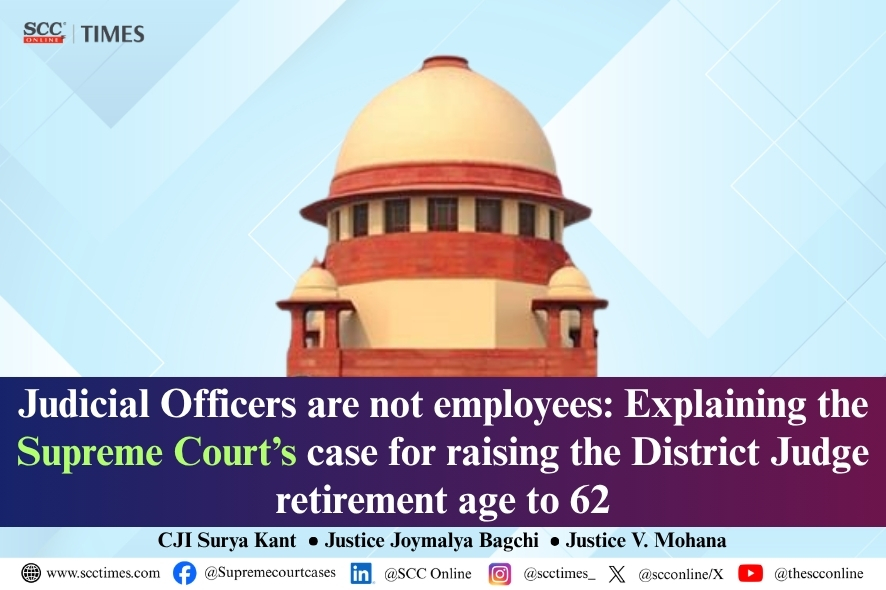
India Supreme Court: Advocates District Judge Retirement Age 62
Summary
- India's Supreme Court has raised the retirement age for District Judges to 62.
- This decision is based on a "balanced approach" aimed at retaining experienced judicial officers.
- The Court also seeks to prevent stagnation by making way for new talent within the judiciary.
- A key aspect of the ruling is the clarification that judicial officers are not considered "employees."
What Happened
A foundational aspect of the Supreme Court's reasoning, which informs its approach to judicial service conditions, is the explicit declaration that 'Judicial Officers are not employees.'
India's Supreme Court has issued a significant ruling concerning the service conditions of District Judges, specifically addressing their retirement age. The Court has clarified its position, advocating for an enhancement of the District Judge retirement age to 62. This decision is rooted in a carefully articulated "balanced approach" to judicial administration, reflecting a strategic vision for the Indian judiciary.
The Court's rationale for this adjustment is multifaceted, aiming to simultaneously achieve two critical objectives. The first objective behind this strategic move is the "preservation of experienced judicial officers," seeking to retain valuable institutional knowledge and expertise within the judicial system. Concurrently, the second objective is to prevent stagnation and ensure dynamism within the ranks, which involves "removing the clog of deadwood" and thereby facilitating the "entrance of young blood invigorating the system." This dual focus underscores the Court's commitment to both continuity and renewal.
Legal Context
A foundational aspect of the Supreme Court's reasoning, which informs its approach to judicial service conditions, is the explicit declaration that "Judicial Officers are not employees." This distinction is pivotal, setting judicial officers apart from conventional government employees and implying a unique constitutional and functional status. This classification suggests that the terms and conditions of judicial service, including the IN judiciary age limit, are to be considered through a lens distinct from standard employment regulations.
The Supreme Court India judicial service conditions are thus framed by this understanding of judicial officers as holding a special position. This legal perspective allows the Court to implement measures like the enhancement of District Judges retirement age, not as a mere administrative adjustment, but as a recognition of the specialized nature of judicial work and the imperative to maintain an independent and effective judiciary. The "not employees" status provides a legal basis for the judiciary to determine its own operational parameters, distinct from the executive or legislative branches' purview over general public service.
Why It Matters
The Supreme Court's decision to raise the District Judge retirement age to 62 carries substantial implications for the Indian judicial system. Primarily, it ensures the continued availability of experienced jurists, potentially bolstering the capacity of district courts to handle complex caseloads and maintain judicial quality. The "preservation of experienced judicial officers" directly addresses concerns about the loss of expertise due to earlier retirements, thereby strengthening the judicial infrastructure across India.
Furthermore, the Court's emphasis on a "balanced approach" highlights a strategic vision for the judiciary that seeks to reconcile the need for seasoned wisdom with the imperative for fresh perspectives. By simultaneously aiming to "remove the clog of deadwood" and facilitate the "entrance of young blood invigorating the system," the ruling signals a proactive stance on judicial reform and efficiency. This clarification regarding the judicial officers not employees India status could also influence future discussions on judicial independence, remuneration, and overall service structure, reinforcing the unique and vital role of the judiciary within the constitutional framework.
Practical Implications
This Supreme Court ruling extends the tenure of experienced District Judges in India, potentially influencing judicial capacity and the handling of cases. Lawyers should be aware of the clarified legal status of judicial officers as 'not employees,' which could impact future litigation concerning judicial service conditions and appointments.
Source
Source: Original reporting via SCC Times
How does this affect you?
Get an AI analysis of this article grounded in your jurisdictions, practice areas, and any policy documents you've uploaded to Wansom.
Finish Reading the Full Story and the Expert Analysis.
Wansom is AI and can make mistakes.