
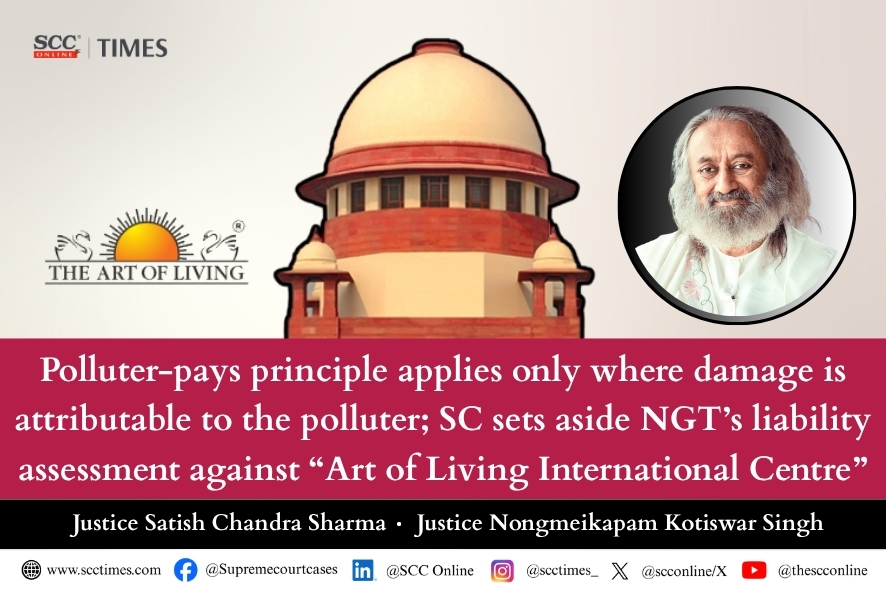
India SC Art of Living Liability: NGT Order Set Aside, Causal Link Key
Summary
- The Supreme Court of India clarified the application of the polluter-pays principle.
- The Court ruled that merely observing environmental degradation is insufficient for imposing liability.
- A direct causal connection between an alleged polluter's actions and environmental damage must be established.
- This decision set aside a liability assessment by the National Green Tribunal against the Art of Living International Centre.
What Happened
The Court explicitly articulated that for the polluter-pays principle to be legitimately applied, an undeniable causal connection must be unequivocally demonstrated between the specific conduct or actions of the alleged polluter and the precise environmental damage that has been observed.
The Supreme Court of India has recently issued a pivotal ruling that significantly redefines the parameters for assigning environmental liability, directly impacting the Art of Living International Centre. This landmark decision saw the nation's highest court set aside a substantial liability assessment that had previously been levied against the spiritual and humanitarian organization. The original assessment, which the Supreme Court has now overturned, stemmed from a determination made by the National Green Tribunal (NGT). This judicial intervention by the Supreme Court serves to clarify the stringent conditions under which the widely recognized polluter-pays principle can legitimately be invoked within India's legal framework.
Legal Context: The Polluter-Pays Principle in India
The polluter-pays principle stands as a foundational tenet of environmental jurisprudence in India, designed to ensure that entities responsible for ecological harm bear the financial burden of its restoration and remediation. This principle has historically served as a critical tool for holding various actors accountable for environmental degradation. However, the Supreme Court's latest pronouncement introduces a crucial and precise refinement to its practical implementation. The ruling emphatically states that the mere observation or existence of environmental degradation, in isolation, is not sufficient grounds to automatically impose liability under this principle. This clarification aims to foster a more accurate, equitable, and evidence-based application of environmental law throughout the country.
Clarifying Evidentiary Standards for Liability
A central and defining aspect of the Supreme Court's judgment is its unwavering insistence on the establishment of a clear and direct causal link. The Court explicitly articulated that for the polluter-pays principle to be legitimately applied, an undeniable causal connection must be unequivocally demonstrated between the specific conduct or actions of the alleged polluter and the precise environmental damage that has been observed. This mandate implies that the burden of proof in such cases now requires more than simply identifying the presence of harm; it demands robust, demonstrable evidence that directly links a party's activities to that particular harm. This judicial clarification effectively sets a significantly higher evidentiary bar for the successful prosecution of environmental liability claims.
Broader Implications for Environmental Litigation
This Supreme Court ruling carries substantial and far-reaching implications for environmental liability cases across the entirety of India. By setting aside the National Green Tribunal's assessment against the Art of Living International Centre, the Court has unequivocally underscored that the mere existence of environmental degradation does not, by itself, automatically trigger the application of the polluter-pays principle. Instead, parties seeking to impose such liability must now present meticulously gathered and robust evidence that conclusively proves a direct causal relationship between the alleged polluter's actions and the environmental harm. This judicial clarification reinforces the critical need for thorough investigation and stringent evidentiary rigor in all future environmental damage claims, thereby ensuring that liability is attributed only in instances where a clear and undeniable link to the polluter's specific actions can be comprehensively demonstrated.
Practical Implications
This ruling clarifies the stringent evidentiary requirements for applying the polluter-pays principle in India, mandating a clear causal link between a party's actions and environmental damage. Lawyers should advise clients that defending against environmental liability claims now requires robust evidence to disprove direct attribution, and prosecuting such claims demands meticulous proof of causation.
Source
How does this affect you?
Get an AI analysis of this article grounded in your jurisdictions, practice areas, and any policy documents you've uploaded to Wansom.
Finish Reading the Full Expert Analysis.
Wansom is AI and can make mistakes.