
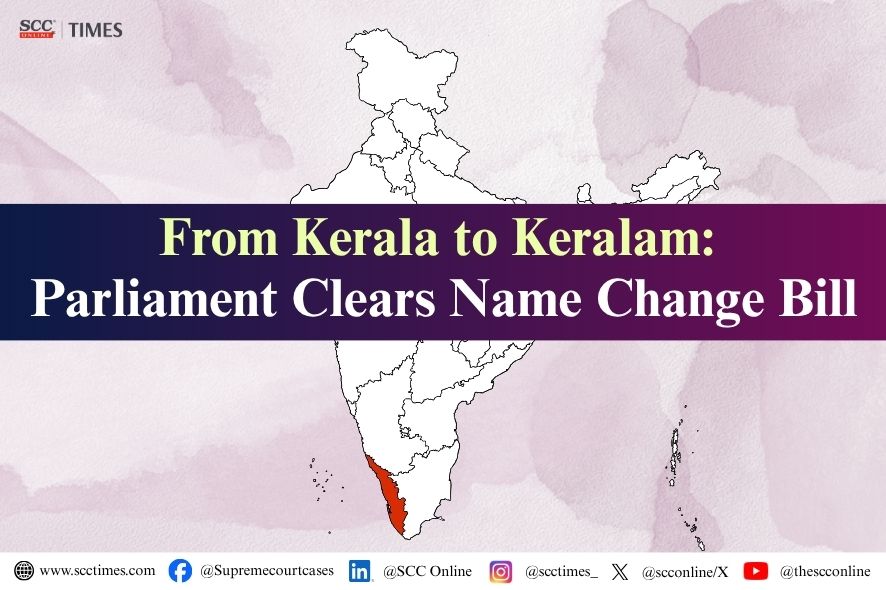
Parliament Passes Kerala (Alteration of Name) Bill 2026: State Renamed Keralam
Summary
- Parliament has passed the Kerala (Alteration of Name) Bill, 2026, which now awaits Presidential assent.
- This legislation aims to formally establish ‘Keralam’ as the official name of the state.
- The bill mandates consequential amendments to the Constitution of India.
- It also requires corresponding changes to be made across all existing laws.
A New Identity for Kerala
The formal adoption of ‘Keralam’ as the state’s official name, as facilitated by the Kerala (Alteration of Name) Bill, 2026, carries significant weight beyond its immediate legal and administrative requirements.
Parliament has recently passed a significant piece of legislation, the Kerala (Alteration of Name) Bill, 2026, which sets in motion the formal process for renaming the southern Indian state. This legislative action represents a pivotal step towards officially adopting ‘Keralam’ as the state’s designated name. The passage of this bill by both houses of India’s Parliament underscores a clear intent to formalize a new identity for the region within the national framework, and it now awaits Presidential assent.
The primary objective of the Kerala (Alteration of Name) Bill, 2026, extends beyond a simple nomenclature change. It is designed to ensure that the transition to ‘Keralam’ is comprehensive and legally sound across all governmental and constitutional strata. This includes provisions for necessary adjustments to the foundational legal document of the nation, the Constitution, as well as a wide array of existing statutes and regulations that currently reference the state by its former name. The legislative journey of this bill through both houses of Parliament marks a critical juncture in the state’s administrative and symbolic evolution.
Navigating Legal and Constitutional Changes
The implications of the Kerala (Alteration of Name) Bill, 2026, are far-reaching, particularly concerning the intricate web of India's legal and constitutional framework. The bill explicitly mandates consequential amendments to the Constitution, a process that requires careful legislative deliberation and approval. Such amendments would likely involve updating references to the state's name in various schedules and articles where states are listed or their jurisdictions defined, ensuring that the supreme law of the land reflects the newly adopted nomenclature of ‘Keralam’. This is not merely a cosmetic change but a fundamental legal adjustment.
Beyond the Constitution, the legislation also necessitates widespread alterations to existing laws. This encompasses a vast spectrum of statutes, ordinances, rules, and notifications enacted at both the central and state levels over decades. Every piece of legislation that currently refers to "Kerala" will require review and amendment to substitute it with "Keralam." This monumental task ensures legal consistency and avoids ambiguity in the application of laws, affecting everything from administrative procedures and judicial pronouncements to public services and official documentation. The legislative machinery must now prepare for the extensive work involved in harmonizing the entire legal landscape with the new official name.
The Broader Significance of Formal Adoption
The formal adoption of ‘Keralam’ as the state’s official name, as facilitated by the Kerala (Alteration of Name) Bill, 2026, carries significant weight beyond its immediate legal and administrative requirements. A state’s name is often deeply intertwined with its cultural heritage, historical identity, and linguistic roots. The legislative move to formalize this change through parliamentary action underscores the importance of aligning official nomenclature with what may be a long-standing or preferred local designation. This process, initiated by Parliament, reflects a deliberate effort to solidify a particular identity at the highest levels of governance.
The act of formally adopting a new name for a state, and subsequently amending the Constitution and existing laws, is a profound statement of self-identification and regional distinctiveness. It impacts how the state is perceived both domestically and internationally, influencing everything from official correspondence and geographical references to cultural representation and tourism branding. The comprehensive nature of the bill, addressing both constitutional and statutory changes, highlights the thoroughness required to effect such a fundamental shift, ensuring that the new name ‘Keralam’ is seamlessly integrated into every facet of public life and legal recognition.
Source
How does this affect you?
Get an AI analysis of this article grounded in your jurisdictions, practice areas, and any policy documents you've uploaded to Wansom.
Wansom is AI and can make mistakes.