
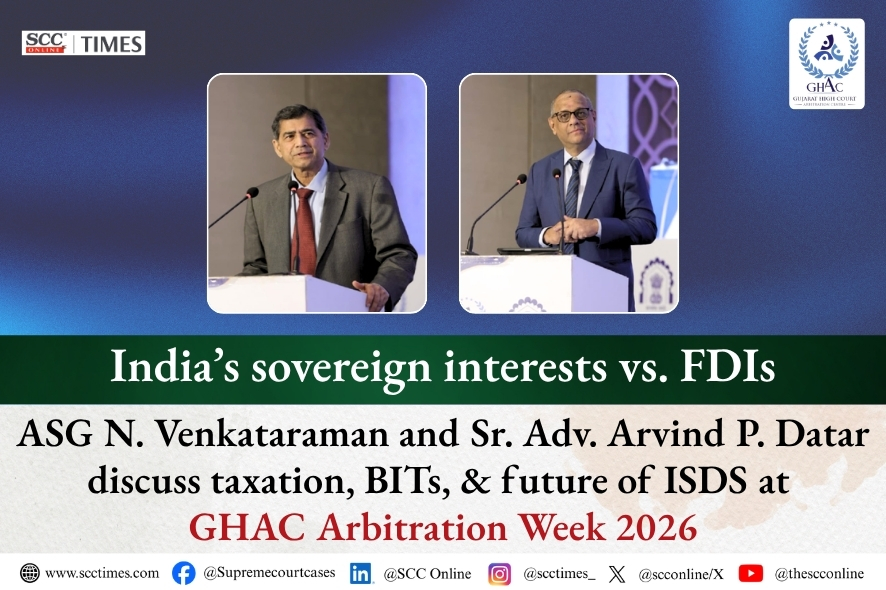
India: Venkataraman, Datar Address ISDS, Retrospective Taxation
Summary
- The GHAC Arbitration Week 2026 featured discussions on India's sovereign interests versus foreign direct investments.
- Additional Solicitor General N. Venkataraman and Senior Advocate Arvind P. Datar were key speakers at the event.
- Topics included retrospective taxation, Bilateral Investment Treaties, foreign investments, and the future of Investor-State Dispute Settlement.
- The discussions provide insight into India's evolving legal and policy landscape concerning international investment.
- The event was organized by the Gujarat High Court Arbitration Centre and the Gujarat High Court.
Key Discussions at GHAC Arbitration Week 2026
The views expressed by high-ranking officials like ASG Venkataraman are crucial for anticipating future legal developments and understanding India's evolving stance on sovereign interests versus FDI.
The Gujarat High Court Arbitration Centre (Domestic & International), in conjunction with the Gujarat High Court, recently hosted the GHAC Arbitration Week 2026, a significant event for legal professionals and policymakers. A central focus of the week's discussions revolved around the intricate balance between India's sovereign interests and the imperative of attracting foreign direct investment (FDI).
Prominent legal figures, including Additional Solicitor General of India Mr. N. Venkataraman and Senior Advocate Mr. Arvind P. Datar, led critical conversations during the event. Their dialogue spanned several contentious and evolving areas of international economic law, underscoring the complexities inherent in India's approach to global commerce and dispute resolution. The presence of such high-ranking legal experts highlighted the gravity of the topics under consideration.
Navigating India's Investment Landscape
Among the key subjects addressed were retrospective taxation, the framework of Bilateral Investment Treaties (BITs), and the broader landscape of foreign investments in India. These discussions are particularly pertinent given India's historical stance on certain tax policies and its evolving approach to international investment agreements. The interplay between these elements directly influences the confidence of foreign investors and the perceived stability of the regulatory environment.
Furthermore, the future of Investor-State Dispute Settlement (ISDS) mechanisms formed a crucial part of the agenda. The debate surrounding ISDS, often a point of contention between host states and foreign investors, reflects India's ongoing efforts to refine its legal architecture for handling international investment disputes. The perspectives offered by N. Venkataraman, ASG India, and Arvind P. Datar on ISDS are vital for understanding the potential trajectory of India's policy in this area.
Implications for Foreign Investment and Dispute Resolution
The insights shared by ASG N. Venkataraman and Senior Advocate Arvind P. Datar at the GHAC Arbitration Week 2026 carry substantial weight for the legal and investment communities. Their engagement on topics such as retrospective taxation and the future of ISDS signals potential shifts in India's policy and legal landscape, which could significantly impact investment risk and dispute resolution strategies for foreign entities operating within the country.
Lawyers advising on foreign investments in India or involved in international arbitration should closely monitor these discussions. The views expressed by high-ranking officials like ASG Venkataraman are crucial for anticipating future legal developments and understanding India's evolving stance on sovereign interests versus FDI. The ongoing dialogue underscores the dynamic nature of India's international investment law and its commitment to shaping a robust, yet balanced, framework for global capital.
Practical Implications
Lawyers advising on foreign investments in India or involved in international arbitration should monitor these discussions, particularly regarding retrospective taxation and the future of ISDS, as they indicate potential shifts in India's policy and legal landscape affecting investment risk and dispute resolution strategies. The views expressed by high-ranking officials like ASG Venkataraman are crucial for anticipating future legal developments.
Source
Source: Original reporting via SCC Times
How does this affect you?
Get an AI analysis of this article grounded in your jurisdictions, practice areas, and any policy documents you've uploaded to Wansom.
Finish Reading the Full Story and the Expert Analysis.
Wansom is AI and can make mistakes.