
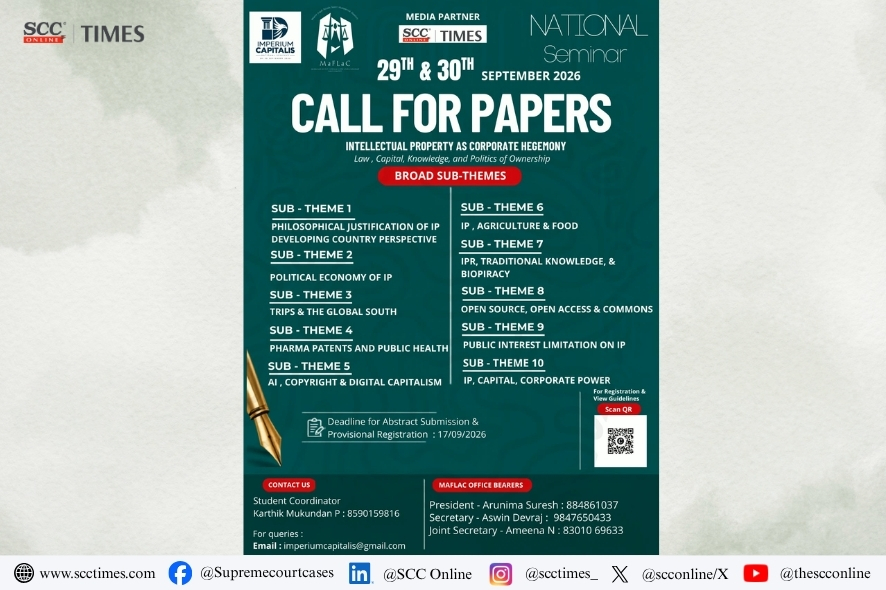
Government Law College, Kozhikode: Imperium Capitalis 2026 Call for Papers
Summary
- Government Law College, Kozhikode, has issued a call for papers for its upcoming national seminar, "Imperium Capitalis 2026."
- The seminar will focus on the theme of "Intellectual Property as Corporate Hegemony."
- It aims to critically examine the question of who owns knowledge and who is excluded from its benefits.
- Submissions for Imperium Capitalis 2026 are welcomed from students, lawyers, research scholars, and professionals.
Call for Papers Announced by Government Law College, Kozhikode
The seminar aims to foster critical discussion and analysis on who controls access to knowledge and the resulting societal implications.
Government Law College, Kozhikode, has announced a forthcoming national seminar, "Imperium Capitalis 2026," extending an invitation for academic contributions. This significant event is specifically designed to delve into the complex and often contentious relationship between intellectual property rights and corporate power structures, encapsulated by its central theme: "Intellectual Property as Corporate Hegemony." The seminar aims to foster critical discussion and analysis on who controls access to knowledge and the resulting societal implications.
The institution's call for papers for Imperium Capitalis 2026 is directed at a broad spectrum of participants, encouraging submissions from students, practicing lawyers, dedicated research scholars, and various professionals. This inclusive approach seeks to gather diverse perspectives on the seminar's core inquiry, which challenges conventional understandings of knowledge ownership. By engaging a wide array of stakeholders, the Government Law College, Kozhikode, intends to facilitate a comprehensive examination of the mechanisms that determine who benefits from intellectual creations and who might be excluded from their advantages.
Legal and Economic Context of Intellectual Property
The concept of intellectual property (IP) forms the bedrock of modern innovation and economic growth, granting creators exclusive rights over their inventions, artistic works, and brand identifiers. However, the seminar's theme, "Intellectual Property as Corporate Hegemony," points to a critical examination of how these legal frameworks, originally conceived to incentivize creativity, can sometimes concentrate power within large corporations. This concentration can lead to a situation where a select few entities exert significant control over essential knowledge and technologies.
This dynamic raises profound questions about the equitable distribution of knowledge and the potential for market dominance. Intellectual property rights, including patents, copyrights, and trademarks, are powerful tools that can shape industries and influence public access to vital resources, from pharmaceuticals to digital content. The seminar's focus on "corporate hegemony" implies an exploration of how these rights, when wielded by powerful corporations, might inadvertently create barriers, limiting competition, stifling independent innovation, and restricting public access to crucial information or products.
Why This Discussion Matters
The national seminar, Imperium Capitalis 2026, provides a crucial platform for addressing a pressing societal question: "Who really owns knowledge, and who gets left outside the gates?" This inquiry goes to the heart of contemporary debates surrounding innovation, access, and equity. In an increasingly knowledge-driven global economy, the control and dissemination of intellectual property have far-reaching consequences for development, public health, education, and cultural expression.
By inviting students, lawyers, research scholars, and professionals to contribute, Government Law College, Kozhikode, is fostering a multidisciplinary dialogue essential for understanding and potentially reshaping the landscape of intellectual property. Such discussions are vital for identifying potential imbalances in the current IP system and exploring alternative frameworks that could promote broader access to knowledge while still incentivizing innovation. The seminar's proactive engagement with this complex issue underscores its relevance in shaping future legal and policy approaches to intellectual property.
Source
Source: Original reporting via SCC Times
How does this affect you?
Get an AI analysis of this article grounded in your jurisdictions, practice areas, and any policy documents you've uploaded to Wansom.
Finish Reading the Full Story and the Expert Analysis.
Get the latest legal & regulatory intelligence in India
Wansom is AI and can make mistakes.