
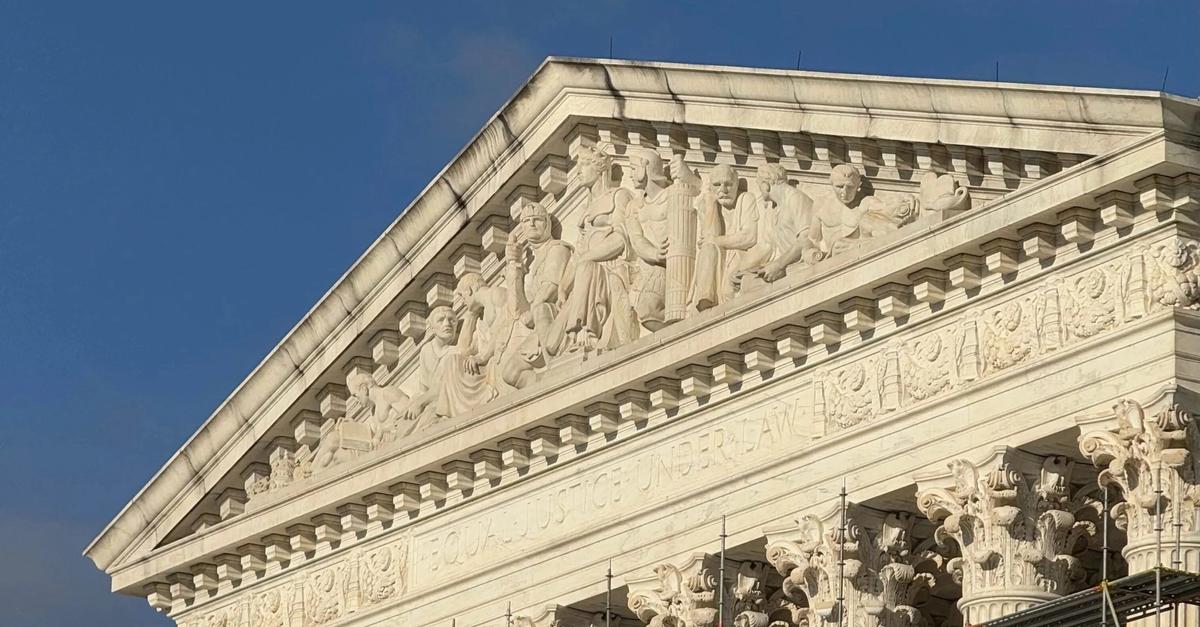
House Vote: Amendment to Cap Supreme Court at Nine Justices
Summary
- House Speaker Mike Johnson announced a vote on a constitutional amendment to cap the Supreme Court at nine justices.
- The Supreme Court is currently considering interim requests regarding political ad rates and a Michigan voting proposal.
- Following Justice Antonin Scalia's death, Supreme Court justices discussed a uniform policy for handling their working papers.
- The Supreme Court will also review plea agreements for two men accused in the 9/11 attacks this fall.
Legislative Push for Judicial Stability
House Speaker Mike Johnson announced that the chamber would hold a vote on a constitutional amendment to cap the number of justices on the Supreme Court at nine.
House Speaker Mike Johnson, a Republican from Louisiana, recently announced a significant legislative initiative aimed at preserving the current structure of the nation's highest court. Speaking to reporters on Tuesday, Speaker Johnson revealed that the House of Representatives would hold a vote on a constitutional amendment designed to permanently cap the number of justices on the Supreme Court at nine. This move is intended to solidify the court's composition, a model that has been in place for an extended period.
The Speaker, whose professional background includes constitutional law and litigation, articulated his strong opposition to proposals for expanding the Supreme Court. He specifically criticized the Democratic Socialists of America for their advocacy of "court packing," arguing that such actions would transform the judiciary into a "political palooza" and ultimately disserve the country. Johnson emphasized that the upcoming House vote, scheduled for Wednesday, would compel Democratic members to formally state their position on the issue of the court's size.
For a constitutional amendment to be adopted, it requires a two-thirds majority vote in both the House and the Senate. Following congressional approval, the proposed amendment must then be ratified by a supermajority of states. This multi-stage process underscores the high bar for altering the fundamental framework of the U.S. government, reflecting the gravity of the proposed change to the Supreme Court's long-standing nine-justice configuration.
High Court's Current Docket and Procedural Matters
Beyond the legislative efforts to define its future, the Supreme Court is actively engaged with several pressing matters on its interim docket. In one notable instance, two Republican organizations have petitioned the Court to overturn a decision by the U.S. Court of Appeals for the 4th Circuit. This appellate ruling currently prohibits political parties and joint fundraising committees from securing preferential broadcast advertising rates for their political campaigns. The Court has since requested a response to this petition by noon EDT on Thursday from the four Democratic individuals who initially challenged the groups' access to these more favorable rates.
Concurrently, another interim docket dispute involves a Michigan-based group that has formally urged the Supreme Court to mandate that Michigan election officials include a specific proposal on the November ballot. This proposal seeks to introduce a requirement for voters in the state to provide proof of citizenship. Officials in Michigan are expected to submit their response to this request by noon EDT today.
In addition to these ongoing petitions, the Supreme Court is preparing to release its third and final order list of the summer. This announcement is scheduled for Friday at 9:30 a.m. EDT, and such lists typically address a range of procedural decisions, including grants or denials of certiorari, and other administrative orders.
Preserving Judicial Legacy: The Handling of Justices' Papers
The meticulous preservation of judicial records became a critical concern for the Supreme Court following the unexpected death of Justice Antonin Scalia in February 2016. It was discovered that Justice Scalia had not made arrangements for his extensive working papers, a situation likened to a private citizen dying without a will. This revelation prompted the remaining justices to engage in private discussions aimed at preventing similar occurrences in the future and establishing a more standardized approach to managing their official documents.
Chief Justice John G. Roberts Jr. took the lead in these discussions among the surviving justices, focusing on the implementation of a more uniform protocol for sealing their papers. While a consensus was reportedly reached among the justices, individuals with knowledge of the process have offered differing recollections regarding the precise terms of the agreement and its long-term solidity.
A potential insight into the outcome of these deliberations may be gleaned from the arrangements made for Justice Ruth Bader Ginsburg's papers after her passing in 2020. Following her explicit instructions, Justice Ginsburg's documents were transferred to the Library of Congress. However, a significant condition was attached: no case file could be accessed until every justice involved in that particular matter had also died. This restriction has the potential to keep a substantial volume of documents inaccessible to the public for many decades.
9/11 Plea Agreements Reach Supreme Court
This autumn, as the nation observes the 25th anniversary of the September 11, 2001, terrorist attacks, the Supreme Court is poised to consider a pivotal issue related to the disposal of controversial plea agreements. The Court will decide whether to intervene in the efforts by Khalid Shaikh Mohammad, identified as the alleged mastermind of the 9/11 attacks, and Mustafa al-Hawsawi, one of his co-conspirators, to reinstate plea agreements. These agreements would remove the possibility of the death penalty in exchange for their admission of guilt.
The original plea agreements were seen by victims, the defendants themselves, and prosecutors as a potential pathway to closure for a case that had been significantly complicated by the government's widely criticized torture program. However, former Secretary of Defense Lloyd Austin subsequently attempted to withdraw these agreements. Despite Austin's efforts, two separate military courts ruled that his withdrawal was unlawful. The D.C. Circuit Court of Appeals has also weighed in on the matter, though the source text does not specify its full ruling. The Supreme Court's decision on whether to review these agreements will have profound implications for the long-delayed legal proceedings surrounding the 9/11 attacks.
Source
How does this affect you?
Get an AI analysis of this article grounded in your jurisdictions, practice areas, and any policy documents you've uploaded to Wansom.
Finish Reading the Full Story and the Expert Analysis.
Wansom is AI and can make mistakes.