
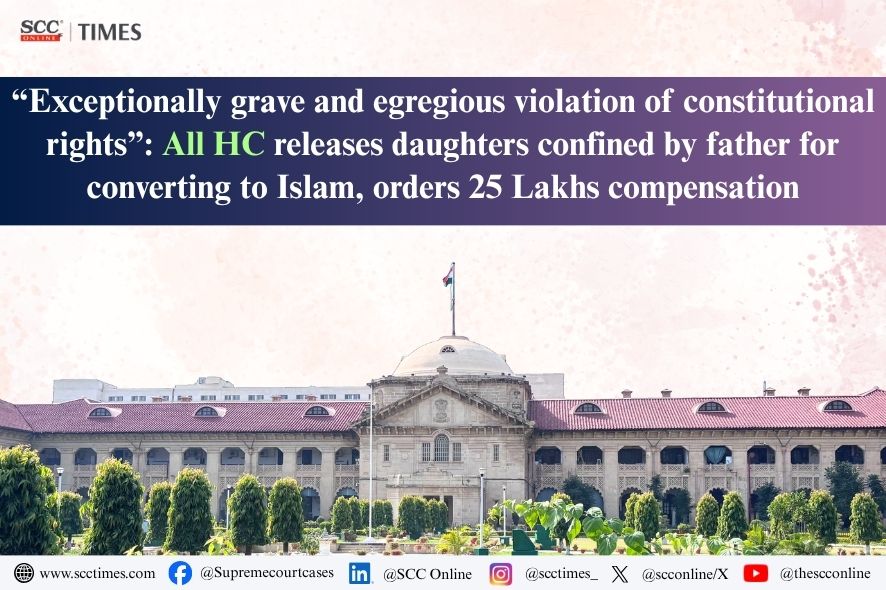
Allahabad High Court: Releases Daughters Confined by Father for Converting to Islam
Summary
- Allahabad High Court releases two adult daughters confined by their father for converting to Islam.
- Court deems confinement an 'exceptionally grave and egregious violation of constitutional rights'.
- 25 Lakhs compensation ordered for violating religious freedom.
- New precedent set for protecting adult children's constitutional rights in India.
- Lawyers should be aware of potential compliance exposures related to family members' religious choices.
Confinement and Constitutional Rights
The confinement was deemed an 'exceptionally grave and egregious violation of constitutional rights' by the court, which emphasized that adult children should be free to choose their own religion without fear of reprisal or restriction.
The Allahabad High Court has intervened in a case where two adult daughters were confined by their father for converting to Islam. Despite being major, educated, and legally competent women, they were deprived of their liberty for an extended period solely because of their exercise of constitutional freedom of conscience. The court's decision highlights the importance of protecting individual rights, particularly those related to religious freedom.
The confinement was deemed an 'exceptionally grave and egregious violation of constitutional rights' by the court, which emphasized that adult children should be free to choose their own religion without fear of reprisal or restriction.
Legal Context
This case has significant implications for Indian law regarding freedom of conscience. The court's ruling underscores the importance of upholding constitutional rights, even in cases where family members may disagree with an individual's choices. In this instance, the daughters' decision to convert to Islam was seen as a fundamental exercise of their right to freedom of conscience.
The court's emphasis on protecting adult children's constitutional rights sets a new standard for lawyers and legal professionals. They should be aware of potential compliance exposures related to family members' religious choices and advise clients accordingly.
Why It Matters
This case has far-reaching implications for the protection of individual rights in India. The court's decision sends a strong message that adult children's freedom of conscience should be respected, even if it differs from their family's beliefs. This precedent will likely influence future cases involving similar circumstances, making it essential for lawyers to understand and apply this new standard.
The compensation ordered by the court – 25 Lakhs – serves as a reminder of the tangible consequences that can result from violating constitutional rights. As such, this case highlights the importance of prioritizing individual freedoms and upholding the rule of law.
Practical Implications
Lawyers should watch for this precedent setting a new standard for protecting the constitutional rights of adult children who convert to a different religion, and consider advising clients on potential compliance exposures related to family members' religious choices.
Source
Source: Original reporting via SCC Times
How does this affect you?
Get an AI analysis of this article grounded in your jurisdictions, practice areas, and any policy documents you've uploaded to Wansom.
Wansom is AI and can make mistakes.