
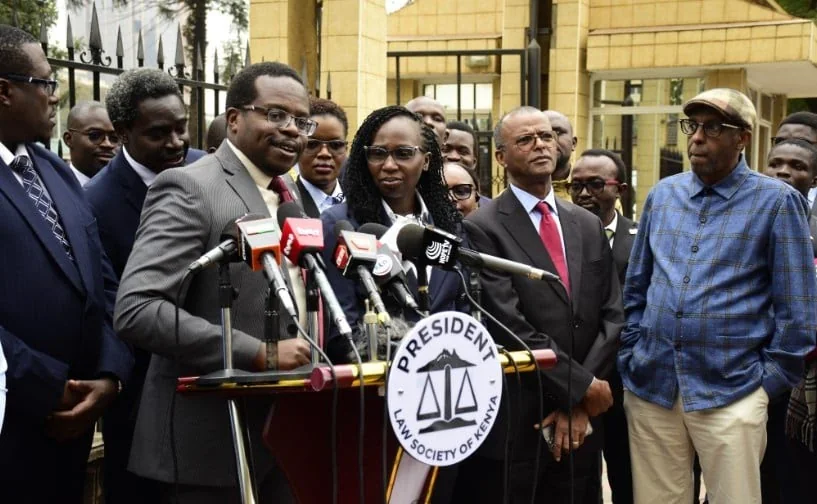
High Court Clears Path for Constitutional Challenge to LSK's Boycott of Kenya's Chief Justice and 12 Other Judicial Officers
What This Ruling Actually Decided and What It Didn't
On 17 September 2026, Justice David Mburu dismissed a preliminary objection filed by the Law Society of Kenya (LSK) seeking to stop a constitutional petition brought by Dr. Adrian Kamotho Njenga, identified in some earlier reporting simply as "lawyer Adrian Kamotho", challenging LSK's boycott of specified judges and judicial officers. This ruling is procedural, not substantive: it does not determine whether LSK's boycott is lawful or constitutional. What it does is clear the path for that question to actually be heard, by rejecting LSK's argument that the case should never have reached the High Court in the first place.
The Underlying Dispute: Why LSK Boycotted Kenya's Chief Justice
LSK's boycott, announced 22–23 July 2026, named 12 judges and one magistrate, including Chief Justice Martha Koome, Deputy Chief Justice Philomena Mwilu, four other Supreme Court justices, two Court of Appeal judges, four High Court judges, and Chief Magistrate Stella Atambo.
LSK President Charles Kanjama said the action followed months of engagement with the Judiciary, including direct meetings with Chief Justice Koome, Bar-Bench sessions, and memoranda, over concerns including alleged judicial corruption and misconduct, registry inefficiencies (delays processing documents and releasing court-held funds, poor file management, inconsistent cause lists, technology disruptions), and chronic case backlogs, with Kenyan cases reportedly taking an average of two years to conclude. The specific trigger for the targeted list, per LSK, was that the named judges and judicial officers had obtained court orders halting Judicial Service Commission (JSC) and Ethics and Anti-Corruption Commission (EACC) investigations into alleged misconduct against themselves, in effect, LSK's position was that these judicial officers used their own judicial authority to block accountability proceedings against themselves.
The nationwide one-day boycott (22 July) was framed by LSK as a lawful exercise of the constitutional rights of assembly and petition (Article 37) and the right to collectively withdraw services (Article 41). Advocates were instructed not to participate in routine hearings during the boycott but were told to continue filing documents to avoid missing statutory deadlines. The subsequent, indefinite targeted boycott (from 23 July) went further: advocates were directed to refrain from appearing before the 13 named judicial officers at all, except to seek new hearing dates or extend existing interim orders, and to actively seek adjournments, transfers, or recusal in matters before them.
The Kenya Magistrates and Judges Association (KMJA) publicly urged LSK to reconsider before the boycott began, and the Judiciary maintained throughout that all courts remained open and operational, with the Judicial Service Commission separately telling the court during the August conservatory-orders hearing that judges and magistrates had been carrying out their duties "under fear" because of the ongoing dispute.
The Court's Timeline
3 August 2026: Justice Mburu issued interim conservatory orders restraining LSK from disrupting or interfering with proceedings before the named judicial officers, or any other judge, pending determination of LSK's preliminary objection to the court's jurisdiction. The judge said the orders were necessary "to restore order within the Judiciary" and ensure uninterrupted court operations. These orders were set to run until 17 September 2026. Some contemporaneous reporting indicated LSK maintained its boycott remained active in some respect even after these orders were issued, we found this in headline-level coverage and were not able to confirm the full details or LSK's precise position on compliance, and flag it as something worth verifying directly rather than treating as fully established.
17 September 2026: Justice Mburu dismissed LSK's preliminary objection outright, and per the specific quoted language, ruled: "The preliminary objection by the respondent (LSK) lacks merit. The same is hereby dismissed. The petition and the notice of motion dated July 24, 2026 by Lawyer Kamotho shall proceed to determination on their respective merits." The court simultaneously extended the interim conservatory orders restraining LSK, pending full determination of the underlying petition and conservatory-orders application. Costs of the preliminary objection will be determined alongside the outcome of the full petition.
The Legal Reasoning, Precisely
LSK's core argument was jurisdictional: that Njenga had failed to first exhaust internal dispute resolution mechanisms, negotiation, conciliation, mediation, and arbitration, available under Regulations 95 and 96 of the Law Society of Kenya (General) Regulations, 2020, and that the High Court therefore lacked jurisdiction to hear the matter at all.
Justice Mburu accepted that exhaustion is, in principle, a legitimate jurisdictional issue that can properly be raised through a preliminary objection — but found it did not apply here. His reasoning rested on several distinct points: the dispute "transcends an ordinary internal disagreement between a member and the society," instead raising questions of judicial independence, administration of justice, and the constitutional rights of advocates, litigants, court users, judges, and judicial officers collectively; an arbitrator operating under Regulation 96 would have no jurisdiction to determine constitutional questions or grant the full range of constitutional remedies sought; and the doctrine of constitutional avoidance is a principle of judicial restraint, not a rule that strips the High Court of its constitutional jurisdiction — meaning LSK could not use it to argue the case shouldn't have been brought as a constitutional matter at all. The judge also declined to resolve, at this preliminary stage, whether LSK's actions were legitimate internal governance decisions or exceeded its statutory mandate, holding that this requires examining the substance and effect of the actual resolutions and communications — a merits question, not a threshold one. On standing, the court found Njenga had sufficient standing under Articles 22 and 258 of the Constitution, which provide broad standing for persons acting in the public interest, not only for those directly and personally affected.
Separately, the court declined to rule on the substance of Njenga's conservatory-orders application at this stage, holding that questions of prima facie case, real prejudice, whether the petition could be rendered nugatory without interim relief, and where the public interest lies all require examining evidence and exercising judicial discretion — matters that cannot be resolved through a preliminary objection confined to pure points of law.
Compliance Implications / What This Means for Businesses and Legal Teams
Who must act, and what specifically changes: Nothing changes for parties outside this specific dispute. LSK must continue complying with the extended conservatory orders. For any business or individual with active litigation before the 13 named judicial officers specifically, or before Kenyan courts generally, the practical situation — courts remaining formally open, with the boycott's disruptive effect judicially restrained — continues as it has since 3 August.
Operational exposure for litigants: Companies and individuals with pending Kenyan litigation should treat this as an ongoing situational risk to monitor rather than a resolved matter. The underlying boycott dispute is unresolved; only the preliminary jurisdictional question has been decided. If LSK's boycott is ultimately found unconstitutional, current disruption should ease; if any part of it is upheld, businesses with matters before the affected judicial officers could face continued adjournment or recusal-related delay risk, depending on how compliant advocates continue to be with the boycott directive during the litigation.
Realistic timeline: No date for the full merits hearing was specified in available reporting — this is the most important open scheduling question for anyone tracking this case and should be confirmed directly with the court registry or case parties.
What remains uncertain or pending: Whether LSK's boycott — either the original one-day nationwide action or the ongoing targeted boycott of the 13 named officers — will ultimately be found constitutional is entirely undecided by this ruling. Whether LSK has in fact been complying with the conservatory orders since 3 August is unclear from available reporting and worth direct verification. The underlying JSC/EACC investigations LSK cited as its trigger, and the court orders LSK says blocked them, were not detailed with case-level specificity in available sourcing.
Frequently Asked Questions
Did the High Court rule that LSK's boycott is illegal? No. This ruling only addresses whether the case can proceed in the High Court at all. LSK argued it should first go through internal arbitration; the court rejected that argument and allowed the constitutional petition to continue. Whether the boycott itself is lawful is a separate question still to be decided at a full hearing.
Why did LSK boycott the Chief Justice and other judges in the first place? LSK said the targeted 13 judicial officers had obtained court orders halting JSC and EACC investigations into alleged misconduct or corruption against themselves, on top of broader, longer-standing concerns about judicial accountability, registry inefficiencies, and case backlogs that LSK said months of Bar-Bench engagement had failed to resolve.
Who is the petitioner challenging LSK's boycott? Dr. Adrian Kamotho Njenga, an advocate, filed the constitutional petition arguing that LSK's boycott is unconstitutional, undermines judicial independence, and sets a dangerous precedent by creating the impression that lawful court orders can be overridden through a boycott.
Is LSK currently required to stop its boycott? Interim conservatory orders restraining LSK from disrupting or interfering with court proceedings have been in force since 3 August 2026 and were extended by this ruling, pending the full hearing. Whether LSK has been fully complying is not entirely clear from available reporting.
What happens next in this case? The petition and Njenga's separate application for conservatory orders will both proceed to a full hearing on their merits. No specific date for that hearing was confirmed in available sourcing.
Does this ruling affect ongoing cases before the 13 named judicial officers? Not directly — it addresses only the LSK-Njenga dispute's procedural posture. However, the extended restraining orders mean LSK remains barred from directing or facilitating disruption of proceedings before those officers, or any other judge, while the case continues.
Citations
- 1.Original reporting on the 17 September ruling: Citizen Digital, "High Court extends orders restraining LSK from disrupting proceedings"; Uzalendo News, "High Court Dismisses LSK Preliminary Objection in Lawyers Protest Case" (confirms case number HCCHRPET E501/2026); The Standard, "Blow to LSK as court rejects bid to strike out petition challenging judges' boycott" (source of the direct quoted ruling language).
- 2.The 3 August 2026 initial conservatory orders and JSC's "working under fear" statement: Kenyans.co.ke, "High Court Halts LSK Boycott of Judges Pending Case Hearing"; allAfrica; Capital FM Kenya; The Eastleigh Voice.
- 3.The full list of 13 targeted judicial officers, including Chief Justice Koome and DCJ Mwilu, and the JSC/EACC investigation trigger: Daily Nation, "LSK names 12 judges, one magistrate facing indefinite court boycott"; Africa Legal; The Kenya Times.
- 4.Background on the boycott's stated rationale, LSK President Charles Kanjama's statements, and the constitutional basis claimed (Articles 37 and 41): People Daily, "LSK President Charles Kanjama confirms start of nationwide court boycott"; Pulse Kenya; TRT Afrika.
- 5.Njenga's specific legal argument (that the boycott sets a precedent that lawful court orders can be overturned by boycott): People Daily, "High Court bars LSK from disrupting court proceedings".
- 6.The report of LSK maintaining the boycott despite court orders is sourced to a headline-level snippet from The Eastleigh Voice and was not independently confirmed in full; we flag this as unverified in the article body.
Finish Reading the Full Story and the Expert Analysis.
Get the latest legal & regulatory intelligence in Kenya
Wansom is AI and can make mistakes.