
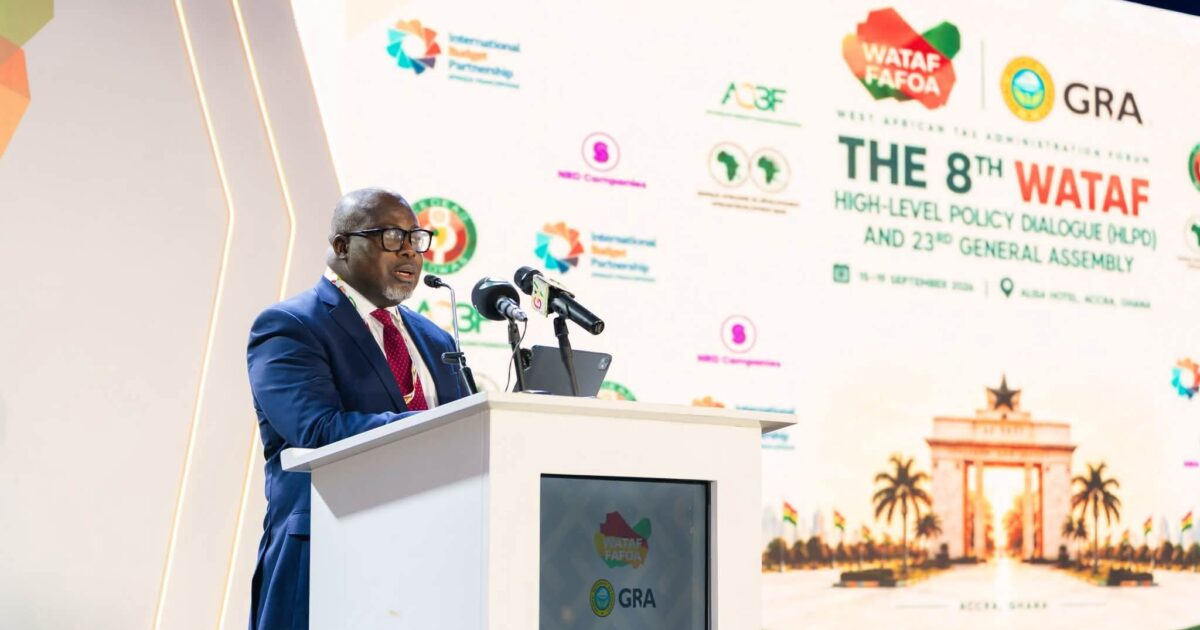
GRA Commissioner-General: Calls for Enhanced WATAF Tax Cooperation
Summary
- GRA Commissioner-General Anthony Kwasi Sarpong called for enhanced tax cooperation among African administrations to boost revenue and sustainable development.
- His call was made at the 8th High-Level Policy Dialogue and 23rd General Assembly of the West African Tax Administration Forum (WATAF) in Accra.
- Sarpong urged tax authorities to broaden tax bases, formalize informal economies, improve natural resource revenue management, and strengthen African tax information exchange.
- He advocated for greater Ghana tax technology adoption, including e-filing, e-payment, digital invoicing, data analytics, and artificial intelligence, to improve compliance and detect evasion.
- The Commissioner-General emphasized that stronger collaboration, technological innovation, and robust institutions are critical for improving regional revenue mobilisation.
Call for Enhanced Regional Tax Cooperation
The Commissioner-General concluded his Anthony Kwasi Sarpong tax call by asserting that a combination of stronger collaboration, continuous technological innovation, and the establishment of robust institutions are absolutely critical for significantly improving revenue mobilisation efforts across the entire West African region.
Anthony Kwasi Sarpong, the Commissioner-General of the Ghana Revenue Authority (GRA), recently issued a significant call for increased collaboration among tax administrations across Africa. His appeal centered on the urgent need to bolster domestic revenue mobilisation and foster sustainable development throughout the continent. This pivotal message was delivered during the opening of the 8th High-Level Policy Dialogue and the 23rd General Assembly of the West African Tax Administration Forum (WATAF), an event co-hosted by the GRA and WATAF in Accra.
The Commissioner-General highlighted the escalating financial pressures confronting governments within the sub-region. These administrations are grappling with expanding public financing requirements and heightened debt vulnerabilities, driven by growing demands for critical infrastructure, social investments, climate adaptation initiatives, and digital transformation efforts. Mr. Sarpong underscored that despite West Africa experiencing real gross domestic product growth of 4.8 percent in 2025, with projections indicating a 4.6 percent growth in 2026, the region continues to face a substantial development financing deficit.
The overarching theme of the Accra meeting, "Building Stronger Tax Administrations for Revenue Mobilisation and Sustainable Development," directly reflected the urgency of Mr. Sarpong's message. He stressed that African nations must effectively, fairly, and sustainably harness their internal resources to overcome persistent development financing hurdles. This call for stronger GRA Commissioner-General WATAF tax cooperation aims to create a more robust and unified approach to fiscal management across the continent.
Strategic Imperatives for African Tax Administrations
To address these pressing challenges, Anthony Kwasi Sarpong outlined several strategic imperatives for tax administrations. He specifically urged authorities to broaden their tax bases, integrate activities from the informal economy into the formal sector, and enhance the management of revenues derived from natural resources. A critical component of this strategy involves strengthening African tax information exchange among jurisdictions, facilitating a more comprehensive and transparent approach to taxation.
Mr. Sarpong emphasized that robust and equitable tax systems are fundamental to establishing state capacity and reinforcing the social contract between citizens and their governments. He articulated that a tax administration perceived as fair and trustworthy can significantly contribute to economic development and boost overall business confidence within a region. These measures are crucial for West African nations to close their development financing gaps and achieve long-term economic stability.
The Role of Technology and Institutional Strength
A cornerstone of the Commissioner-General's vision for improved Ghana regional revenue mobilisation involves the aggressive deployment of advanced technology. Mr. Sarpong advocated for the widespread adoption of tools such as e-filing, e-payment systems, and digital invoicing. Furthermore, he called for greater integration of data analytics and artificial intelligence (AI) within tax operations, signaling a push for significant Ghana tax technology adoption.
The rationale behind this technological push is multifaceted: these innovations are expected to enhance tax compliance, improve the detection of tax evasion, and ultimately contribute to broadening the tax base. Beyond technology, Mr. Sarpong also stressed the indispensable need for tax administrations to cultivate strong institutions. He specified that these institutions must be firmly rooted in principles of professionalism, meritocracy, integrity, accountability, and transparency. The Commissioner-General concluded his Anthony Kwasi Sarpong tax call by asserting that a combination of stronger collaboration, continuous technological innovation, and the establishment of robust institutions are absolutely critical for significantly improving revenue mobilisation efforts across the entire West African region.
Practical Implications
Lawyers and compliance officers should advise clients operating in Ghana and West Africa to prepare for a more integrated and technologically advanced tax administration landscape. Increased regional cooperation and the deployment of AI and data analytics by tax authorities will likely lead to enhanced scrutiny, more efficient detection of evasion, and a need for businesses to adapt to new digital compliance processes and cross-border information sharing.
Source
How does this affect you?
Get an AI analysis of this article grounded in your jurisdictions, practice areas, and any policy documents you've uploaded to Wansom.
Finish Reading the Full Story and the Expert Analysis.
Get the latest legal & regulatory intelligence in Ghana
Wansom is AI and can make mistakes.