
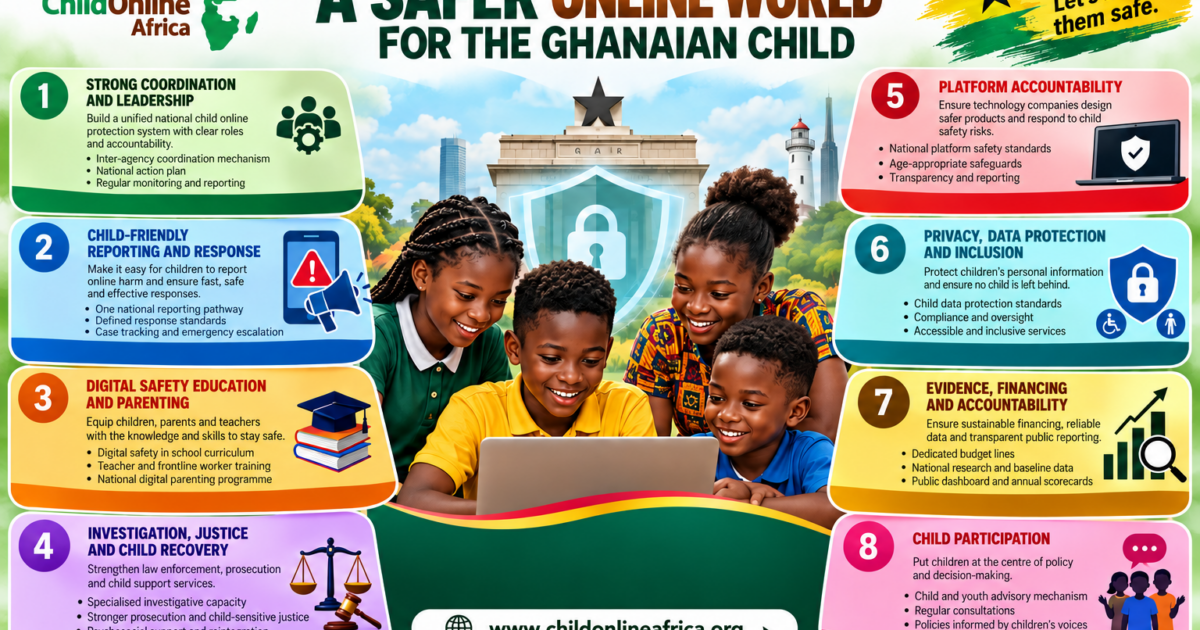
Ghana: Child Online Protection Framework Efficacy Tested
Summary
- Ghana has established foundational elements for child online protection, including specific laws and frameworks.
- The Cybersecurity Act, 2020 (Act 1038) criminalizes key forms of online child sexual exploitation.
- Numerous stakeholders, from government agencies to civil society organizations, contribute to digital child safety efforts in Ghana.
- The primary challenge is whether these efforts form a connected, measurable, and sufficiently rapid system against evolving digital threats.
- Modern childhood is inherently digital, requiring protection systems specifically designed for online environments rather than traditional physical spaces.
Ghana's Digital Child Protection Efforts Under Scrutiny
The digital environment must now be treated as a core domain of childhood, necessitating the development of protection systems specifically engineered for this new reality.
Ghana has established significant foundational elements aimed at safeguarding children in the online realm. However, a crucial question arises regarding the collective efficacy of these foundations: do they constitute a cohesive system capable of operating at the speed, scale, and sophistication demanded by the contemporary digital world children now inhabit? The answer to this complex query is not straightforward.
Far from being passive, Ghana is actively engaged in addressing these challenges. A diverse array of stakeholders contributes to the nation's digital child safety initiatives. These include the Cyber Security Authority, through its Safer Digital Ghana campaign, UNICEF Ghana, the Commission on Human Rights and Administrative Justice (CHRAJ), the Data Protection Commission, and the Ghana Police Service. Additionally, schools, technology companies, and various civil-society organizations, such as Child Online Africa, all play a role in these efforts. The core issue, therefore, is not a lack of dedicated effort, but rather whether these numerous contributions are sufficiently connected, measurable, and agile enough to meet evolving threats.
Legal and Policy Foundations
Central to Ghana's child online protection framework are specific legal and policy instruments designed to create a safer digital environment. The Cybersecurity Act, 2020 (Act 1038), for instance, plays a pivotal role by criminalizing key forms of online child sexual exploitation, providing a critical legal deterrent against such abuses. This legislation forms a cornerstone of the nation's response to digital threats against minors.
Further reinforcing these efforts, the National Child Online Protection Framework offers a structured architecture for coordinating and guiding the various initiatives. This framework is intended to provide a comprehensive blueprint for how different entities can work together to enhance digital child safety in Ghana. Together, these legal and policy foundations represent important building blocks in the nation's commitment to protecting its youngest citizens online.
The Shifting Landscape of Childhood and Risk
The nature of childhood has fundamentally transformed, with the digital environment now serving as a core domain of children's lives. What once constituted a physical playground now extends to social-media platforms. Classrooms frequently spill over into WhatsApp groups and various online learning tools, while entertainment is increasingly consumed via YouTube, TikTok, gaming sites, and streaming services. This pervasive digital presence introduces new vulnerabilities that traditional protection systems were not designed to address.
In this new landscape, the modus operandi of predators has also evolved dramatically. There is no longer a necessity for physical proximity or for an offender to enter a specific neighborhood. Instead, insidious acts such as grooming, blackmail, and sexual exploitation can commence remotely through a simple chat, a game interaction, or a direct message, even when perpetrator and victim are separated by thousands of kilometers. Traditional child-protection systems were conceived for physical spaces—the home, the school, the community—making them inherently ill-equipped to contend with the borderless and rapidly evolving threats posed by the digital world.
Reimagining Protection for a Digital Generation
Given the profound shift in how children experience the world, it is imperative that the digital environment be recognized and treated as a fundamental domain of childhood. This recognition necessitates a paradigm shift in how protection systems are conceived and implemented. Rather than adapting old models, new protection systems must be specifically engineered from the ground up to address the unique challenges and opportunities presented by the online world.
The overarching challenge for Ghana's child online protection framework remains ensuring that its existing foundations—laws, policies, and stakeholder efforts—coalesce into a truly integrated, measurable, and agile system. Such a system is vital to effectively counter the speed, scale, and sophistication of contemporary digital threats, thereby securing the well-being of children in their increasingly digital lives.
Practical Implications
Lawyers and compliance officers in Ghana should critically evaluate the effectiveness of their clients' digital child protection policies and compliance measures, recognizing that while legal foundations exist (e.g., Cybersecurity Act 2020), their practical implementation and interconnectedness may not adequately address the speed and scale of evolving online threats to children.
Source
How does this affect you?
Get an AI analysis of this article grounded in your jurisdictions, practice areas, and any policy documents you've uploaded to Wansom.
Finish Reading the Full Story and the Expert Analysis.
Get the latest legal & regulatory intelligence in Ghana
Wansom is AI and can make mistakes.