
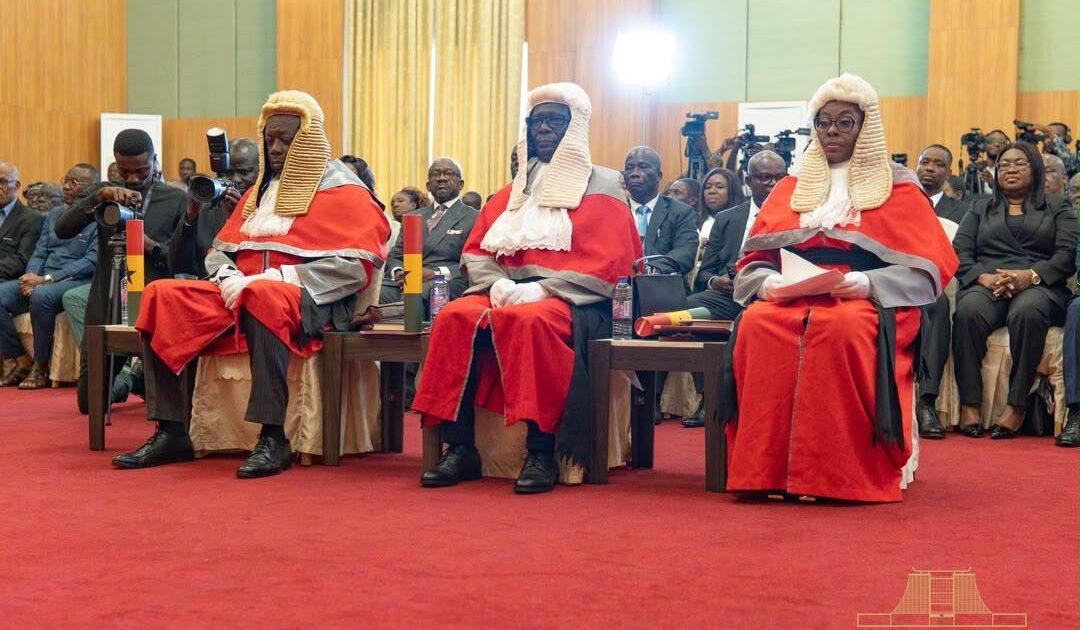
Ghana: 3 New Supreme Court Justices Sworn In, Pledge Impartiality
Summary
- Three new Supreme Court justices were sworn into office in Ghana on September 10, 2026.
- Justice Sophia Rosetta Oduokouan Bernasko-Essah spoke on behalf of her colleagues, pledging fairness, impartiality, and fidelity to the Constitution.
- The justices committed to deciding cases according to law, acting with courage and integrity, and avoiding personal preferences in legal interpretation.
- They expressed gratitude to President John Dramani Mahama for their appointments, as well as to the Judicial Council, Council of State, and Parliament for their roles.
- The new appointees also acknowledged the support and sacrifices of their families, friends, colleagues, and mentors.
Ghana's Highest Court Welcomes New Justices
We are called not to bend the law to personal preference but to interpret and apply it faithfully, impartially, and courageously.
Three new members were officially inducted into Ghana's Supreme Court on September 10, 2026, marking a significant update to the nation's highest judicial body. During a formal swearing-in ceremony, these Ghana new Supreme Court justices sworn in publicly committed to upholding the principles of fairness, impartiality, and unwavering fidelity to the Constitution in their judicial duties.
Speaking on behalf of her newly appointed colleagues, Justice Sophia Rosetta Oduokouan Bernasko-Essah articulated a profound understanding of their roles, emphasizing that judicial office is recognized as a sacred public trust. This foundational statement set the tone for the expectations placed upon the new justices as they assume their critical responsibilities within the Ghanaian legal system.
Justice Bernasko-Essah's remarks underscored the gravity of their appointments, highlighting the collective resolve to serve the nation with integrity. The ceremony not only formalized their positions but also served as a public declaration of their intent to contribute to the robust administration of justice in Ghana, reinforcing confidence in the judiciary.
Upholding Judicial Integrity and Constitutional Fidelity
The Justice Sophia Bernasko-Essah pledge outlined specific commitments crucial for maintaining the integrity of the bench. She affirmed that the new justices would approach every case with fairness and impartiality, ensuring decisions are rendered strictly according to law. Furthermore, they pledged to act with courage and integrity, remaining steadfastly faithful to both the Constitution and the Ghana judicial oath they had taken.
Crucially, Justice Bernasko-Essah stressed that personal preferences would not be permitted to influence their interpretation or application of legal statutes. She articulated a clear mandate: "We are called not to bend the law to personal preference but to interpret and apply it faithfully, impartially, and courageously." This statement reinforces the judiciary's role as an impartial arbiter of law, free from individual biases.
Moreover, the justices committed to maintaining sufficient independence to make decisions based solely on legal principles, particularly when confronted with complex or challenging cases. This commitment to judicial independence is vital for ensuring that the Supreme Court can effectively serve as the ultimate guardian of the Constitution and the rule of law in Ghana.
Acknowledging the Appointment Process
The newly appointed justices conveyed their sincere gratitude to President John Dramani Mahama for their appointments, acknowledging his pivotal role in shaping the composition of the Supreme Court. Their appreciation also extended to other key institutions involved in the rigorous selection and approval process for Ghana Supreme Court appointments.
Specifically, they recognized the Judicial Council, the Council of State, and Parliament for their respective contributions to the comprehensive appointment procedures. This collective acknowledgment highlights the multi-faceted and collaborative nature of judicial appointments within Ghana's governance framework, involving both executive and legislative oversight.
Beyond institutional recognition, the justices also expressed heartfelt thanks to their families, friends, colleagues, and mentors. They credited these personal support networks for the invaluable encouragement and sacrifices that facilitated their journey to the nation's highest court, underscoring the personal dedication required to reach such a distinguished position.
The Enduring Significance of Judicial Oaths
The public commitments made by the new justices carry substantial weight for the future direction and public perception of Ghana's judiciary. Their collective pledge to fairness, impartiality, and constitutional fidelity sets a high standard for judicial conduct and reinforces the public trust in the Supreme Court as the final arbiter of justice.
These Ghana new Supreme Court justices sworn in with a clear understanding that their decisions will profoundly impact the nation's legal landscape. The emphasis on interpreting and applying the law without personal bias, as articulated by Justice Bernasko-Essah, provides insight into the expected judicial temperament and approach to legal interpretation at this critical level. Lawyers and citizens alike will observe how these commitments translate into practice, shaping the court's jurisprudence.
The appointments by President John Dramani Mahama, coupled with the solemn oaths taken, signify not just a change in personnel but a reaffirmation of the core values underpinning Ghana's legal system. The public declaration of independence and courage in decision-making is crucial for maintaining the judiciary's role as a stable and impartial pillar of democracy.
Practical Implications
This article serves as an update on the composition of Ghana's highest court. While it doesn't introduce new legal obligations, lawyers should note the new appointments and the public commitment of the justices to fairness and constitutional fidelity, which informs the expected judicial temperament and approach to legal interpretation at the Supreme Court level.
Source
How does this affect you?
Get an AI analysis of this article grounded in your jurisdictions, practice areas, and any policy documents you've uploaded to Wansom.
Finish Reading the Full Story and the Expert Analysis.
Get the latest legal & regulatory intelligence in Ghana
Wansom is AI and can make mistakes.