
Ghana: Labour Act 651 AI Amendment Proposed for Worker Protection
Summary
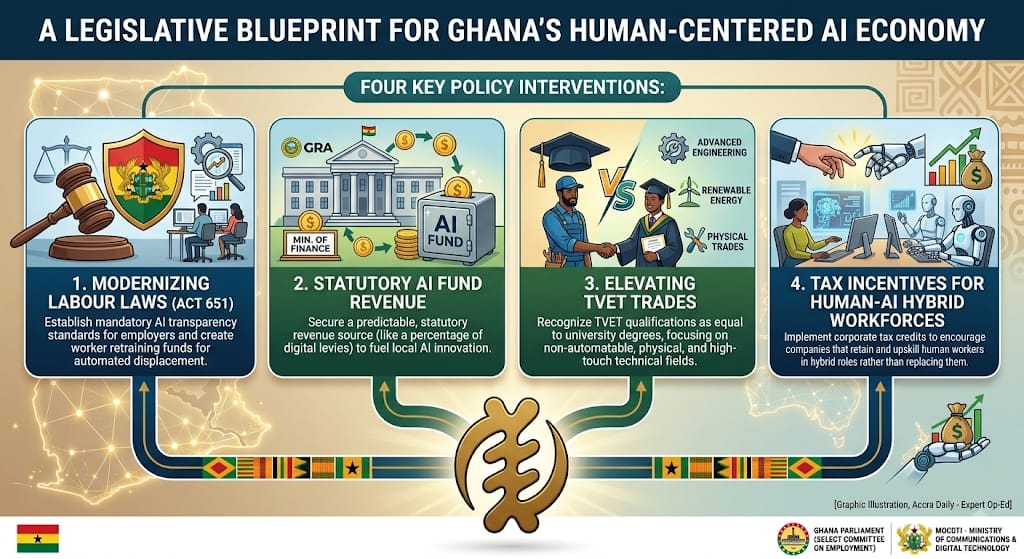
- Proposed amendments to the Ghana Labour Act (Act 651) aim to define "Algorithmic and Technological Displacement" and mandate corporate reporting on AI integration.
- Employers above a certain threshold would be required to give advance notice of workforce restructuring and contribute to a national retraining fund for displaced workers.
- A GH¢5 billion National AI Fund, capitalized by a fixed percentage of digital communications levies, is proposed to provide venture capital for Ghanaian AI startups.
- The Ministry of Education is urged to rebalance funding towards advanced Technical and Vocational Education and Training (TVET) for non-automatable skills.
- Tax credits are suggested for enterprises demonstrating human-AI hybrid workflows to encourage junior talent retention and internal mentorship.
Proposed Legislative Framework for AI Governance
Ghana stands at a critical juncture, facing a choice between passively consuming imported automation—which risks eroding its tax base and exacerbating graduate unemployment—or actively structuring its regulatory environment to protect human labor and build local technological sovereignty.
Ghanaian policymakers are being urged to enact immediate legislative changes to address the potential negative impacts of artificial intelligence on the nation's workforce. A key proposal centers on amending the Ghana Labour Act (Act 651) to explicitly define "Algorithmic and Technological Displacement." This amendment would introduce new obligations for corporate employers operating above a specified threshold, requiring them to maintain transparent reporting on their AI integration strategies and provide advance notice of any workforce restructuring resulting from automation.
Beyond transparency and notice, the proposed changes to the Labour Act (Act 651) AI impact would also mandate contributions from these employers to a co-financed national retraining fund. This fund is intended to support workers displaced by technological advancements, ensuring they have pathways to new employment opportunities. The legislative blueprint also calls for the establishment of a GH¢5 billion National AI Fund, which is envisioned to provide predictable local venture capital for Ghanaian AI startups focused on developing sovereign, locally hosted solutions.
Crucially, the Ghana National AI Fund legislation suggests that this significant capital should not rely on volatile donor funding or discretionary budgetary allocations. Instead, it proposes that a fixed percentage of existing digital communications levies be statutorily earmarked to capitalize the fund, ensuring a stable and consistent source of financing for Ghana's burgeoning AI sector and its strategic development.
Rethinking Education and Workforce Adaptation
To complement these legislative reforms, a strategic rebalancing of educational funding is advocated, moving away from basic software coding towards advanced Technical and Vocational Education and Training (TVET). The Ministry of Education is encouraged to equip trade centers with sophisticated industrial machinery, enabling young Ghanaians to master non-automatable, physical skill sets. Examples include industrial electrical engineering, renewable energy grid maintenance, and specialized mechanics—areas where digital software cannot replicate human expertise.
This shift aims to prepare the workforce for an economy increasingly shaped by automation, ensuring that Ghanaian workers are equipped with skills that are resilient to technological displacement. Furthermore, the Ministry of Finance is advised to introduce Ghana tax credits for enterprises that demonstrate structured human-AI hybrid workflows. These incentives would encourage companies to retain junior talent and invest in internal mentorship programs, rather than implementing immediate workforce reductions solely to maximize short-term profits.
Such tax credits are designed to foster an environment where technology augments human capabilities rather than replaces them entirely, promoting a more stable and inclusive labor market. The focus on hybrid workflows underscores a commitment to integrating AI in a manner that preserves and enhances human employment, aligning with the broader goal of an inclusive economy.
Ghana's Crucial Juncture in the Digital Age
Ghana stands at a critical juncture, facing a choice between passively consuming imported automation—which risks eroding its tax base and exacerbating graduate unemployment—or actively structuring its regulatory environment to protect human labor and build local technological sovereignty. The current trajectory, as highlighted in previous analyses, presents risks such as the "AI Layoff Trap," the erosion of the white-collar Pay-As-You-Earn (PAYE) tax base, and an entry-level talent crisis stemming from automated workplace workflows.
These proposed legislative and educational interventions are designed to close execution gaps in Ghana's National AI Strategy, ensuring it fosters an inclusive economy rather than accelerating graduate unemployment. The ultimate measure of Ghana's digital transformation will not be found solely in broad GDP projections, but rather in whether its policies succeed in building a stable, resilient economy where Ghanaian workers are empowered to direct technology, rather than being replaced by it.
Lawmakers are urged to act decisively and without delay to ensure that Ghana's digital future serves its people effectively, particularly before the entry-level employment pipeline diminishes entirely. The comprehensive approach, encompassing the Ghana Labour Act 651 AI amendment, the Ghana National AI Fund legislation, and Ghana corporate AI reporting requirements, aims to safeguard the nation's workforce and economic stability in the face of rapid technological change.
Practical Implications
Lawyers and compliance officers in Ghana should closely monitor proposed amendments to the Labour Act (Act 651) and related legislative initiatives, as they signal upcoming requirements for corporate reporting on AI integration, potential contributions to a national retraining fund, and new tax incentives for human-AI hybrid workflows, all of which will impact workforce management and compliance strategies.
Source
How does this affect you?
Get an AI analysis of this article grounded in your jurisdictions, practice areas, and any policy documents you've uploaded to Wansom.
Finish Reading the Full Story and the Expert Analysis.
Get the latest legal & regulatory intelligence in Ghana
Wansom is AI and can make mistakes.