
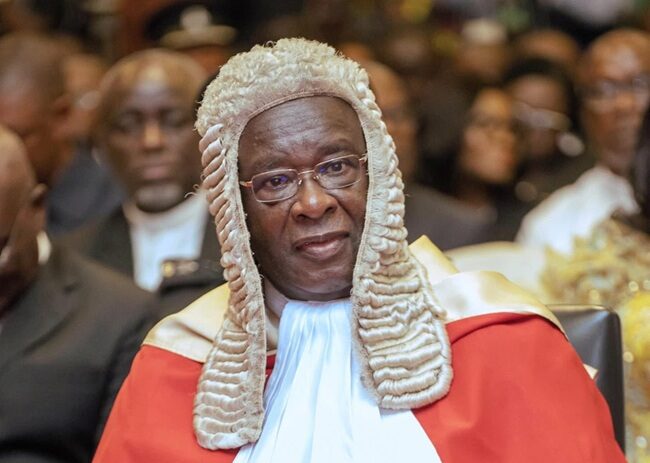
Paul Baffoe-Bonnie: SOE Comments Spark Ghana Judicial Independence Debate
Summary
- Chief Justice Paul Baffoe-Bonnie's recent comments on state-owned enterprises sparked public debate regarding judicial independence.
- During visits to SSNIT and MIIF on September 2, the Chief Justice praised current administration's management of SOEs and contrasted it with past performance.
- The Ghana Judicial Service responded on September 4, stating the remarks were made in good faith and not intended to undermine judicial independence.
- Critics, including CDD-Ghana and the New Patriotic Party, expressed concerns that the comments could create a perception of political bias and erode public trust.
- The controversy underscores the critical importance of perceived judicial impartiality and the need for judicial leaders to exercise discretion in public statements.
Chief Justice's Remarks Spark Debate on Judicial Independence
The controversy surrounding Chief Justice Paul Baffoe-Bonnie's remarks highlights the critical importance of perceived judicial independence in Ghana.
Ghana's Chief Justice, Paul Baffoe-Bonnie, recently ignited a public discussion following observations he made regarding the performance of state-owned enterprises (SOEs). During official visits on Wednesday, September 2, the Chief Justice offered comments that have since drawn significant scrutiny concerning the delicate balance of Paul Baffoe-Bonnie judicial independence. Specifically, while visiting the Minerals Income Investment Fund (MIIF), he commended its operational improvements and posed a rhetorical question about Ghana's activities over the preceding eight years, implying a positive shift in state institution management.
His remarks extended to the Social Security and National Insurance Trust (SSNIT), where he referenced past proposals to divest assets, including the Labadi Beach Hotel. He contrasted this historical context with what he described as enhanced management practices within state institutions under the current administration. These Chief Justice SOE comments Ghana quickly garnered a mixed public reception, prompting a broader conversation about the appropriate scope of public commentary by the head of the judiciary, particularly when touching upon matters that could be perceived as political.
Judicial Service Defends Chief Justice's Intent
In response to the escalating public debate, the Ghana Judicial Service issued a statement on Friday, September 4, clarifying the intent behind the Chief Justice's observations. Signed by the Judicial Secretary, the statement emphasized that the Ghana Judicial Service CJ remarks were made in good faith and were not designed to compromise judicial independence. The Service acknowledged that Chief Justice Baffoe-Bonnie had taken note of the varied public reactions to his comments, which were delivered during an outreach engagement with several state institutions.
The official communication reiterated that the Chief Justice remains steadfast in his commitment to upholding the integrity and independence of the Judiciary. It further affirmed his dedication to promoting justice and ensuring equality before the law, underscoring his adherence to the constitutional role assigned to the judiciary. This defense aimed to reassure the public that the Chief Justice's actions were consistent with his duties, despite the controversy generated by his specific pronouncements.
Concerns Over Perceived Political Bias Emerge
The Chief Justice's statements attracted considerable criticism from various quarters, with many questioning the appropriateness of a judicial leader publicly commenting on the performance of successive governments. The Ghana Center for Democratic Development (CDD-Ghana) was prominent among the critics, urging Chief Justice Baffoe-Bonnie to exercise greater restraint and discretion in his public engagements. CDD-Ghana argued that comments contrasting the current administration with its predecessor could foster a perception of Ghana judiciary political bias, thereby eroding public confidence in the institution's impartiality.
Further concerns were voiced by the New Patriotic Party, which openly questioned the Chief Justice's neutrality and warned that such remarks could negatively impact public trust in the judiciary. Political activist and physician Dr. Arthur Kobina Kennedy also contributed to the criticism, suggesting that the comments could easily be interpreted as political commentary emanating from an independent branch of government.
Conversely, some members of the public defended the Chief Justice's right to comment on the performance of public institutions, particularly when observations are rooted in measurable performance indicators and broader national development objectives.
Underscoring the Importance of Judicial Impartiality
The controversy surrounding Chief Justice Paul Baffoe-Bonnie's remarks highlights the critical importance of perceived judicial independence in Ghana. The incident serves as a stark reminder that even seemingly innocuous comments from high-ranking judicial officials can be interpreted through a political lens, potentially influencing public trust in the judiciary's impartiality. The concerns raised by organizations like CDD-Ghana regarding CDD-Ghana judicial impartiality underscore the constant need for judicial leaders to maintain an appearance of strict neutrality, especially when discussing government performance or state-owned enterprises like SSNIT and MIIF.
This situation emphasizes that the judiciary's credibility hinges not only on its actual independence but also on the public's perception of that independence. Lawyers and legal practitioners must remain acutely aware of how such public statements can shape the legal landscape and potentially be leveraged in arguments concerning judicial impartiality, particularly in cases involving state entities or government policy. The incident reinforces the delicate balance required to safeguard the judiciary's role as an unbiased arbiter of justice.
Practical Implications
This incident underscores the critical importance of perceived judicial independence in Ghana. Lawyers should be mindful of how public statements by high-ranking judicial officials can influence public trust and potentially be leveraged in arguments concerning judicial impartiality, particularly in cases involving state-owned enterprises or government policy.
Source
How does this affect you?
Get an AI analysis of this article grounded in your jurisdictions, practice areas, and any policy documents you've uploaded to Wansom.
Finish Reading the Full Story and the Expert Analysis.
Wansom is AI and can make mistakes.