
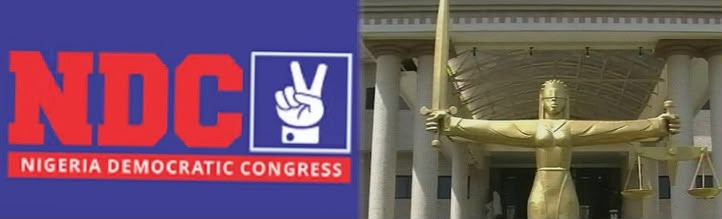
Federal High Court Lokoja: Overturns NDC Deregistration
Summary
- In June, the Federal High Court in Lokoja, Kogi State, issued a ruling that set aside one of its earlier judgments.
- The previous judgment had specifically directed the Independent National Electoral Commission (INEC) to register the NDC as a political party.
- This recent judicial action effectively nullifies the prior court order for the NDC's registration.
Court Overturns Party Registration Directive
The court's action in June therefore nullifies the previous mandate, altering the legal trajectory for the NDC's aspirations to become a formally registered political entity.
In a significant judicial development reported in June, the Federal High Court, situated in Lokoja, Kogi State, issued a ruling that effectively reversed one of its prior judicial pronouncements. This recent decision specifically set aside an earlier judgment which had directed the Independent National Electoral Commission (INEC) to proceed with the registration of the NDC as a recognized political party. The court's action in June therefore nullifies the previous mandate, altering the legal trajectory for the NDC's aspirations to become a formally registered political entity.
Legal Framework for Political Party Registration
The Federal High Court holds a pivotal position within Nigeria's judicial architecture, possessing extensive jurisdiction over matters involving federal government agencies, constitutional questions, and electoral disputes. Its role often includes adjudicating challenges related to the Independent National Electoral Commission, the body statutorily empowered to oversee elections and regulate political parties. INEC is tasked with the crucial responsibility of registering political associations that meet specific legal criteria, thereby enabling them to participate in the democratic process.
The legal mechanism by which a court 'sets aside' its own judgment is a fundamental aspect of judicial review and self-correction. Unlike an appeal, which involves a higher court reviewing a lower court's decision, setting aside a judgment means the same court has found sufficient grounds—perhaps due to new evidence, a procedural error, or a re-evaluation of legal principles—to invalidate its original ruling. This particular action by the Lokoja court indicates a re-assessment of the legal basis or factual premises that underpinned its initial directive for the NDC's registration, highlighting the judiciary's capacity to revisit and modify its own pronouncements when deemed necessary.
Implications for Electoral Integrity and Party Formation
This judicial reversal carries substantial implications for both the political landscape and the operational autonomy of electoral bodies. For the NDC, the immediate consequence is the removal of a court-ordered pathway to registration, meaning their status as a political party is no longer mandated by the specific judgment that has now been nullified. This places the onus back on the standard registration processes overseen by INEC, or potentially opens avenues for further legal challenges through different means.
Furthermore, the decision underscores the delicate balance between judicial oversight and the administrative independence of institutions like INEC. While courts serve as crucial arbiters in disputes, the act of setting aside a directive for party registration reaffirms, in this instance, the commission's primary role in determining which political associations meet the requirements to operate. Such judicial actions, whether initial directives or subsequent reversals, inevitably shape public perception of electoral fairness and the stability of the legal framework governing political participation. The capacity of the judiciary to correct its own errors, as demonstrated by the Federal High Court in Lokoja, is a vital component of maintaining public trust in the legal system and ensuring the integrity of democratic processes.
Source
How does this affect you?
Get an AI analysis of this article grounded in your jurisdictions, practice areas, and any policy documents you've uploaded to Wansom.
Finish Reading the Full Story and the Expert Analysis.
Get the latest legal & regulatory intelligence in Nigeria
Wansom is AI and can make mistakes.