
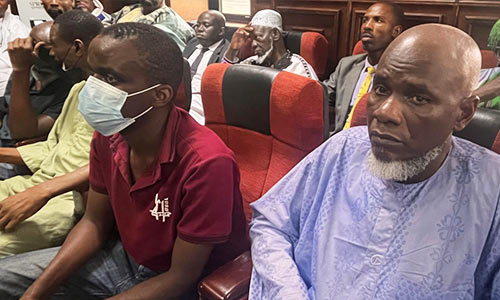
Federal High Court Abuja: Nigeria Coup Plotters' Evidence Admitted
Summary
- The Federal High Court in Abuja admitted written statements and video recordings against six alleged coup plotters.
- Justice Joyce Abdulmalik delivered the ruling on Thursday, November 5, 2026.
- The defendants are accused of plotting to overthrow President Bola Tinubu's administration.
- The court rejected claims by the defendants that their extrajudicial statements were coerced, calling them an "afterthought."
- The Federal Government tendered the admitted evidence in the trial.
What Happened
The admission of written statements and video evidence against the alleged Nigeria coup plotters carries substantial implications for legal strategy and outcomes in high-profile criminal cases across the nation.
The Federal High Court in Abuja has issued a significant ruling concerning the trial of six individuals accused of orchestrating a plot to overthrow the government of President Bola Tinubu. On Thursday, November 5, 2026, Justice Joyce Abdulmalik presided over proceedings where the court formally admitted into evidence both written statements and video recordings presented by the Federal Government. These crucial pieces of evidence are now officially part of the prosecution's case against the alleged coup plotters, marking a pivotal moment in the ongoing legal battle.
The defendants had vigorously contested the admissibility of their extrajudicial statements, arguing that these confessions were not made voluntarily but were instead obtained under duress. However, Justice Abdulmalik ultimately rejected these assertions. In her decision, the judge characterized the claims of coercion as an "afterthought," thereby allowing the Federal Government to proceed with using the contested materials to support its allegations of a Nigeria coup plot.
Legal Context
The Justice Joyce Abdulmalik decision at the Federal High Court Abuja ruling provides important clarity on the admissibility of evidence, particularly extrajudicial statements and video evidence, within the Nigerian judicial system. A fundamental principle of criminal law dictates that statements made by an accused person must be voluntary to be admissible in court. The court's rejection of the defendants' claims of coercion suggests that the defense failed to present sufficient evidence to convince the judge that the statements were indeed involuntarily obtained.
This ruling underscores the stringent requirements for challenging the voluntariness of confessions. The court's finding that the coercion claims were an "afterthought" implies that the defense's arguments either lacked timely presentation, credible substantiation, or both. This judicial stance sets a precedent for future cases, especially those involving national security, where the provenance and voluntariness of critical evidence are often fiercely debated. The admissibility of these materials in the alleged coup plotters trial Nigeria will undoubtedly shape subsequent legal arguments.
Why It Matters
The admission of written statements and video evidence against the alleged Nigeria coup plotters carries substantial implications for legal strategy and outcomes in high-profile criminal cases across the nation. This ruling by Justice Abdulmalik signals a judicial posture that is prepared to admit significant evidence, including extrajudicial statements and video recordings, even when claims of coercion are raised, provided those claims are not definitively proven or are presented belatedly. This places a considerable onus on defense counsel to proactively and robustly challenge the circumstances under which such evidence is obtained.
For legal professionals representing clients in sensitive national security matters, this development highlights the critical need for meticulous and timely efforts to dispute the voluntariness and authenticity of any extrajudicial statements or video evidence. The court's decision suggests that without compelling and irrefutable proof of duress, the evidentiary value of the materials themselves may take precedence. This judicial pronouncement will undoubtedly influence how defense teams approach the admissibility phase in future trials where such crucial evidence is contested, particularly in cases involving alleged coup plotters.
Practical Implications
Lawyers defending clients in high-profile criminal cases in Nigeria, particularly those involving national security, should note this ruling as it indicates a judicial stance on the admissibility of extrajudicial statements and video evidence, even when coercion claims are raised. This highlights the need for robust challenges to the voluntariness and provenance of such evidence, as courts may prioritize the evidence itself if coercion is not definitively proven.
Source
How does this affect you?
Get an AI analysis of this article grounded in your jurisdictions, practice areas, and any policy documents you've uploaded to Wansom.
Wansom is AI and can make mistakes.