
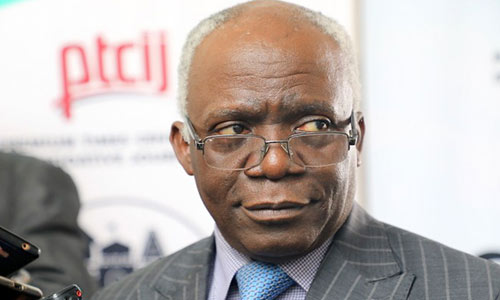
Femi Falana Chambers: Challenges Nigeria Customs Training Exclusion
Summary
- Femi Falana's law firm has formally requested an explanation from the Nigeria Customs Service.
- The request concerns the exclusion of successful candidates from basic training.
- These candidates were on the final recruitment list and had accepted provisional appointment letters.
- The firm addressed its demand to the Comptroller-General of the NCS.
Formal Inquiry into Training Exclusion
The firm's intervention highlights a significant concern over the transparency and fairness of the ongoing Nigeria Customs Service recruitment process.
The legal practice of Femi Falana, a prominent human rights lawyer, has formally challenged the Nigeria Customs Service (NCS) regarding the unexpected exclusion of several candidates from its basic training program. Falana & Falana’s Chambers dispatched a letter to the Comptroller-General of the NCS, seeking a comprehensive explanation for this decision. The firm's intervention highlights a significant concern over the transparency and fairness of the ongoing Nigeria Customs Service recruitment process.
This direct communication from Falana's firm underscores a demand for accountability from the Customs leadership. The core of the inquiry revolves around why individuals, who had seemingly fulfilled all prior requirements, were suddenly barred from proceeding to the essential training phase, which is a critical step towards their full integration into the Service. The firm's action signals a potential legal challenge if a satisfactory explanation is not provided by the Comptroller-General.
Candidates' Prior Status
The candidates at the center of this NCS recruitment dispute had successfully navigated the earlier stages of the selection process. They were officially included in the final recruitment list, signifying their qualification for the roles. Following this, each candidate received and subsequently accepted a provisional appointment letter, which typically serves as a precursor to formal employment and training within government agencies.
Despite these crucial steps, which would reasonably lead candidates to expect progression, they were ultimately prevented from participating in the basic training exercise. This abrupt halt in their recruitment journey, after having been deemed successful and accepting a provisional offer, forms the basis of the Falana Nigeria Customs training exclusion inquiry. The firm is questioning the procedural integrity that led to such an outcome for these provisionally appointed individuals.
Legal and Procedural Concerns
The intervention by Falana & Falana’s Chambers raises significant questions about administrative fairness and due process within public sector recruitment. When candidates are placed on a final list and accept a Customs provisional appointment letter, a legitimate expectation of employment or at least a clear pathway to it is established. Their subsequent exclusion from training without apparent cause could be viewed as an arbitrary decision, potentially violating their rights.
This situation could set a precedent for future administrative law challenges against government bodies if the Nigeria Customs Service fails to offer a justifiable reason for the exclusion. The Comptroller-General NCS questioned by a prominent human rights lawyer like Femi Falana emphasizes the seriousness of the alleged procedural lapses and the need for adherence to established recruitment protocols.
Why This Matters
The involvement of Femi Falana, a renowned human rights lawyer, in this NCS recruitment dispute elevates the issue beyond a mere administrative oversight. His firm's demand for an explanation from the Comptroller-General of the Nigeria Customs Service highlights the importance of upholding fair and transparent recruitment practices in public institutions. Such interventions are crucial for ensuring that government agencies operate within legal frameworks and respect the rights of citizens participating in their processes.
This case serves as a reminder that even after receiving a provisional appointment letter, candidates can face unexpected hurdles, and that legal advocacy can be vital in challenging what appears to be an arbitrary Falana Nigeria Customs training exclusion. The outcome of this inquiry could influence future recruitment policies and accountability mechanisms within the NCS and potentially other government parastatals.
Practical Implications
This development signals potential administrative law challenges against government recruitment processes, particularly concerning the rights of provisionally appointed candidates. Lawyers should be aware of precedents set by such interventions when advising clients on employment disputes with public sector bodies or challenging arbitrary exclusions.
Source
How does this affect you?
Get an AI analysis of this article grounded in your jurisdictions, practice areas, and any policy documents you've uploaded to Wansom.
Finish Reading the Full Story and the Expert Analysis.
Get the latest legal & regulatory intelligence in Nigeria
Wansom is AI and can make mistakes.