
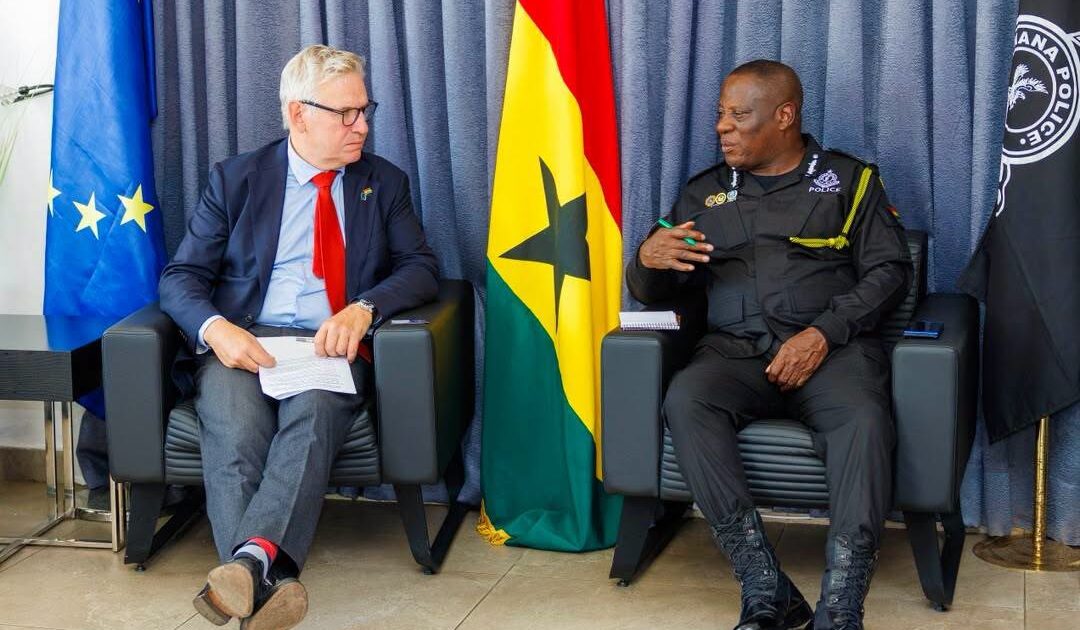
EU Ambassador Ghana: IGP Seeks Enhanced Policing Cooperation
Summary
- EU Ambassador Rune Skinnebach met with Ghana's IGP Christian Tetteh Yohuno on September 19, 2026, to strengthen policing cooperation.
- Discussions focused on EU support for training, community policing, forensic investigations, cybersecurity, and crime scene management.
- IGP Yohuno requested deeper collaboration in cybersecurity, counter-terrorism, specialized training, and community policing to address emerging security challenges.
- Ambassador Skinnebach reaffirmed the EU's commitment to strengthening Ghana's policing and promoting security and the rule of law.
- This meeting is part of ongoing efforts to enhance the institutional capacity and improve policing within the Ghana Police Service.
Diplomatic Engagement Bolsters Policing Cooperation
Lawyers and compliance officers are advised to proactively review and, if necessary, strengthen their clients' compliance frameworks.
On September 19, 2026, a significant diplomatic meeting took place in Ghana, aimed at reinforcing the collaborative efforts between the European Union and the nation's law enforcement body. Rune Skinnebach, the EU Ambassador to Ghana, conducted a courtesy visit with Christian Tetteh Yohuno, the Inspector-General of Police (IGP). The central objective of this high-level engagement was to fortify the existing cooperation framework between the European Union and the Ghana Police Service, signaling a continued commitment to mutual security objectives.
Discussions during the meeting specifically highlighted the European Union's ongoing contributions to the Ghana Police Service. These contributions encompass a broad spectrum of capacity-building initiatives. Key areas of support include comprehensive training programs, advancements in community policing strategies, crucial assistance in Ghana forensic investigations, bolstering Ghana cybersecurity policing capabilities, and enhancing crime scene management protocols. The dialogue underscored the multifaceted nature of the EU's commitment to improving policing standards and operational effectiveness within Ghana.
Strategic Priorities for Enhanced Security
During the discussions, Inspector-General Christian Tetteh Yohuno conveyed his profound appreciation for the sustained support provided by the European Union. He subsequently advocated for an expansion of this partnership, urging for more profound collaboration in several critical domains. Specifically, IGP Yohuno identified cybersecurity, EU Ghana counter-terrorism initiatives, specialized training, and community policing as areas where intensified cooperation would be particularly beneficial. He articulated that continued assistance in these strategic sectors is vital for empowering the Ghana Police Service to effectively address the evolving landscape of security threats confronting the nation.
Ambassador Rune Skinnebach, representing the EU, reiterated the Union's unwavering dedication to working alongside the Ghana Police Service. This commitment extends to strengthening overall policing capabilities and actively supporting endeavors designed to uphold security and advance the rule of law across Ghana. The meeting itself forms an integral part of broader, ongoing initiatives designed to deepen the collaborative ties between the EU and the Ghana Police Service, with a clear focus on enhancing institutional capacity and refining policing methodologies.
Implications for Enforcement and Compliance
The reinforced partnership between the European Union and the Ghana Police Service, particularly in areas like Ghana cybersecurity policing, EU Ghana counter-terrorism, and Ghana forensic investigations, carries significant implications for legal and compliance professionals. The EU's commitment to bolstering the Ghana Police Service's capacity in these specialized fields suggests a future where enforcement actions could become notably more sophisticated and targeted. As the police force gains enhanced capabilities through specialized training and improved resources, the likelihood of more rigorous investigations and prosecutions in these complex areas increases.
This enhanced support is expected to lead to heightened regulatory scrutiny, especially for entities operating within sectors vulnerable to cyber threats or those with potential links to counter-terrorism concerns. Consequently, businesses and individuals should anticipate a more robust enforcement environment. Lawyers and compliance officers are advised to proactively review and, if necessary, strengthen their clients' compliance frameworks. Ensuring adherence to evolving standards in cybersecurity, anti-terrorism financing, and data handling, informed by advanced forensic capabilities, will be crucial to mitigate risks in this increasingly sophisticated enforcement landscape.
Practical Implications
Lawyers and compliance officers should note the EU's commitment to strengthening the Ghana Police Service's capacity in cybersecurity, counter-terrorism, and forensic investigations. This enhanced support could lead to more sophisticated enforcement actions and increased regulatory scrutiny in these areas, requiring clients to review their compliance frameworks.
Source
How does this affect you?
Get an AI analysis of this article grounded in your jurisdictions, practice areas, and any policy documents you've uploaded to Wansom.
Finish Reading the Full Story and the Expert Analysis.
Get the latest legal & regulatory intelligence in Ghana
Wansom is AI and can make mistakes.