
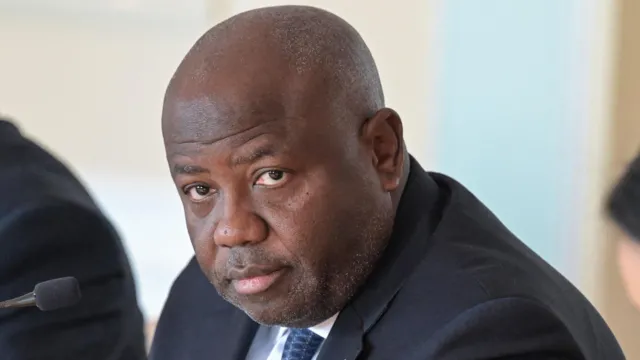
Equatorial Guinea government resigns after failing to meet targets
Abstract
Equatorial Guinea's government has collectively resigned, citing a failure to meet national objectives, with Vice-President Teodoro Nguema Obiang Mangue indicating the administration achieved barely 10% of its targets. This development underscores the highly centralized nature of executive power within the Republic of Equatorial Guinea, where the President holds extensive constitutional authority to appoint and dismiss cabinet members, including the Prime Minister. For legal professionals, this event highlights the significant influence of presidential prerogative in governmental transitions and the implications for policy continuity, administrative stability, and the legal framework governing executive accountability in a system where separation of powers is nominally guaranteed but practically limited.
Introduction
The government of Equatorial Guinea recently tendered its collective resignation, a move announced by Vice-President Teodoro Nguema Obiang Mangue, who attributed the decision to the administration's failure to achieve its set objectives, reportedly meeting less than 10% of its targets. This significant political development, while framed as a matter of governmental accountability, immediately draws attention to the unique constitutional and administrative landscape of the Central African nation. The resignation of the entire cabinet, led by Prime Minister Manuel Osa Nsue Nsua, signals a period of executive restructuring and potential policy shifts.
For legal practitioners, understanding the implications of such a mass resignation requires a deep dive into Equatorial Guinea's constitutional framework and the practical exercise of executive power. The event is not merely a political reshuffle but a manifestation of the President's overarching authority in a system characterized by a strong presidential republic. This article will explore the legal underpinnings of government formation and dissolution in Equatorial Guinea, analyze the extent of presidential powers in this context, and consider the broader implications for legal certainty and administrative continuity.
Background
Equatorial Guinea operates as a presidential republic, a structure formally established by its 1991 Constitution, which has undergone amendments, notably in 1995 and 2011/2012. Under this constitutional arrangement, the President serves as both the Head of State and Head of Government, wielding extensive executive powers. Article 33 of the Constitution explicitly states that the President of the Republic is the Head of State and exercises Executive Power as Head of Government, defining the nation's policy and ensuring the functioning of public powers.
The President's powers include the prerogative to name and dismiss members of the cabinet, make laws by decree, dissolve the Chamber of Representatives, and appoint the Prime Minister. The Prime Minister, while responsible for coordinating government activities, operates under powers specifically designated by the President. This concentration of power in the presidency means that, despite constitutional provisions for a separation of powers, the executive branch, dominated by the President and Vice-President, exercises near-total control over all aspects of government, including significant influence over the judiciary. This historical context of executive dominance is crucial for interpreting the legal and practical implications of a government resignation.
Analysis
The recent resignation of the Equatorial Guinean government, precipitated by its stated failure to meet national targets, must be understood within the context of the President's expansive constitutional authority. While the Vice-President emphasized accountability for public management and results, the decision to resign appears to be a political act initiated by the Prime Minister, likely at the behest or with the full approval of the President, rather than a direct constitutional mandate for failure to meet specific performance metrics. The Constitution of Equatorial Guinea grants the President the power to appoint and dismiss cabinet members, including the Prime Minister, effectively making the government's tenure contingent on presidential confidence.
Article 32 of the Constitution outlines the various organs through which the State exercises its powers, including the Council of Ministers, and specifies that the President may designate a Prime Minister for administrative coordination and other delegated functions. This framework underscores that the executive power ultimately resides with the President, and the Prime Minister and cabinet serve at his pleasure. Therefore, a resignation due to 'unmet targets' functions as a mechanism for the President to reorganize the executive branch and align it with his strategic priorities, a process the ruling Democratic Party of Equatorial Guinea (PDGE) described as part of "institutional reorganization processes" to adapt the government structure to new state priorities.
The lack of an effective separation of powers, where the executive branch exerts significant control over the legislative and judicial branches, means that traditional checks and balances on executive power are largely diminished. This environment allows for swift governmental changes without significant parliamentary or judicial challenge. For legal practitioners, this implies that the legal continuity of government projects, contracts, and regulatory frameworks during such transitions is primarily secured through presidential decrees and the directives of the incoming administration, rather than through independent institutional oversight. The implications extend to foreign investment and commercial dealings, where the stability of legal and regulatory regimes can be highly susceptible to executive reshuffles.
Conclusion
The resignation of Equatorial Guinea's government, driven by a reported failure to meet national objectives, serves as a stark reminder of the highly centralized nature of executive power in the country. For legal practitioners, this event underscores the paramount importance of presidential prerogative in governmental affairs, from appointments to dismissals and the overall direction of state policy. The constitutional framework, while outlining a presidential republic, grants the President extensive powers that allow for significant flexibility in restructuring the government based on performance or political considerations.
Practitioners advising clients with interests in Equatorial Guinea must closely monitor the formation of the new government, including key ministerial appointments and any subsequent policy directives or legislative changes. The continuity of existing contracts, regulatory compliance, and the stability of the business environment will largely depend on the pronouncements and actions of the incoming administration, all under the ultimate authority of the President. Understanding this dynamic is crucial for navigating the legal and operational landscape in a jurisdiction where executive decisions can rapidly reshape the governmental and regulatory environment.
Citations
- 1.Constitution of Equatorial Guinea (1991, as amended through 2012)
How does this affect your business?
Get an AI analysis of this article grounded in your jurisdictions, practice areas, and any policy documents you've uploaded to Wansom.
Wansom is AI and can make mistakes.