
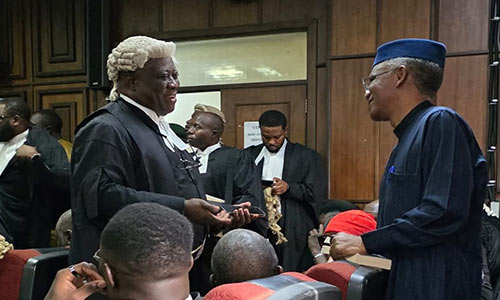
Federal High Court: El-Rufai N1bn Rights Suit Hearing Set Amid AGF Opposition
Summary
- The Federal High Court in Abuja has scheduled October 27 for a definite hearing in a N1 billion fundamental rights suit filed by former Kaduna State Governor Nasir El-Rufai.
- Mr. El-Rufai is suing the Independent Corrupt Practices and Other Related Offences Commission (ICPC), the Inspector-General of Police (IGP), and the Attorney-General of the Federation (AGF).
- The suit alleges an unlawful search as the basis for the N1 billion claim for fundamental rights enforcement.
- Justice Joyce Abdulmalik is presiding over the case, and the Attorney-General of the Federation has filed an opposition to the suit.
High-Profile Rights Suit Proceeds
This high-profile fundamental rights enforcement suit, involving a former governor against key state agencies, could set important precedents regarding the limits of state power and the scope of fundamental rights.
The Federal High Court in Abuja has set a definitive date for the hearing of a significant fundamental rights enforcement suit initiated by former Kaduna State Governor, Nasir El-Rufai. The legal action seeks N1 billion in damages and is directed against three prominent federal entities: the Independent Corrupt Practices and Other Related Offences Commission (ICPC), the Inspector-General of Police (IGP), and the Attorney-General of the Federation (AGF).
Justice Joyce Abdulmalik, presiding over the Federal High Court Abuja El-Rufai case, has scheduled October 27 for the conclusive hearing. This development comes as the Attorney-General of the Federation has formally registered opposition to the claims made by Mr. El-Rufai, indicating a contested legal battle ahead in this El-Rufai N1bn rights suit AGF opposition hearing.
The former governor's legal challenge centers on allegations of an unlawful search, forming the core of his fundamental rights enforcement suit. The substantial N1 billion claim underscores the gravity with which Mr. El-Rufai views the alleged infringement of his rights by the state agencies.
Parties and Allegations
At the heart of this Nigeria fundamental rights lawsuit are serious accusations leveled against key government bodies. The Independent Corrupt Practices and Other Related Offences Commission (ICPC), a primary anti-graft agency, is named as a defendant, suggesting its involvement in the alleged unlawful search that forms the basis of the suit. Similarly, the Inspector-General of Police, representing the nation's police force, is also a party to the action, indicating potential police involvement in the alleged rights violation.
The Attorney-General of the Federation (AGF), as the chief legal officer of the country, is the third defendant. The AGF's role typically involves defending the federal government and its agencies in legal proceedings. The AGF's decision to file an opposition in the ICPC IGP AGF El-Rufai case signals the federal government's intent to challenge the former governor's claims vigorously.
Mr. El-Rufai's suit specifically alleges an unlawful search, which he contends constitutes a violation of his fundamental human rights. The outcome of this particular aspect of the case could have implications for how state agencies conduct searches and investigations, particularly concerning high-profile individuals.
Judicial Process and Future Outlook
The setting of October 27 for a definite hearing by Justice Joyce Abdulmalik signifies a critical juncture in the legal proceedings. A definite hearing typically implies that all preliminary matters have been addressed, and the court is prepared to hear arguments on the substantive issues of the case, potentially leading to a final judgment.
The formal opposition filed by the Attorney-General of the Federation adds another layer of complexity to the El-Rufai N1bn rights suit AGF opposition hearing. This opposition means the court will need to weigh the arguments presented by Mr. El-Rufai against the defense mounted by the federal government's legal representative, concerning the alleged unlawful search and the subsequent claim for damages.
This high-profile fundamental rights enforcement suit, involving a former governor against key state agencies, could set important precedents regarding the limits of state power and the scope of fundamental rights. Lawyers should monitor the definite hearing for potential implications on similar claims or for understanding judicial interpretations of state agency actions.
Source
How does this affect you?
Get an AI analysis of this article grounded in your jurisdictions, practice areas, and any policy documents you've uploaded to Wansom.
Finish Reading the Full Story and the Expert Analysis.
Get the latest legal & regulatory intelligence in Nigeria
Wansom is AI and can make mistakes.