
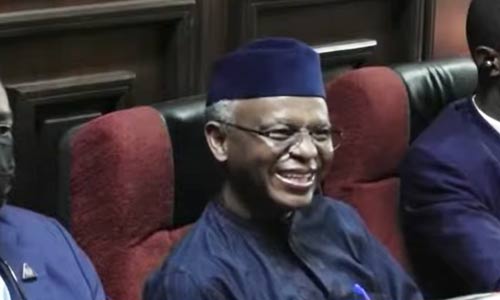
Nasir El-Rufai: Demands Fair Trial After 256 Days Detention in Nigeria
Summary
- Former Kaduna State Governor Nasir El-Rufai has demanded a fair trial after 256 days in detention.
- El-Rufai asserts that a fair hearing is a fundamental human right, not an act of mercy, and must be respected regardless of allegations.
- His prolonged detention highlights persistent challenges regarding due process and the right to a fair trial in Nigeria.
- The case underscores the importance of upholding fundamental human rights and timely judicial processes for all citizens.
- Legal professionals are encouraged to advocate robustly for due process, citing such instances as evidence of systemic issues.
The Demand for Justice
The former governor emphasized that the right to a fair hearing stands as an inherent human entitlement, not a discretionary act of clemency, and must be upheld irrespective of the accusations leveled against an individual.
Former Kaduna State Governor, Nasir El-Rufai, has recently reiterated his call for a fair trial, marking what he describes as 256 days spent in detention. This prolonged period without resolution has prompted the prominent political figure to emphasize that the right to a fair hearing is an inherent human entitlement, not a discretionary act of clemency, and must be upheld irrespective of the accusations leveled against an individual.
El-Rufai's public statement underscores a critical aspect of legal systems: the fundamental nature of due process. His insistence highlights that the principles of justice should apply universally, ensuring that every accused person, including a high-profile individual like the Kaduna ex-governor, receives equitable treatment under the law. The demand for a fair trial in Nigeria, particularly after such an extended period of detention, brings into sharp focus the challenges faced by individuals navigating the country's judicial processes.
Legal Context and Human Rights Imperative
The assertion by Nasir El-Rufai that a fair trial is a fundamental human right aligns with international legal standards and Nigeria's own constitutional provisions. The right to a fair hearing Nigeria guarantees that individuals are presumed innocent until proven guilty, have access to legal representation, and are tried within a reasonable timeframe. Prolonged detention, such as the 256 days cited by El-Rufai, often raises significant concerns about adherence to these fundamental principles of due process.
This situation exemplifies the persistent challenges regarding due process and the right to a fair trial in Nigeria. The legal framework is clear on the necessity of timely judicial proceedings, yet practical implementation can often fall short. The former governor's case serves as a stark reminder that even prominent figures can face extended periods of legal uncertainty, prompting questions about the efficiency and accessibility of justice for all citizens.
Broader Implications for Nigerian Justice
The El-Rufai fair trial demand Nigeria resonates beyond the individual case, shedding light on systemic issues within the nation's judicial landscape. When a figure of El-Rufai's stature experiences such a lengthy detention without trial, it inevitably draws attention to the broader implications for human rights and the rule of law across the country. It underscores the potential for prolonged detention without trial, even for those with significant public profiles, and highlights the need for consistent application of legal safeguards.
This scenario emphasizes the importance for legal professionals to robustly advocate for their clients' fundamental human rights, particularly the right to a fair hearing. Such high-profile instances serve as illustrative examples of systemic issues that require continuous vigilance and advocacy to ensure that due process is not merely a theoretical concept but a practical reality for every individual in Nigeria, regardless of their background or the nature of the allegations against them.
Practical Implications
This case underscores the persistent challenges regarding due process and the right to a fair trial in Nigeria, even for prominent figures. Lawyers should note the potential for prolonged detention without trial and be prepared to robustly advocate for their clients' fundamental human rights, particularly the right to a fair hearing, citing such high-profile instances as illustrative of systemic issues.
Source
How does this affect you?
Get an AI analysis of this article grounded in your jurisdictions, practice areas, and any policy documents you've uploaded to Wansom.
Finish Reading the Full Story and the Expert Analysis.
Wansom is AI and can make mistakes.