
ECOWAS Court Dakar: Conference Recommendations on Displaced, Efficiency
Summary
- An ECOWAS Court of Justice conference in Dakar, held from September 21-25, 2026, focused on protecting displaced persons and enforcing judgments.
- The conference identified the application of existing rules as the main challenge, especially given ECOWAS's reduced membership to twelve states after three withdrawals.
- Recommendations include issuing identity documents, facilitating services, and providing legal aid for displaced persons, alongside raising awareness of the Court's jurisdiction.
- The report also called for member states to designate authorities for judgment enforcement and for the Court to clarify rules, increase judges, and improve digital management.
- States were urged to ratify and integrate the Kampala Convention into national law, as Niger, Chad, Ethiopia, and Somalia currently have specific legislation on internal displacement.
The Dakar Conference Convenes
The ability of the ECOWAS Court to ensure adherence to common regulations is therefore a central concern.
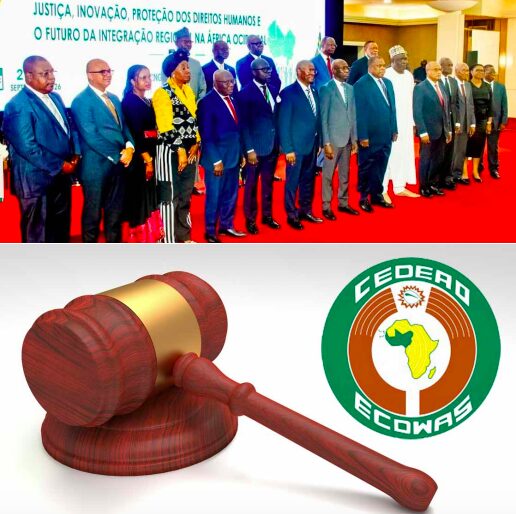
The ECOWAS Court of Justice recently convened an international conference in Dakar, Senegal, from September 21 to 25, 2026. Chaired by Bassirou Diomaye Faye, the gathering brought together nearly 200 participants to critically assess the Court's role and future direction. The event concluded on Friday, September 25, with the issuance of significant ECOWAS Court Dakar conference recommendations.
Preparations for this crucial meeting commenced on August 28, when Senegal's Justice Minister, Me Moussa Sarr, hosted a delegation from the Court, led by its Chief Registrar, Dr. Yaouza Ouro-Sama. The final report, subsequently disseminated by LII Quotidien, underscored a primary concern: "The main challenge is the application of existing rules." The recommendations primarily focused on two critical areas: enhancing the protection of displaced persons and improving the operational efficiency of the judicial body itself.
Regional Context and Legal Framework Gaps
The conference took place against a backdrop of significant regional shifts, with the Economic Community of West African States (ECOWAS) having seen its membership reduced to twelve states following the effective withdrawal of Mali, Burkina Faso, and Niger on January 29, 2025. This contraction, coupled with intra-regional trade remaining below 15%, intensifies questions about the practical reach and impact of the Court's decisions across the region. The ability of the ECOWAS Court to ensure adherence to common regulations is therefore a central concern.
Despite a robust regional legal framework designed to protect vulnerable populations, a considerable gap exists between these established norms and their practical implementation. This framework includes foundational instruments such as the 1951 Refugee Convention, the 1969 OAU Convention, the Kampala Convention, the Protocol on Free Movement, and the safeguards embedded within the African Charter on Human and Peoples' Rights. However, the conference report highlighted that many national laws concerning asylum and internal displacement are either inadequate or entirely absent in several member countries. Consequently, displaced individuals frequently encounter discrimination, arbitrary detention, the threat of collective expulsion, and statelessness.
Recommendations for Displaced Persons and Enforcement
The ECOWAS Court Dakar conference recommendations specifically urged member states to adopt concrete measures to safeguard displaced populations. These include the provision of essential identity documents, facilitating access to vital services, and ensuring legal assistance for those seeking redress through national judicial systems or the ECOWAS Court itself. Furthermore, the recommendations emphasized the importance of public awareness campaigns, particularly through media channels, to inform refugees and displaced persons about the Court's jurisdiction and how they can access it.
To bolster the enforcement of its judgments, the conference advised the Court to continue refining the legal principles applicable to displacement cases. Concurrently, member states were called upon to designate specific authorities responsible for coordinating the implementation of the Court's rulings and to provide regular reports on the actions taken to fulfill these obligations. This dual approach aims to bridge the identified gap between judicial pronouncements and their tangible impact on the ground.
Strengthening the Court's Institutional Capacity
Beyond the immediate needs of displaced persons and judgment enforcement, the conference also put forth recommendations aimed at enhancing the Court's institutional capacity. These included proposals to increase the number of judges, modernize case management through digital solutions, and secure adequate financial resources to support its operations. Such improvements are deemed crucial for the Court to effectively fulfill its mandate in a complex and evolving regional environment.
A significant recommendation also focused on the Kampala Convention, urging all states that have not yet done so to ratify this crucial instrument and integrate its provisions into their domestic legal frameworks. The report noted that, as of the conference, Niger, Chad, Ethiopia, and Somalia had enacted specific national legislation addressing internal displacement, underscoring the widespread need for greater legislative action across the ECOWAS bloc.
Source
How does this affect you?
Get an AI analysis of this article grounded in your jurisdictions, practice areas, and any policy documents you've uploaded to Wansom.
Finish Reading the Full Story and the Expert Analysis.
Get the latest legal & regulatory intelligence in Senegal
Wansom is AI and can make mistakes.