
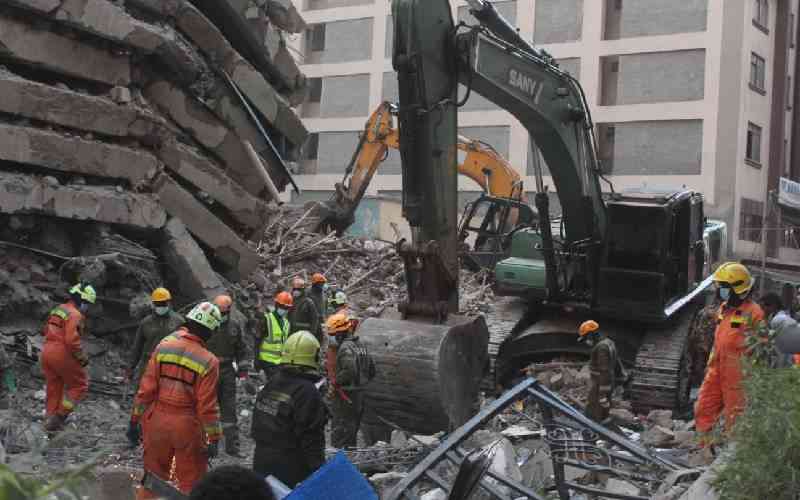
Sakaja: Eastleigh Building Collapse Due to Unapproved Plans
Summary
- A 16-storey building collapsed in Eastleigh, Nairobi, trapping approximately seven people and leaving 31 families with missing relatives.
- Nairobi Governor Johnson Sakaja stated the collapse was due to an approved change of use but unapproved architectural designs.
- City Hall approved the change of use on October 17, 2024, but architectural plans submitted on November 20, 2024, by architect Emmanuel Mwangi Maina were not approved.
- Governor Sakaja has called for professional bodies to investigate members involved and renewed his plea for prosecutorial powers for county governments.
- City Hall had previously taken enforcement actions against unauthorized construction at the site.
Eastleigh Building Collapse Prompts Scrutiny of Approvals
Governor Sakaja emphasized that the critical distinction between the approved change of use and the unapproved construction plans is central to establishing accountability.
A 16-storey structure in Nairobi's Eastleigh neighborhood recently collapsed, leaving approximately seven individuals trapped beneath the debris and prompting 31 families to report missing relatives. Nairobi Governor Johnson Sakaja attributed the catastrophic failure to a combination of an approved change of use and subsequently unapproved architectural designs. This incident has immediately intensified public and official scrutiny of building approvals and the enforcement of Nairobi building regulations enforcement within the city.
Rescue operations are currently underway at the site on 9th Street, located within Kamukunji Sub-County, coordinated by a multi-agency team. The immediate priority remains the recovery of any individuals still caught in the rubble. Preliminary investigations are also being conducted to ascertain the precise sequence of events and identify those responsible for the structural failure.
Unapproved Plans at Heart of Regulatory Breach
Governor Sakaja clarified that while City Hall had indeed granted approval for a change of use for the building on October 17, 2024, converting it from a purely residential property to a commercial-cum-residential one, this approval did not extend to the architectural plans. The application for the change of use was submitted by physical planner Nathan Mutunga Kiiti, registered under number 0274. However, architectural plans later submitted on November 20, 2024, by architect Emmanuel Mwangi Maina, registration number A2045, never received county approval.
The civil and structural engineering submissions were made under Precise Civil Engineering Ltd, with Stromax Holdings E.A. Limited identified as the contractor. Emmanuel Mwangi Maina was listed as the project architect, and Joseph Mutturi Mugu as the project structural engineer. Governor Sakaja emphasized that the critical distinction between the approved change of use and the unapproved construction plans is central to establishing accountability. He stressed that professionals involved in development bear the responsibility to ensure that construction adheres to approved plans, building regulations, and safety standards. City Hall had previously taken enforcement action on multiple occasions after detecting unauthorized construction at the site.
Calls for Stronger Enforcement and Accountability
Describing the collapse as a case of "total impunity," Governor Sakaja has urged professional bodies representing architects, engineers, quantity surveyors, and builders to launch investigations into their members' conduct. He called for disciplinary action against any individuals found culpable, underscoring the need for rigorous adherence to Kenya construction law compliance. The county has already forwarded its comprehensive report to relevant authorities, including the Directorate of Criminal Investigations (DCI), for further investigation.
This tragic event has reignited the debate surrounding the effectiveness of building approvals, professional oversight, and the enforcement of construction regulations across Nairobi. Governor Sakaja used the opportunity to renew his long-standing call for the restoration of prosecutorial powers to county governments. He argued that granting counties such powers would significantly strengthen their capacity to pursue building-related offenses, deter developers who violate regulations, and ensure that penalties imposed serve as effective deterrents. The findings from the ongoing investigations will be crucial in determining individual responsibility and guiding any subsequent legal or disciplinary actions.
Practical Implications
Lawyers advising developers, architects, and engineers in Nairobi must ensure meticulous compliance with all building regulations, especially regarding 'change of use' and explicit approval of architectural plans by City Hall, as this incident signals heightened enforcement and potential for severe legal and disciplinary action against non-compliant professionals and developers. Compliance officers should also monitor the push for restored prosecutorial powers for county governments, which could significantly alter the landscape of enforcement for building-related offenses.
Source
How does this affect you?
Get an AI analysis of this article grounded in your jurisdictions, practice areas, and any policy documents you've uploaded to Wansom.
Finish Reading the Full Story and the Expert Analysis.
Get the latest legal & regulatory intelligence in Kenya
Wansom is AI and can make mistakes.