
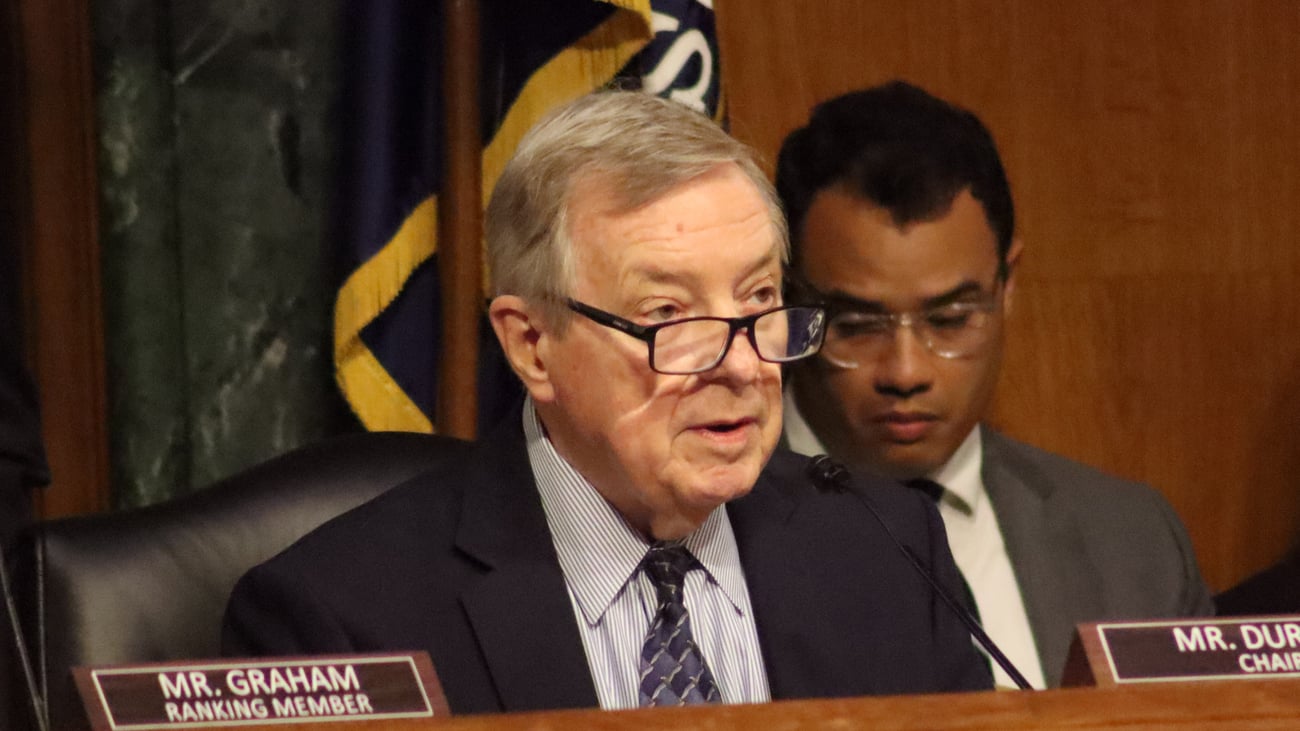
Durbin: Opposes Democratic SCOTUS Retaliation, Court Packing
Summary
- Senator Dick Durbin, Ranking Member of the Senate Judiciary Committee, opposes Democratic retaliation regarding Supreme Court nominations and court packing.
- Durbin insists all future Supreme Court nominees should receive a vote, contrasting with Mitch McConnell's past actions like the Merrick Garland nomination block.
- He dismissed court packing as unrealistic due to potential presidential vetoes and current political dynamics.
- Senator Sheldon Whitehouse plans to reintroduce a bill proposing staggered 18-year term limits for Supreme Court justices.
- Durbin and Republican Representative Darrell Issa both lamented the court's politicization but disagreed on whether former President Trump was solely to blame.
Durbin Urges Restraint on Supreme Court Nominations
Durbin asserted that McConnell was the sole senator to have fundamentally altered the Supreme Court's tenure and composition, specifically by leaving a vacancy for ten months as the Obama presidency concluded, effectively deciding that eight justices were sufficient.
Senator Dick Durbin, the Ranking Member of the Senate Judiciary Committee, recently cautioned his party against adopting aggressive tactics regarding Supreme Court nominations, even if they secure a majority in the upcoming November midterm elections. Speaking on a Wednesday during a hearing of the Senate Judiciary Committee on September 24, 2024, Durbin emphasized that all future Supreme Court nominees should be granted a vote, irrespective of which political party controls Congress. He acknowledged the significant power vested in the Senate but advocated for a departure from the "political gamesmanship" that has characterized past judicial appointment processes.
Durbin, who announced in April 2025 that he will retire at the close of his term in January 2027, explicitly discouraged Democrats from engaging in retaliatory measures. He also dismissed the notion of altering the number of Supreme Court justices, a concept often referred to as court packing. Durbin argued that such a proposal, even if passed by a majority in a "wave election," would likely face a presidential veto, rendering it an unrealistic discussion given the current political landscape in Washington.
Historical Context of Judicial Appointment Battles
Durbin's remarks drew a clear contrast with the strategies employed by Republican Senator Mitch McConnell during the Obama administration. Durbin asserted that McConnell was the sole senator to have fundamentally altered the Supreme Court's tenure and composition, specifically by leaving a vacancy for ten months as the Obama presidency concluded, effectively deciding that eight justices were sufficient. He characterized McConnell's actions as "overstepping" and inconsistent with previous stances on judicial appointments.
This historical precedent includes McConnell's refusal in 2016, while serving as Senate majority leader, to hold a vote on President Barack Obama’s nomination of former Attorney General Merrick Garland to fill the seat left vacant by the late Justice Antonin Scalia. McConnell justified his opposition by citing the impending 2016 presidential election. However, on the eve of the subsequent election in 2020, the Kentucky Republican expedited the appointment of a successor for the late Justice Ruth Bader Ginsburg, leading to Amy Coney Barrett becoming the third Supreme Court justice nominated by President Trump and confirmed by the Senate during his initial term. Democrats have consistently criticized McConnell's approach to bolstering conservative judicial nominees over the past decade.
Proposals for Judicial Reform
Amidst the ongoing debate over the US judicial appointments process and the structure of the Supreme Court, Senator Sheldon Whitehouse of Rhode Island announced in July his intention to reintroduce the Supreme Court Term Limits and Regular Appointments Act. This proposed legislation aims to implement staggered 18-year term limits for new justices appointed to the bench, a significant reform that could reshape the judiciary.
Under Whitehouse's proposal, the Senate would also gain the ability to waive its traditional "advice and consent" power concerning Supreme Court nominees. The bill outlines a system where the next president would be authorized to nominate two new Supreme Court justices during both the first and third years following a presidential election. Furthermore, the legislation stipulates that only the nine most junior justices on the bench would actively rule on cases, with a justice being deemed retired after completing an 18-year term.
Debating the Court's Politicization
Durbin's comments were made during a panel discussion that also featured Republican Representative Darrell Issa, a member of the House Judiciary Committee. Both lawmakers expressed concern over the increasing politicization of the Supreme Court, though they differed significantly on the root cause of this trend. Durbin attributed the court's politicized perception to former President Trump's rhetoric.
He argued that Trump's consistent demands for loyalty, coupled with his practice of rewarding favorable rulings and castigating unfavorable ones, has led the public to view the court's decisions through a political lens. Conversely, Representative Issa contended that Trump was not solely responsible for the sharp critiques leveled against the judiciary, suggesting a broader context for the perceived politicization.
Practical Implications
This article signals the ongoing political debate over the structure and appointment process of the US Supreme Court, including proposals for term limits. Lawyers should monitor these discussions as they could lead to significant reforms impacting judicial stability, the interpretation of law, and the long-term predictability of legal outcomes.
Source
How does this affect you?
Get an AI analysis of this article grounded in your jurisdictions, practice areas, and any policy documents you've uploaded to Wansom.
Finish Reading the Full Story and the Expert Analysis.
Get the latest legal & regulatory intelligence in United States
Wansom is AI and can make mistakes.