
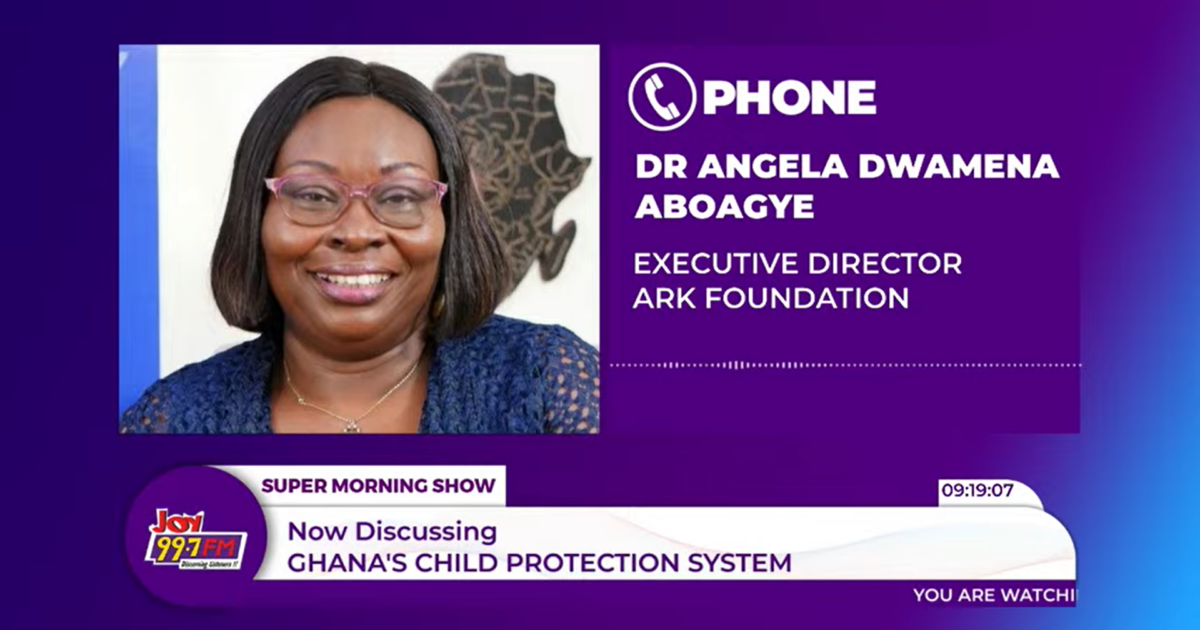
Discipline must not become abuse in raising children – ARK Foundation
Summary
- Dr. Angela Dwamena-Aboagye of the Ark Foundation emphasized that discipline is essential for children but must never become abuse.
- She identified hitting children with objects, locking them in rooms, or withholding food as clear examples of abuse, not discipline.
- Dr. Dwamena-Aboagye warned against increasingly severe disciplinary methods, despite some traditional physical correction.
- Her statements precede a new JoyNews and SOS Children’s Villages documentary, “Hands That Hurt, Hands That Heal,” investigating violent child punishment.
- The documentary will examine existing child protection systems, identify gaps, and scrutinize discipline practices in various child-care settings.
The Crucial Distinction in Child Rearing
Discipline must have clear limits and should never become a justification for violence or cruel treatment.
Dr. Angela Dwamena-Aboagye, the Founder of the Ark Foundation, recently underscored the indispensable role of discipline in raising children, while simultaneously issuing a stern caution to parents and caregivers against allowing corrective measures to escalate into abuse. Speaking on Joy FM’s Super Morning Show on a Monday, Dr. Dwamena-Aboagye articulated that discipline is fundamental for nurturing responsible individuals, particularly given that young people are in their formative years and require clear guidance and established boundaries.
She emphasized that the necessity of discipline extends universally, applying equally to both adults and children. However, Dr. Dwamena-Aboagye firmly stated that disciplinary actions must always operate within defined limits and should never serve as a justification for violence or cruel treatment. Her remarks, made on September 14, 2026, highlight a critical area of concern for child welfare advocates in Ghana.
Defining the Boundaries of Acceptable Discipline
While acknowledging that some forms of physical correction have historically been integrated into traditional approaches to discipline, Dr. Dwamena-Aboagye issued a strong warning against the adoption of increasingly severe and perilous methods. She provided concrete examples of actions that unequivocally constitute abuse rather than appropriate discipline, including striking a child with household items such as a frying pan, confining them to a room, or intentionally depriving them of food. These acts, she asserted, clearly cross the line into harmful conduct.
Dr. Dwamena-Aboagye posited that there is a general, intuitive understanding among people regarding when disciplinary actions have gone too far and transformed into abusive behavior. As a staunch proponent of discipline, she stressed that this commitment must be paired with a clear differentiation between constructive correction and actions that inflict harm or degradation upon a child. This distinction is vital for upholding Ghana child protection laws and ensuring that the Ghana child abuse legal definition is clearly understood by all caregivers.
Broader Advocacy and Investigative Focus on Child Welfare
The Ark Foundation Ghana child rights advocate further elaborated on the significant societal repercussions that can arise from a pervasive lack of discipline among both children and adults. Her comments arrive as JoyNews has launched a new investigative documentary, produced in collaboration with SOS Children’s Villages, which aims to delve deeper into the issue of violent punishment against children across Ghana.
This Hotline documentary, titled “Hands That Hurt, Hands That Heal,” is designed to explore the lived experiences of children who have been subjected to violent forms of punishment. It will also critically examine the existing systems, institutions, and safeguards intended to protect vulnerable children, while simultaneously highlighting the persistent gaps that undermine efforts to ensure child safety. The documentary, a key piece of SOS Children's Villages Ghana advocacy, seeks to bring national attention to the broader question of how discipline is practiced within homes, schools, and other environments where children are entrusted to adult care, thereby influencing future Ghana child welfare legislation and public discourse on the Ghana child discipline abuse distinction.
Source
How does this affect you?
Get an AI analysis of this article grounded in your jurisdictions, practice areas, and any policy documents you've uploaded to Wansom.
Finish Reading the Full Story and the Expert Analysis.
Get the latest legal & regulatory intelligence in Ghana
Wansom is AI and can make mistakes.