
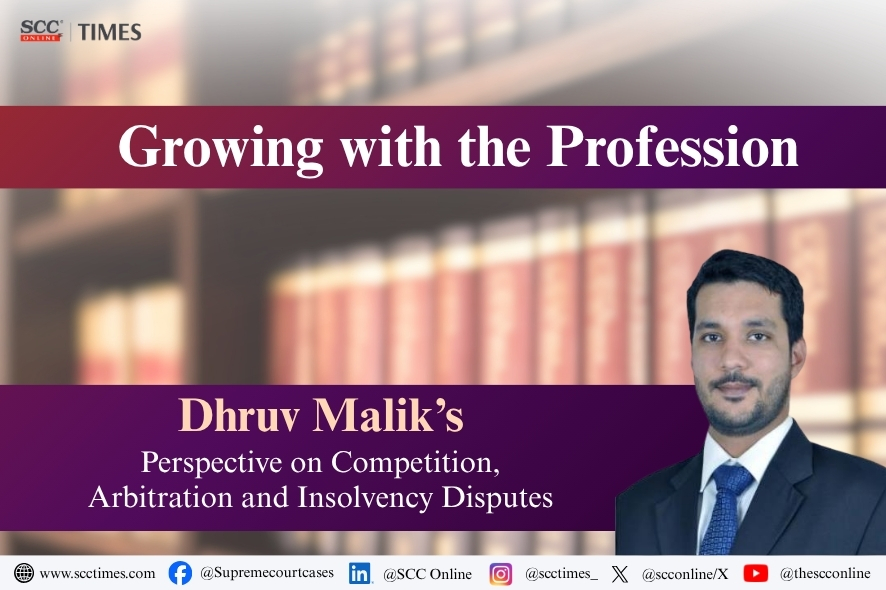
Dhruv Malik: India's Integrated Competition, Arbitration, Insolvency Practice
Summary
- Dhruv Malik's legal career began with a deliberate process of elimination, leading him to embrace law.
- He developed a multi-disciplinary practice in India due to commercial disputes frequently spanning multiple statutes like SARFAESI, insolvency, and civil suits.
- Malik was recognized among the ALB Asia Super 50 Disputes Lawyers in 2022 and Top 30 in 2021, attributing this to client confidence and teamwork.
- His approach emphasizes that effective dispute resolution requires a holistic understanding, as clients present business problems, not siloed legal issues.
- Malik holds postgraduate diplomas in European Union Competition Law from King's College, London, and NLU Delhi, which informs his Indian competition law approach.
The Evolution of a Multi-Disciplinary Practice
His instinct to follow a dispute wherever it might lead, rather than restricting himself to a particular forum or statute, has been the foundational principle shaping his current practice, which adeptly handles complex matters spanning competition, arbitration, and insolvency in India.
Dhruv Malik's journey into the legal profession was marked by a process of deduction, where he systematically ruled out career paths he did not wish to pursue, ultimately arriving at law as a field he felt capable of excelling in. His initial attraction to law school stemmed from the intellectual rigor and the art of advocacy it presented. What he did not foresee was the profound way legal practice would immerse him in the intricacies of business, economics, human behavior, and strategic thinking.
Malik's decision to cultivate a diverse practice, rather than specializing in a single area, was a direct response to the inherent nature of commercial disputes in Delhi. He observed that legal challenges rarely remain confined to one statute. For instance, a recovery suit frequently evolves into a matter under the Securitisation and Reconstruction of Financial Assets and Enforcement of Security Interest (SARFAESI) Act, while a shareholder dispute often spills over into insolvency proceedings. Similarly, a regulatory complaint can exist concurrently with a civil suit for damages.
This interconnectedness of legal issues led Malik to make a conscious choice early in his career to avoid siloing his expertise. He recognized that clients approach lawyers with overarching business problems, viewing the law simply as a comprehensive toolkit to address these challenges. This instinct to follow a dispute wherever it might lead, rather than restricting himself to a particular forum or statute, has been the foundational principle shaping his current practice, which adeptly handles complex matters spanning competition, arbitration, and insolvency in India.
Navigating Interconnected Legal Challenges
The dynamic and ever-evolving landscape of dispute resolution remains a constant source of professional excitement for Dhruv Malik, as no two matters are ever identical. One day, his practice might involve a distressed infrastructure asset under the Insolvency and Bankruptcy Code, 2016 (IBC 2016 insolvency practice India); the next, he could be addressing a complex competition law issue concerning market power; and the day after, he might be engaged in a multijurisdictional arbitration. While the law provides a common language, the underlying commercial realities are in perpetual flux.
Malik frequently advises younger legal professionals that the most rewarding aspect of this career is the continuous opportunity for learning. Even after fifteen years in practice, he finds that every significant matter offers new insights and serves as another chance to expand his knowledge. This commitment to ongoing education and a holistic approach underscores his Dhruv Malik dispute resolution strategy, emphasizing adaptability and a broad understanding across various legal domains.
Professional Recognition and the Essence of Indian Litigation
In 2022, Dhruv Malik was distinguished as one of only eight lawyers in India to be featured in the Asian Legal Business (ALB) Asia Super 50 Disputes Lawyers list, building on his recognition in 2021 among the Top 30 Disputes Lawyers in India. While acknowledging the gratification of such accolades, Malik primarily views them as a testament to the trust clients place in him and the privilege of collaborating with exceptional teams throughout his career. His perspective on litigation underwent a significant transformation during his tenure at Juris Corp, under the mentorship of Senior Partners.
Contrary to the common perception of disputes practice as an individual endeavor—often observed through lawyers arguing in court—Malik emphasizes that successful outcomes are invariably the product of extensive teamwork, involving months of meticulous research, drafting, and strategic discussions. He considers rankings to be useful indicators but not definitive measures of professional excellence, noting that many highly competent and ethical lawyers, who have built extraordinary practices, do not appear in such listings. The true measure of success in Indian dispute resolution, he asserts, is the credibility earned through consistent preparation, sound judgment, and unwavering integrity, as judged by clients and courts alike, one brief at a time.
Foundational Insights from Competition Law
Dhruv Malik's academic background includes postgraduate diplomas in European Union Competition Law from King's College, London, and in Competition Policy and Law from NLU Delhi. This specialized education has provided him with an immensely valuable comparative lens, particularly in shaping his Indian competition law approach CCI matters. His exposure to the European framework, which has developed one of the most sophisticated competition law regimes globally, offers a robust foundation for navigating the complexities of competition law in India.
Practical Implications
Lawyers can gain strategic insights from a leading Indian practitioner on effectively managing complex commercial disputes that span competition, arbitration, and insolvency, emphasizing a holistic, multi-disciplinary approach to client problems rather than siloed specialisation.
Source
How does this affect you?
Get an AI analysis of this article grounded in your jurisdictions, practice areas, and any policy documents you've uploaded to Wansom.
Wansom is AI and can make mistakes.