
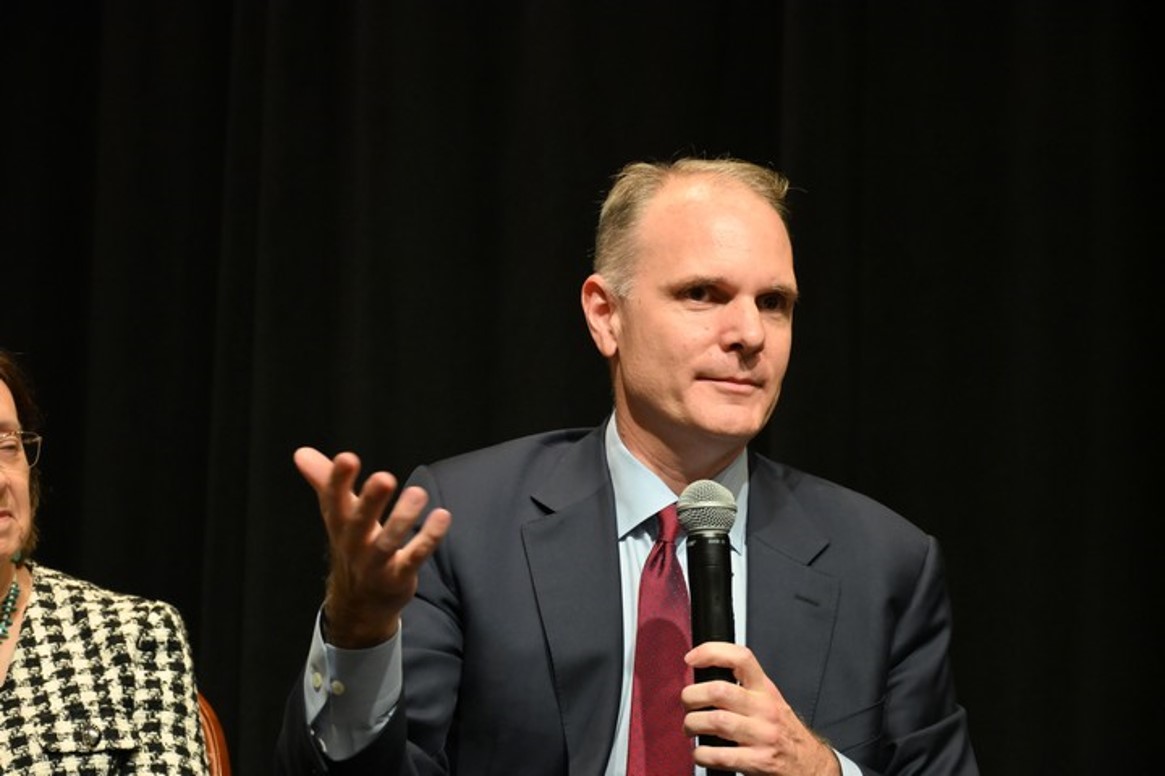
Derek Webb: ABA Explores Civility and The Spirit of Amity
Summary
- Law professor Derek Webb presented his work on the "spirit of amity" and the original meaning of civility at the ABA Annual Conference.
- King Charles had previously cited Webb's research on Magna Carta, lending significant external validation to his scholarship.
- Webb highlighted George Washington's letter transmitting the Constitution, which emphasized mutual deference and concession as indispensable for governance.
- He warned against "factional entropy," where unresolved conflict and cycles of revenge undermine republican government and trust.
- Webb stressed the vital importance of civic education and social trust for a functioning democracy, drawing parallels between historical and modern challenges.
A Call for Amity at the ABA Annual Conference
Washington’s foundational belief was that a baseline of amity, social trust, and "civic friendship" was not merely desirable but indispensable for the nation's security and continued governance.
Derek Webb, an assistant professor of law at the Columbus School of Law at the Catholic University of America, recently shared insights from his forthcoming Cambridge University Press book, "The Spirit of Amity: The Constitution’s Cover Letter and the Original Meaning of Civility," at the ABA Annual Conference in Chicago. His presentation, hosted by the ABA’s Crossroads Caucus, came with a notable pre-endorsement: King Charles had cited Webb’s work on Magna Carta in an April speech to a joint session of Congress just months prior. This recognition underscored the timely relevance of Webb's scholarship on civility and constitutional governance.
The program was introduced by Past President Deborah Enix-Ross, who currently leads the ABA’s Center for Civic Engagement, Education and the Rule of Law. Enix-Ross highlighted the spirit of collaboration and dedication within the ABA, exemplified by the successful negotiation of Resolution 702 at the year’s midyear meeting and the organization of events like Webb’s talk. She also referenced her role in initiating the "Disagreeing Better" series, designed to foster constructive dialogue and model productive disagreement on critical issues. The audience for Webb's discussion included a diverse group of ABA leadership and members, notably a sitting Supreme Court justice from the United Kingdom and a prominent advocate before the U.S. Supreme Court.
Washington's Vision: The Original Meaning of Civility
Webb transported his audience back 250 years, illustrating how the American founders grappled with profound disagreements on foundational issues, drawing clear parallels to contemporary political discord. He described the immense difficulty they faced in achieving compromise, noting a historical pattern where factions sought to dominate one another, leading to cycles of revenge as power shifted. Webb termed this destructive dynamic "factional entropy," explaining that unresolved conflict inevitably breeds disorder, and such cycles can erode public confidence in republican government, potentially paving the way for authoritarian rule.
Central to Webb’s presentation was George Washington’s pivotal role as president of the Federal Convention. Washington transmitted the newly drafted Constitution to the president of Congress accompanied by a concise yet profoundly significant letter. This document articulated Washington’s perspective on balancing competing interests, such as individual liberty versus social stability, and the distinct interests of various states. He emphasized that these matters demanded evaluation based purely on their merits, explicitly rejecting ad hominem attacks and urging delegates to consider issues independently of their political affiliations. The letter famously declared: “The Constitution, which we now present, is the result of a spirit of amity and of that mutual deference and concession, which the peculiarity of our political situation rendered indispensable.” Washington’s foundational belief was that a baseline of amity, social trust, and "civic friendship" was not merely desirable but indispensable for the nation's security and continued governance.
Sustaining Democracy Through Civic Engagement
Webb further elaborated that Washington’s work did not conclude with the Constitution’s adoption; rather, the "spirit of amity" had to evolve into comity, guiding how the states would coexist after the initial compromises and agreements were forged. He underscored the critical role of civic education in ensuring the enduring functionality of democracy, both domestically and internationally. This emphasis on education and dialogue was evident in the lively question-and-answer session that followed his presentation, which extended well beyond its scheduled hour.
Webb’s recent experiences further highlight his commitment to these principles. He had just returned from Normandy, France, where he participated in a conference on the state of democracy, hosted by descendants of Alexis de Tocqueville at the very château where *Democracy in America* was written. Webb concluded that the form of democracy Tocqueville observed and analyzed would not have been possible without the enduring "spirit of amity" championed by Washington, reinforcing the timeless relevance of these principles for modern governance.
Practical Implications
This discussion reminds lawyers and compliance officers of the foundational importance of civility, mutual deference, and constructive dialogue in legal practice and constitutional governance. It underscores the professional obligation to foster these principles in advocacy and dispute resolution, recognizing their role in maintaining public trust in the legal system and democratic institutions.
Source
How does this affect you?
Get an AI analysis of this article grounded in your jurisdictions, practice areas, and any policy documents you've uploaded to Wansom.
Finish Reading the Full Story and the Expert Analysis.
Get the latest legal & regulatory intelligence in United States
Wansom is AI and can make mistakes.