
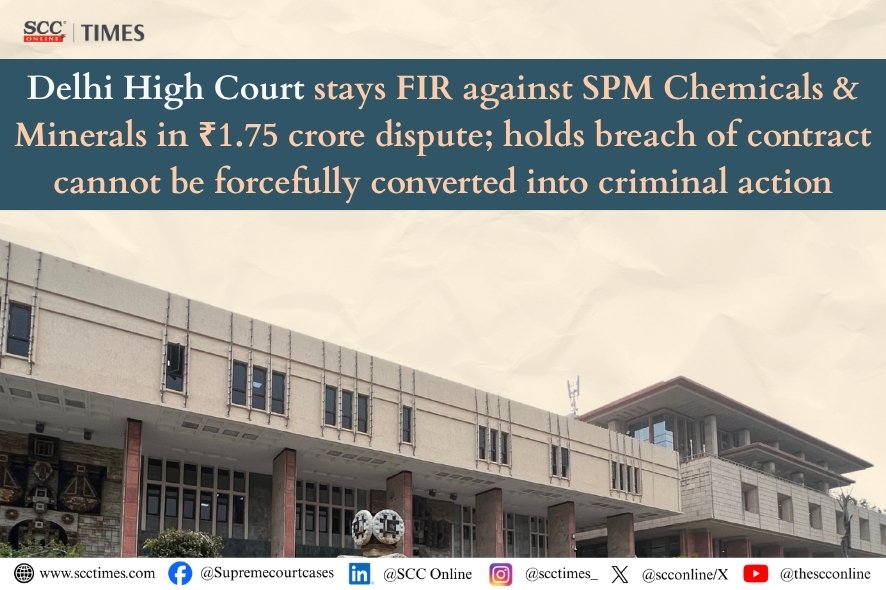
Delhi High Court Stays FIR Against SPM Chemicals in Contract Dispute
Summary
- The Delhi High Court stayed an FIR registration order against SPM Chemicals & Minerals in a ₹1.75 crore dispute.
- The court held that breach of contract cannot be forcefully converted into criminal action, setting a significant precedent for contract law in India.
- Businesses must now ensure their contracts clearly outline the consequences of non-compliance to avoid potential disputes and criminal proceedings.
What Happened
The court's observation that breach of contract cannot be forcefully converted into criminal action is a significant departure from previous interpretations.
The Delhi High Court has intervened in a commercial dispute between SPM Chemicals & Minerals and its business partners, staying an FIR registration order. The court's decision is significant as it sets a precedent for the interpretation of contract law in India. According to reports, the dispute revolves around a ₹1.75 crore claim made by one of the parties against SPM Chemicals & Minerals.
The FIR was registered on allegations of breach of contract, but the court has now held that such breaches cannot be forcefully converted into criminal actions. This ruling is expected to have far-reaching implications for businesses operating in India.
Legal Context
The Delhi High Court's decision is a crucial development in the realm of commercial dispute resolution in India. The court's observation that breach of contract cannot be forcefully converted into criminal action is a significant departure from previous interpretations. This ruling is likely to impact the way businesses approach contractual disputes and the potential consequences of non-compliance.
The case highlights the importance of clear contractual agreements that outline the consequences of non-performance or breach. Businesses must now ensure that their contracts are robust enough to withstand potential disputes and criminal proceedings. The court's decision also underscores the need for a nuanced understanding of contract law in India, particularly with regards to the distinction between civil and criminal actions.
Why It Matters
The Delhi High Court's ruling has significant implications for businesses operating in India. Lawyers must now advise their clients on the potential consequences of contractual disputes being escalated to criminal proceedings. This precedent sets a new benchmark for contract law in India, emphasizing the importance of clear contractual agreements and robust dispute resolution mechanisms.
As businesses navigate complex commercial relationships, they must be aware of the potential risks associated with breach of contract. The court's decision serves as a reminder that contracts are not mere documents but living agreements that require ongoing attention and compliance. By understanding this precedent, businesses can better manage their contractual obligations and mitigate potential disputes.
Practical Implications
Lawyers should watch for this precedent when advising clients on the potential for contractual disputes to be escalated to criminal proceedings, and ensure that their clients' contracts clearly outline the consequences of non-compliance.
Source
Source: Original reporting via SCC Times
How does this affect you?
Get an AI analysis of this article grounded in your jurisdictions, practice areas, and any policy documents you've uploaded to Wansom.
Wansom is AI and can make mistakes.