
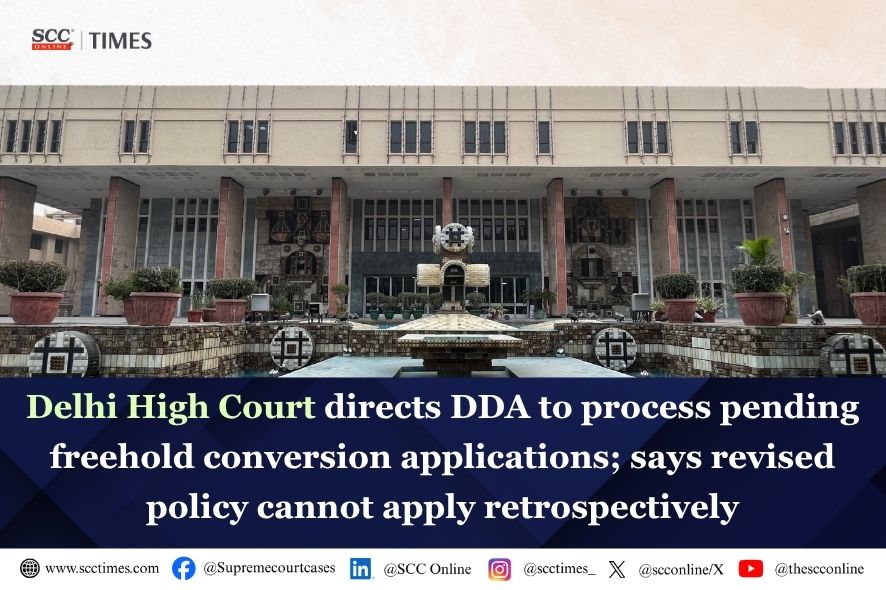
Delhi High Court: DDA Freehold Retrospective Policy Must Be Prospective
Summary
- The Delhi High Court ruled that new DDA freehold conversion policies must apply prospectively, not retrospectively.
- All 1373 pending applications, for which Rs. 155.06 crores have been collected, must be processed under the policy prevailing at the time of their filing.
- The court found the DDA's conversion portal had been shut down since February 2026, stalling numerous applications.
- The decision cited the *Neera Sharma v. Delhi Development Authority* precedent, which held that DDA cannot charge higher rates retrospectively if initial charges were deposited.
- The court noted that DDA's internal discussions had not yet yielded a final, clear new policy on conversions.
What Happened
All past applications for which payment had been received would have to be processed as per the policy prevalent at the relevant point in time.
The Delhi High Court has issued a significant directive concerning the Delhi Development Authority's (DDA) long-standing issue of converting leasehold properties to freehold status. A Division Bench comprising Justices Prathiba M. Singh and Vikas Mahajan addressed the predicament of numerous property owners whose applications for DDA leasehold to freehold conversion remained unprocessed. The court observed that the DDA's portal for these conversions had been non-operational since February 2026, effectively halting all pending applications, despite many applicants having already submitted the required charges.
This administrative paralysis left a substantial number of property owners in limbo. The court specifically noted that 1373 applications were pending, with the DDA having already collected a considerable sum of Rs. 155.06 crores in conversion charges. The core of the court's ruling mandates that any new policy regarding DDA freehold retrospective policy must be applied prospectively, ensuring that all applications for which payment has been received are processed under the policy that was in effect at the time of their original submission.
Prior to this ruling, the court had instructed a meeting involving key stakeholders, including the Secretary of the Department of Capital Development, MoHUA, and the DDA, to discuss the matter. Minutes from this meeting, dated August 14, 2026, indicated ongoing discussions about simplifying documentation, streamlining the conversion process, and re-evaluating the structure of conversion charges. However, no final substantive decisions had been reached, and the DDA's conversion policy remained under review, aimed at rationalization and simplification. Despite this, leaseholders retained their rights to transfer, gift, inherit, or mortgage their properties according to established procedures, and could still apply to the DDA for property transfers.
Legal Context and Court's Reasoning
Central to the Delhi High Court's decision was the question of whether a revised DDA conversion policy could be applied retrospectively to applications where charges had already been paid. The court probed counsels for the DDA and MoHUA on the retrospective application of new policies, to which they conceded that such policies are generally prospective, with only rare exceptions. This acknowledgment laid the groundwork for the court's subsequent findings.
The property owners' arguments were bolstered by the precedent set in *Neera Sharma v. Delhi Development Authority*, W.P.(C) 5180 of 2012. In that case, the court had unequivocally stated that if an applicant had deposited charges along with their application, the DDA lacked a legal basis to impose higher rates simply because rates had changed before the permission was granted. The court in *Neera Sharma* also highlighted that the DDA had failed to identify any rule or regulation supporting the application of higher charges based on rates prevalent at the date of grant, rather than the date of application. It emphasized that in such scenarios, the applicant, not the DDA, bears the brunt, as their funds remain tied up while they are unable to utilize their land.
The current Division Bench concurred with the reasoning articulated in the *Neera Sharma* judgment. It firmly held that any new policy announced by the DDA must operate prospectively. Given the large volume of pending applications where conversion charges had already been collected but processing stalled due to the portal shutdown, the court explicitly clarified that all past applications with received payments must be processed under the policy prevailing at the time of their submission. The court further noted that the minutes from the August 2026 meeting did not reflect a concrete final policy, but rather a continued lack of clarity on documentation and conversion charges, and even on the basic mechanisms for transferring leasehold properties.
Implications of the Ruling
This judgment by the Delhi High Court provides crucial clarity for property owners affected by the DDA's stalled leasehold to freehold conversion process. By mandating that new policies cannot be applied retrospectively, the court has safeguarded the interests of the 1373 applicants who collectively paid Rs. 155.06 crores, ensuring their applications are assessed under the terms they initially agreed to. This ruling effectively prevents the DDA from imposing potentially higher charges or more stringent conditions under a new policy on applications already submitted and paid for.
The court's insistence on prospective application of any new DDA freehold retrospective policy underscores a fundamental principle of administrative law, protecting individuals from arbitrary changes in regulations. While the DDA and other authorities continue their internal discussions on rationalizing and simplifying the conversion process, the court's finding that no final, clear policy has emerged means that the existing legal framework, as interpreted by the court, remains paramount for pending cases. This decision compels the DDA to address the backlog of applications based on the original prevailing policies, rather than waiting for an undefined future policy.
Furthermore, the ruling reinforces that property owners' fundamental rights to transfer, gift, inherit, or mortgage their leasehold properties were not curtailed by the DDA's review of its conversion policy. This distinction is important, as it separates the ongoing policy discussions from the immediate processing obligations for existing applications. The court's clear stance aims to resolve the uncertainty faced by numerous property owners and ensure timely processing of their DDA leasehold to freehold conversion applications.
Practical Implications
Lawyers and compliance officers representing property owners with pending DDA leasehold-to-freehold conversion applications should advise clients that their applications must be processed under the policy prevailing at the time of submission, not any new retrospective policy. This ruling provides a strong basis to compel DDA to expedite processing of these applications and ensures clients are not disadvantaged by policy changes after their initial application and payment.
Source
Source: Original reporting via LiveLaw
How does this affect you?
Get an AI analysis of this article grounded in your jurisdictions, practice areas, and any policy documents you've uploaded to Wansom.
Finish Reading the Full Story and the Expert Analysis.
Get the latest legal & regulatory intelligence in India
Wansom is AI and can make mistakes.