
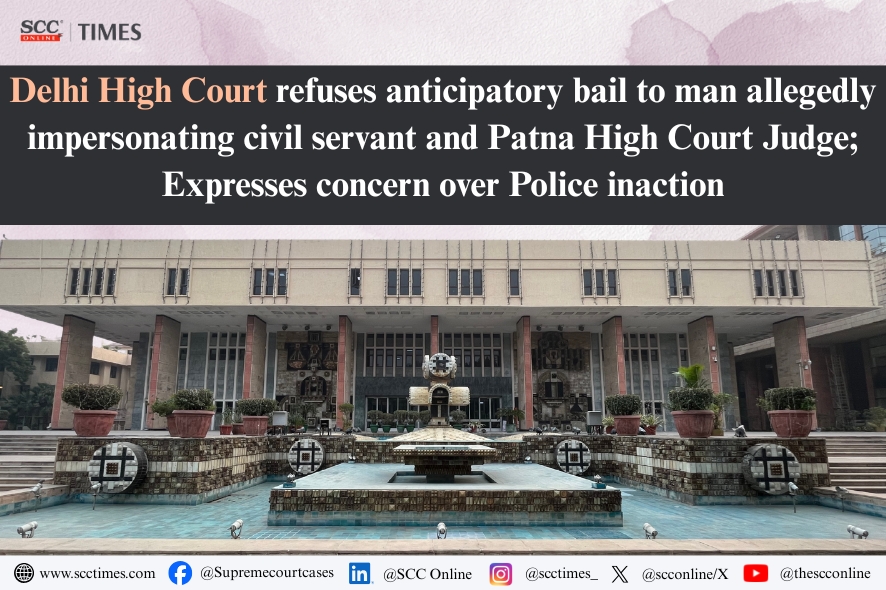
Delhi High Court Denies Anticipatory Bail for Impersonating Civil Servant
Summary
- Delhi High Court rejects anticipatory bail application for man accused of impersonating civil servant and Patna High Court judge.
- Court expresses surprise at police inaction despite repeated dismissals of bail applications, including one by Supreme Court.
- Case highlights need for thorough background checks on individuals interacting with judges or high-ranking officials.
What Happened
The Court observed that such inaction conveyed an impression that the accused was being helped and that “there is something more that meets the eye”.
A man, accused of impersonating a civil servant and a Patna High Court judge, had his anticipatory bail application rejected by the Delhi High Court. This decision marks the latest development in a case that has seen repeated dismissals of the accused's bail applications, including one by the Supreme Court. The Court's ruling highlights concerns about police inaction in the matter.
The Delhi High Court expressed surprise at the lack of action taken by local authorities to apprehend the accused, despite multiple opportunities to do so. This perceived inaction has raised suspicions that the accused may be receiving assistance from within the system.
Legal Context
Anticipatory bail is a legal provision that allows individuals to seek protection against potential arrest and prosecution. In India, anticipatory bail was historically enshrined under Section 438 of the Code of Criminal Procedure (CrPC), 1973. However, with the recent overhaul of India's criminal laws, the Bharatiya Nagarik Suraksha Sanhita (BNSS), 2203, has replaced the CrPC, and anticipatory bail is now explicitly covered under Section 482 of the BNSS, 2023. In this case, the accused had filed multiple applications for anticipatory bail, which were repeatedly dismissed by various courts, including the Supreme Court. The Delhi High Court's rejection of his latest application underscores the importance of thorough background checks on individuals, particularly those interacting with judges or high-ranking officials.
The case has also sparked concerns about police inaction and potential collusion between law enforcement and accused individuals. This raises questions about the effectiveness of current laws and regulations in preventing such incidents.
Why It Matters
The Delhi High Court's decision highlights the need for thorough background checks on individuals, especially those interacting with judges or high-ranking officials. Lawyers and compliance officers should be aware of the potential risks associated with impersonation and take necessary precautions to prevent such incidents. The case also underscores the importance of effective police action in preventing and investigating cases of impersonation.
The incident has significant implications for the legal profession, emphasizing the need for robust measures to ensure the integrity of the judicial system.
Practical Implications
This development highlights the importance of thorough background checks on individuals, particularly those who may be interacting with judges or other high-ranking officials. Lawyers and compliance officers should ensure that their clients are aware of the potential risks associated with impersonation and take necessary precautions to prevent such incidents.
Source
Source: Original reporting via SCC Times
How does this affect your business?
Get an AI analysis of this article grounded in your jurisdictions, practice areas, and any policy documents you've uploaded to Wansom.
Wansom is AI and can make mistakes.