
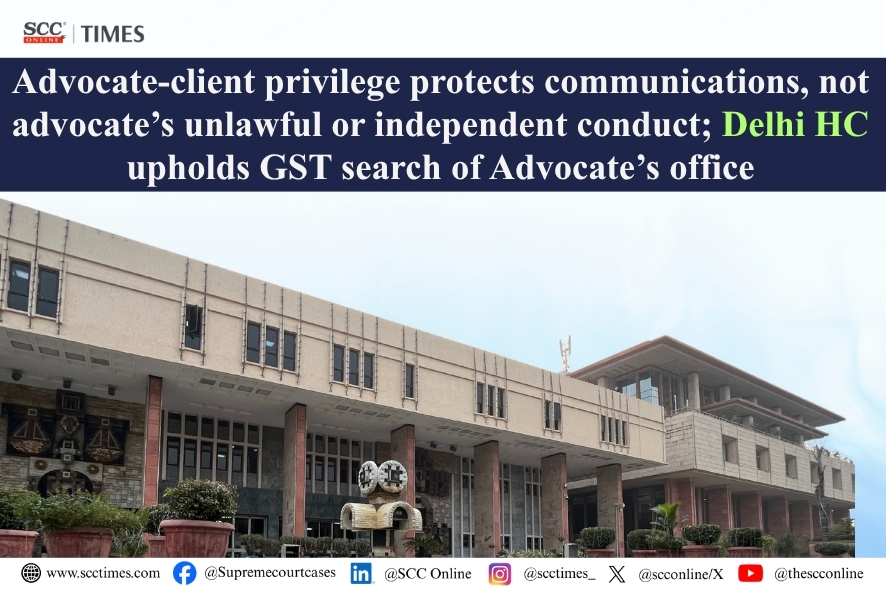
Delhi HC Upholds GST Search Advocate Office: Privilege Protected
Summary
- The Delhi High Court upheld a search conducted at an advocate's office under the CGST Act, 2017.
- The search was specifically carried out under Section 67(2) of the Central Goods and Services Tax Act.
- The court mandated the protection of privileged and third-party confidential material during the search.
- Advocate-client privilege protects communications but does not shield a lawyer's own unlawful or independent conduct.
- This ruling clarifies the extent of investigative powers over legal professionals in India during GST inquiries.
What Happened
The court unequivocally stated that while advocate-client privilege protects confidential communications between a lawyer and their client, it does not extend to shield an advocate's own unlawful activities or their independent conduct from investigation.
The Delhi High Court recently issued a significant ruling, affirming the legality of a search conducted at an advocate's office under the provisions of the Central Goods and Services Tax Act, 2017. This decision, which specifically addresses a Delhi HC upholds GST search advocate office, underscores the judiciary's stance on the balance between investigative powers and professional protections. The court's judgment upheld the search, which was carried out pursuant to Section 67(2) of the CGST Act, 2017.
However, this affirmation was not absolute; the High Court explicitly stipulated that the search's validity was contingent upon the strict protection of both privileged material and any confidential information belonging to third parties. This nuanced ruling provides crucial clarity on the extent to which legal professionals in India are subject to regulatory scrutiny.
Legal Framework and Privilege
At the heart of this matter lies the interplay between the investigative powers granted by the Central Goods and Services Tax Act and the fundamental principle of advocate-client privilege India. Section 67(2) of the CGST Act empowers authorities to conduct searches when there is reason to believe that goods liable to confiscation or documents relevant to proceedings are concealed. The Delhi High Court meticulously distinguished between the sanctity of privileged communication lawyer India and an advocate's personal conduct.
The court unequivocally stated that while advocate-client privilege protects confidential communications between a lawyer and their client, it does not extend to shield an advocate's own unlawful activities or their independent conduct from investigation. This distinction is vital, as it clarifies that the privilege is designed to facilitate open communication for legal advice, not to provide immunity for a lawyer's alleged personal transgressions. The ruling thus delineates the precise boundaries of this crucial legal protection during a GST investigation advocate's conduct.
Implications for Legal Professionals
This judgment carries substantial implications for legal practitioners across India, particularly concerning the scope of their professional immunity during regulatory inquiries. The Delhi High Court's decision means that while the core of advocate-client privilege remains inviolable for client-related communications, lawyers cannot invoke this protection to evade scrutiny over their own alleged involvement in activities that fall outside the purview of legitimate legal advice.
For any GST investigation advocate's conduct, this ruling establishes that authorities can proceed with searches under Section 67(2) CGST Act advocate, provided they adhere to the safeguard of protecting client-privileged and third-party confidential documents. It reinforces the principle that no profession is entirely above the law when it comes to personal conduct, even as the integrity of the legal advisory relationship is preserved. This clarification is essential for both legal professionals navigating compliance and for investigative agencies exercising their statutory powers.
Practical Implications
Lawyers in India must understand that advocate-client privilege does not shield their own alleged unlawful conduct from regulatory investigations, such as GST searches, though client communications remain protected. This ruling clarifies the extent of investigative powers over legal professionals and the boundaries of privilege during such actions.
Source
How does this affect you?
Get an AI analysis of this article grounded in your jurisdictions, practice areas, and any policy documents you've uploaded to Wansom.
Finish Reading the Full Story and the Expert Analysis.
Get the latest legal & regulatory intelligence in India
Wansom is AI and can make mistakes.