
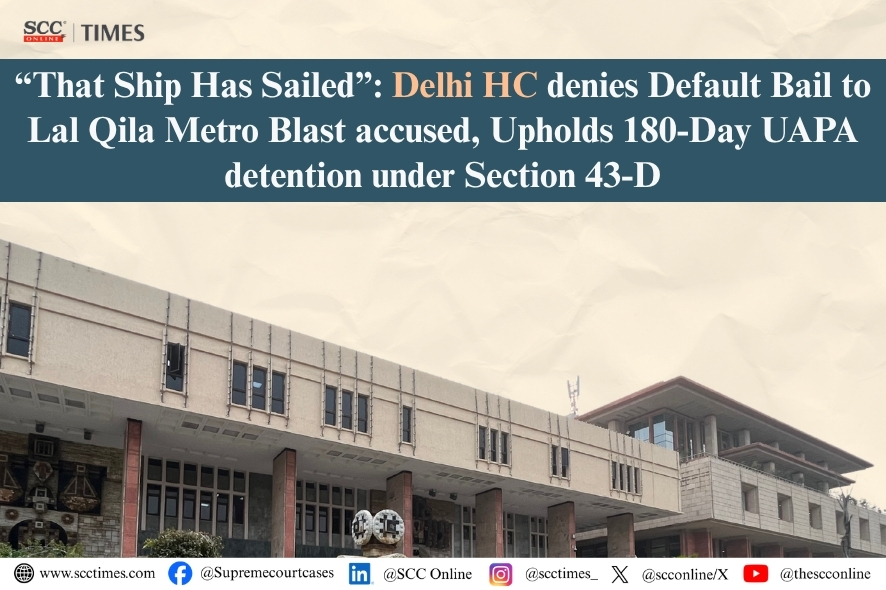
Delhi HC: No Default Bail After 180-Day UAPA Detention Under Section 43-D
Summary
- The Delhi High Court has upheld the detention of UAPA accused under Section 43-D for up to 180 days without default bail.
- The court's ruling is based on a recent amendment to the UAPA, which replaced the CrPC with the BNSS.
- Accused individuals can be detained for longer periods without access to default bail, potentially infringing on their fundamental rights.
- Lawyers are concerned about the impact of this decision on their clients' rights and obligations under Indian law.
Delhi High Court's Ruling
The Delhi High Court's ruling has significant implications for the rights and obligations of accused individuals under Indian law.
In a significant development, the Delhi High Court has upheld the detention of accused individuals under the Unlawful Activities (Prevention) Act (UAPA), ruling that they are not entitled to default bail even after 90 days. This decision was made in relation to the Lal Qila Metro Blast case, where several individuals have been detained under Section 43-D of the UAPA. The court's ruling has sparked concerns among lawyers and experts about the implications for accused individuals' rights and obligations under Indian law.
The Delhi High Court's decision is based on a recent amendment to the UAPA, which replaced the Code of Criminal Procedure (CrPC) with the National Investigation Agency (NIA) Special Courts Act (BNSS). Section 43-D(2) of the UAPA now permits detention up to 180 days, even after the BNSS has been implemented. This means that accused individuals can be detained for a longer period without being entitled to default bail.
The court's ruling has significant implications for the rights and obligations of accused individuals under Indian law. Lawyers are concerned that this decision may lead to an increase in prolonged detentions, potentially infringing on the fundamental rights of accused individuals.
Legal Context
The UAPA is a comprehensive legislation aimed at preventing and combating terrorism in India. Section 43-D of the UAPA provides for the detention of accused individuals for up to 180 days, subject to certain conditions. The recent amendment to the UAPA replaced the CrPC with the BNSS, which has significant implications for the detention period under Section 43-D.
The Delhi High Court's decision is a crucial milestone in the interpretation of the UAPA and its provisions. The court's ruling has clarified that accused individuals are not entitled to default bail even after 90 days, as previously thought. This decision has far-reaching implications for the rights and obligations of accused individuals under Indian law.
The BNSS has been implemented to streamline the investigation process and ensure faster trials. However, the Delhi High Court's ruling suggests that this may not necessarily lead to a reduction in prolonged detentions. In fact, the opposite may be true, with more individuals being detained for longer periods without access to default bail.
Why It Matters
The Delhi High Court's decision has significant implications for accused individuals and their rights under Indian law. The ruling means that UAPA accused can be detained for up to 180 days without being entitled to default bail, potentially infringing on their fundamental rights.
Lawyers are concerned about the impact of this decision on their clients' rights and obligations under Indian law. They argue that prolonged detentions may lead to an increase in miscarriages of justice, as accused individuals may not have access to adequate legal representation or due process.
The Delhi High Court's ruling has sparked a debate among lawyers and experts about the balance between national security and individual rights. While the UAPA is aimed at preventing terrorism, its provisions must be interpreted in a way that respects the fundamental rights of accused individuals.
Practical Implications
Lawyers should note that the Delhi High Court's ruling means that UAPA accused can be detained for up to 180 days without being entitled to default bail, potentially impacting their clients' rights and obligations under Indian law.
Source
Source: Original reporting via SCC Times
How does this affect you?
Get an AI analysis of this article grounded in your jurisdictions, practice areas, and any policy documents you've uploaded to Wansom.
Wansom is AI and can make mistakes.