
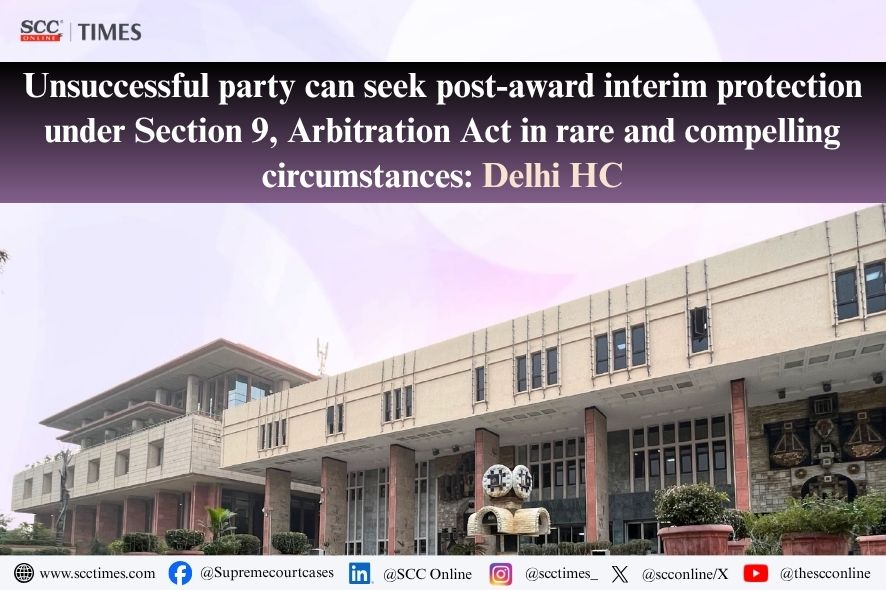
Delhi High Court: Unsuccessful Party Gets Post-Award Interim Protection
Summary
- The Delhi High Court recently ruled that an unsuccessful party can seek post-award interim protection under Section 9 of the Arbitration Act.
- This relief is available in rare and compelling circumstances, particularly if there are prima facie concerns about the evidentiary basis of the arbitral tribunal's findings.
- The court made a preliminary finding that an arbitral tribunal's decision regarding a loan sanction letter lacked evidentiary support.
- This ruling provides a potential avenue for challenging or delaying the enforcement of an arbitral award in India.
- Section 9 of the Arbitration Act, India, allows courts to grant interim measures even after an arbitral award has been issued.
Court Clarifies Post-Award Relief for Losing Parties
Lawyers advising clients in arbitration proceedings should note that even an unsuccessful party may seek post-award interim protection Delhi HC under Section 9 of the Arbitration Act in rare and compelling circumstances, as clarified by the Delhi High Court.
The Delhi High Court recently issued a significant clarification regarding the scope of interim protection available under the Arbitration and Conciliation Act, 1996. The court determined, on a preliminary assessment, that an arbitral tribunal's conclusion, which characterized a specific loan sanction letter as a fabricated document, lacked sufficient evidentiary backing. This finding formed the basis for the court's broader pronouncement.
This particular case underscores a crucial point: even a party that has not succeeded in an arbitration proceeding may, under specific and compelling circumstances, seek `post-award interim protection Delhi HC`. This avenue for relief is not typically associated with the losing side, making the court's stance particularly noteworthy for practitioners navigating `arbitral award enforcement challenges`.
The court's prima facie observation about the evidentiary deficit in the arbitral award highlights a potential ground for intervention, even after the award has been rendered. It suggests that the judicial system retains a limited oversight function to ensure fundamental fairness and evidentiary integrity, even at the post-award stage.
Understanding Section 9 of the Arbitration Act
The legal basis for this potential relief stems from `Section 9 Arbitration Act India`, which empowers courts to grant interim measures before, during, or after arbitral proceedings. While often invoked to preserve assets or secure claims prior to or during arbitration, the Delhi High Court's ruling emphasizes its applicability for `post-award interim measures India`.
Traditionally, `Section 9 Arbitration Act India` serves to prevent the arbitration process or the eventual award from being rendered ineffective. For an unsuccessful party, invoking this section post-award is an exceptional step, requiring the demonstration of rare and compelling circumstances that warrant judicial intervention to protect their interests, even if temporarily.
This judicial interpretation expands the understanding of `Delhi High Court arbitration relief`, indicating that the court can step in to address glaring issues, such as a lack of evidentiary support for a tribunal's critical findings, even after the arbitral process has concluded and an award has been issued.
Implications for Award Enforcement and Legal Strategy
This ruling carries substantial implications for `arbitral award enforcement challenges` in India. It establishes that the finality of an arbitral award is not absolute, particularly when there are `prima facie` concerns about the evidentiary foundation of the tribunal's decision. Lawyers advising clients in arbitration proceedings should note that even an unsuccessful party may seek `post-award interim protection Delhi HC` under Section 9 of the Arbitration Act in rare and compelling circumstances, as clarified by the Delhi High Court.
Such an application, while not overturning the award itself, could potentially delay or complicate its enforcement. The court's willingness to scrutinize the evidentiary basis of an award, even at a preliminary stage, provides a potential avenue for challenging or delaying the enforcement of an arbitral award, particularly if there are prima facie concerns about the evidentiary basis of the tribunal's findings.
This decision reinforces the principle that while courts generally defer to arbitral tribunals, they retain the power to intervene in extraordinary situations to prevent a miscarriage of justice. The threshold for such intervention remains high, requiring 'rare and compelling circumstances,' but the precedent now exists for `unsuccessful party post-award interim protection Delhi HC` where fundamental evidentiary flaws are apparent.
Practical Implications
Lawyers advising clients in arbitration proceedings should note that even an unsuccessful party may seek post-award interim protection under Section 9 of the Arbitration Act in rare and compelling circumstances, as clarified by the Delhi High Court. This ruling provides a potential avenue for challenging or delaying the enforcement of an arbitral award, particularly if there are prima facie concerns about the evidentiary basis of the tribunal's findings.
Source
Source: Original reporting via SCC Times
How does this affect you?
Get an AI analysis of this article grounded in your jurisdictions, practice areas, and any policy documents you've uploaded to Wansom.
Wansom is AI and can make mistakes.