
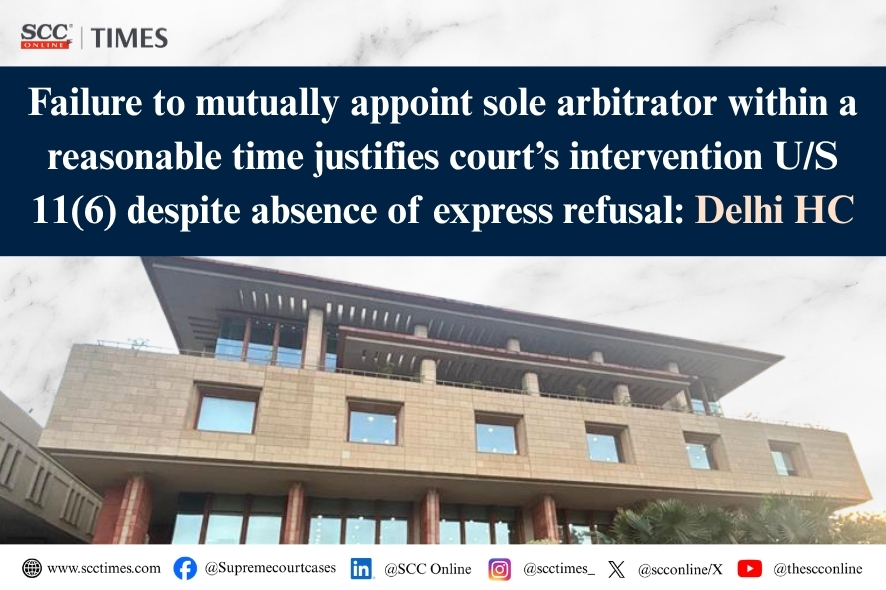
Delhi HC Section 11(6) Arbitrator Intervention: Court Clarifies Appointment Power
Summary
- The Delhi High Court ruled that court intervention under Section 11(6) of the Arbitration and Conciliation Act is justified by a failure to mutually appoint an arbitrator within a reasonable time.
- This intervention is permissible even if there is no express refusal from either party to appoint an arbitrator.
- The court will determine a 'failure to act' by examining the overall circumstances and assessing if a reasonable time for the agreed appointment procedure has passed.
- The ruling clarifies that mere delay or inaction in arbitrator appointment can trigger judicial oversight in Delhi arbitration procedures.
Landmark Ruling on Arbitrator Appointment
The Delhi High Court has clarified that judicial intervention under Section 11(6) of the Arbitration and Conciliation Act is justified when parties fail to mutually appoint a sole arbitrator within a reasonable timeframe, even in the absence of an explicit refusal.
The Delhi High Court has delivered a significant ruling clarifying the conditions under which it will exercise its power of intervention in arbitrator appointments. The court has determined that judicial intervention under Section 11(6) of the Arbitration and Conciliation Act is justified when parties fail to mutually appoint a sole arbitrator within a reasonable timeframe, even in the absence of an explicit refusal from either party to proceed with the appointment.
This decision provides crucial guidance on the threshold for court involvement in cases of stalled arbitration proceedings. It underscores that mere inaction or a prolonged delay in the mutual selection process, rather than an outright rejection, can now be sufficient grounds for the Delhi HC Section 11(6) arbitrator intervention, ensuring that arbitration processes do not remain in limbo indefinitely.
Understanding Section 11(6) of the Arbitration Act
The ruling specifically pertains to Section 11(6) of the Arbitration and Conciliation Act, India, a provision designed to facilitate the appointment of arbitrators when parties to an arbitration agreement are unable to reach a consensus. This section empowers the High Court, or the Supreme Court in international commercial arbitrations, to appoint an arbitrator or arbitrators upon the request of a party.
The primary objective of Section 11(6) is to prevent the frustration of arbitration agreements due to a deadlock in the arbitrator selection process. It acts as a vital mechanism to ensure that disputes can proceed to resolution, even when parties struggle to agree on the adjudicator, thereby upholding the efficacy of arbitration as an alternative dispute resolution method.
Criteria for Court Intervention
In its determination, the Delhi High Court outlined the criteria for assessing whether a 'failure to act' has occurred, thereby warranting judicial intervention. The court emphasized that such a determination must be made by examining the circumstances as a whole, taking into account all relevant factors surrounding the arbitrator appointment process.
A key aspect of this assessment involves evaluating whether a reasonable time had elapsed for the performance of the agreed appointment procedure. This means that the court will scrutinize the timeline and efforts made by the parties to mutually appoint an arbitrator. The ruling clarifies that a prolonged period of inaction, even without an express refusal to appoint, can constitute a 'failure to act' justifying the court's role in the arbitrator appointment without express refusal, thereby streamlining the Delhi High Court arbitration procedure.
Implications for Arbitration Procedure in Delhi
This judgment carries significant implications for parties engaged in arbitration within Delhi. It signals that parties cannot indefinitely delay the mutual appointment of an arbitrator without risking court intervention under Section 11(6). The emphasis on 'reasonable time' means that parties must be proactive and diligent in their efforts to select an arbitrator, or face the prospect of the court stepping in to make the appointment.
The ruling effectively lowers the bar for court intervention in cases of mutual arbitrator appointment failure Delhi, moving beyond the requirement of an explicit refusal. This approach aims to enhance the efficiency of the arbitration process by preventing procedural stalemates and ensuring that arbitration proceedings can commence without undue delay caused by prolonged negotiation or inaction over arbitrator selection.
Practical Implications
This ruling clarifies that a mere delay in mutually appointing an arbitrator, even without an explicit refusal, can justify court intervention under Section 11(6) of the Arbitration and Conciliation Act. Lawyers should proactively manage arbitrator appointment timelines to avoid court involvement and potential delays in dispute resolution.
Source
Source: Reporting based on SCC Times.
How does this affect you?
Get an AI analysis of this article grounded in your jurisdictions, practice areas, and any policy documents you've uploaded to Wansom.
Finish Reading the Full Story and the Expert Analysis.
Wansom is AI and can make mistakes.