
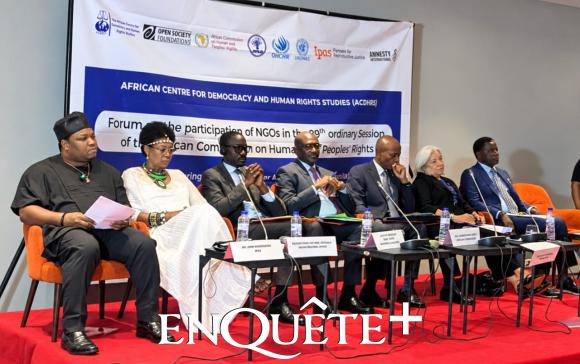
Dakar NGO Forum: State Urged To Guarantee Right To Water
At a forum of NGOs in Dakar, Julien Ngagne Ndour, Director of Human Rights at the Senegalese Ministry of Justice, called on the state to guarantee the right to water, highlighting that millions of Africans still lack access to safe drinking water and adequate sanitation. Speaking at the opening of a three-day forum on water and sanitation, held as part of the 89th ordinary session of the African Commission on Human and Peoples' Rights, Ndour emphasized the state's primary responsibility in planning, investing, regulating, protecting resources, and ensuring the quality and accessibility of water services. He described the hardships faced by families spending a significant portion of their income on water, communities traveling long distances, and the health issues arising from contaminated water, noting the disproportionate burden on women and girls which impacts their education and work. This call to action comes as the world is falling short of the UN's 2030 target for universal access to water and sanitation, with the 2025 report indicating a dangerous deviation from this goal. A high-level meeting with the United Arab Emirates in Dakar on January 26-27, 2026, is intended to address these urgent issues as the deadline approaches.
The legal significance of this statement and the forum lies in its reinforcement of the right to water as a fundamental human right, placing a direct obligation on states to ensure its provision. For practitioners, this underscores the growing importance of international human rights law and sustainable development goals in domestic legal and policy frameworks. It signals potential future litigation or advocacy efforts focused on water access and sanitation, particularly in light of the missed international targets. The emphasis on state responsibility implies that legal challenges could be directed at governmental inaction or inadequate policies. The forum itself, convened under the auspices of the African Commission on Human and Peoples' Rights, indicates a regional commitment to addressing these issues through legal and policy mechanisms.
The legal context involves international human rights law, specifically the recognition of the right to water and sanitation, which is increasingly being incorporated into national legal systems. The UN's Sustainable Development Goals (SDGs), particularly SDG 6 (Clean Water and Sanitation), provide a global framework and targets. The African Commission on Human and Peoples' Rights, as a regional human rights body, plays a role in promoting and monitoring the implementation of these rights across the continent. National legislation and policies related to water resource management, public health, and environmental protection are also relevant. The statement by the Director of Human Rights indicates that the Senegalese government acknowledges these obligations, at least at the ministerial level, and is engaging in discussions about how to fulfill them.
The key parties involved include Julien Ngagne Ndour, representing the Senegalese Ministry of Justice, the forum of NGOs focused on water and sanitation, the African Commission on Human and Peoples' Rights, and indirectly, the United Nations and its member states, including the United Arab Emirates, in the context of international development goals. The Senegalese state, as the entity called upon to guarantee the right to water, is a central party. The excerpt does not mention any specific court cases or rulings, but rather a call to action and a discussion within a human rights and development framework.
Practitioners should be aware of the increasing legal and political emphasis on the right to water and sanitation. This could translate into new domestic legislation, regulatory changes, or increased public investment in water infrastructure in Senegal and across Africa. Lawyers advising clients in the environmental, public health, or infrastructure sectors should consider the implications of these rights and goals. Businesses operating in water-scarce regions or involved in water management may face greater scrutiny regarding their environmental impact and social responsibility. Furthermore, NGOs and advocacy groups are likely to leverage such statements and forums to push for stronger legal protections and enforcement mechanisms, making it crucial for legal professionals to stay informed about evolving human rights jurisprudence and policy developments in this critical area.
How does this affect you?
Get an AI analysis of this article grounded in your jurisdictions, practice areas, and any policy documents you've uploaded to Wansom.
Finish Reading the Full Story and the Expert Analysis.
Get the latest legal & regulatory intelligence in Senegal
Wansom is AI and can make mistakes.