
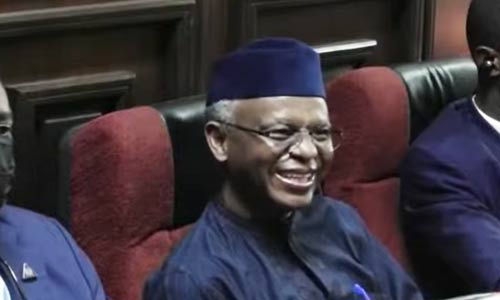
Nigeria Court of Appeal: El-Rufai Bail Appeal Dismissed, Lower Court Upheld
Summary
- The Court of Appeal in Kaduna dismissed an appeal filed by former Governor Nasir El-Rufai.
- El-Rufai had challenged the Kaduna State High Court's refusal of his fresh bail application.
- A three-member appellate panel delivered a unanimous judgment in the case.
- The court affirmed that the presumption of innocence does not automatically entitle an accused person to bail.
- This ruling emphasizes that bail applications require consideration of multiple factors beyond just the presumption of innocence.
Court of Appeal Upholds Bail Refusal
The appellate panel unequivocally stated that while the presumption of innocence is a cornerstone of justice and a constitutional right, it does not, in itself, automatically entitle an accused person to bail.
The Court of Appeal, sitting in Kaduna, has delivered a significant ruling by dismissing an appeal filed by former Kaduna State Governor, Nasir El-Rufai. This judicial action effectively upholds the prior decision of the Kaduna State High Court, which had previously rejected Mr. El-Rufai's application for fresh bail. The unanimous judgment, rendered by a three-member appellate panel, underscores a consistent judicial stance on the matter, reinforcing the initial refusal.
Mr. El-Rufai's legal team had sought to challenge the High Court's refusal, aiming to secure his release on bail pending further legal proceedings. However, the appellate court, after reviewing the arguments, found no grounds to overturn the lower court's decision. The Certified True Copy of this pivotal judgment, obtained on Friday, confirms the dismissal of the appeal, marking a definitive step in the legal saga involving the former governor and his quest for bail.
Legal Principles Governing Bail in Nigeria
A core aspect of the Court of Appeal's ruling was its explicit reaffirmation of fundamental Nigerian bail application principles, particularly concerning the concept of the presumption of innocence. The appellate panel unequivocally stated that while the presumption of innocence is a cornerstone of justice and a constitutional right, it does not, in itself, automatically entitle an accused person to bail. This crucial clarification highlights that the judicial process for granting bail involves a more comprehensive assessment beyond this single principle.
The court's pronouncement on presumption of innocence bail Nigeria emphasizes that while an accused is presumed innocent until proven guilty, this presumption does not negate the court's discretion to consider other factors. These factors typically include the nature and gravity of the alleged offense, the strength of the evidence against the accused, the likelihood of the accused absconding or interfering with witnesses, and the potential impact on public order. The Kaduna Court of Appeal judgment thus serves as an important reminder that bail is not an automatic right but a privilege granted based on a careful balancing of various legal considerations.
Implications of the Kaduna Court of Appeal Judgment
The dismissal of the Nasir El-Rufai bail appeal by the Kaduna Court of Appeal carries substantial implications for the landscape of bail applications, particularly for high-profile individuals and complex cases across Nigeria. This ruling reinforces the judiciary's commitment to a thorough and multi-faceted evaluation of bail requests, moving beyond a singular focus on the presumption of innocence. It signals that legal teams must present robust and well-rounded arguments that address all relevant criteria for bail, rather than relying solely on the fundamental principle of innocence until proven guilty.
This specific judgment, arising from the El-Rufai fresh bail application, provides a clear precedent for legal practitioners. It underscores the necessity of meticulously preparing arguments that encompass all statutory and common law requirements for bail, demonstrating why the accused should be granted temporary freedom. The appellate court's affirmation solidifies the understanding that while the presumption of innocence is a sacred right, it does not serve as an automatic guarantee for bail, and the court's discretion is guided by a comprehensive assessment process.
Practical Implications
This judgment reinforces that the presumption of innocence, while fundamental, does not automatically guarantee bail in Nigeria. Lawyers advising clients on bail applications, especially in high-profile cases, must present arguments beyond mere presumption of innocence, addressing other factors considered by the courts to secure a favorable outcome.
Source
How does this affect you?
Get an AI analysis of this article grounded in your jurisdictions, practice areas, and any policy documents you've uploaded to Wansom.
Finish Reading the Full Story and the Expert Analysis.
Get the latest legal & regulatory intelligence in Nigeria
Wansom is AI and can make mistakes.